

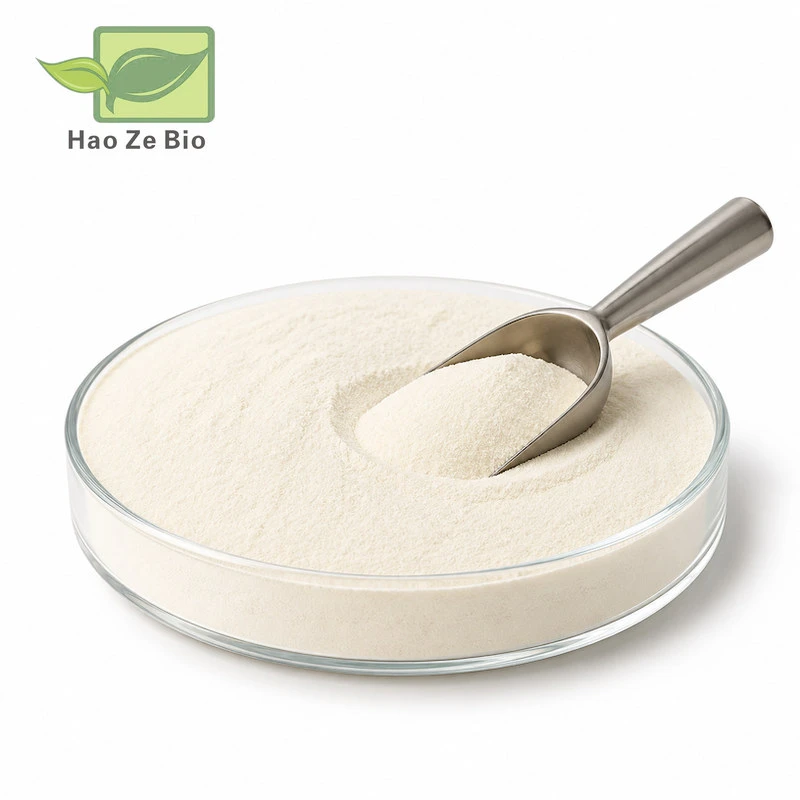


What you get: a soluble fiber you can dose in grams, in a drink that still tastes like the drink. This partially hydrolyzed guar gum (PHGG) powder carries 80.0% or more dietary fiber by AOAC 991.33, with 84.0% typical. A 5% solution stays under 12 mPa·s at 20 °C. Native guar gum powder at 1% reaches 2,000 to 3,000 mPa·s. Viscosity holds from pH 3.0 to pH 7.0, and up to 130 °C.
Average molecular weight is about 20,000 Da. In plain words, the chains are short. That is why this fiber powder can go into a beverage at gram doses without changing the texture.
Haoze Bio runs the enzyme step, the heat stop and the spray drying on its own line. Blending, sieving, packing and batch release stay with us too. Every drum ships with its own certificate of analysis (COA), from a lab on our own site.
Private label and OEM orders start at 100 bags (MOQ), so a first order can be a market test. A free sample of 10 to 20 g goes out for bench work, with courier on your account.
1. What Is Partially Hydrolyzed Guar Gum (PHGG)?
Guar gum and PHGG are the same raw material doing two different jobs. Guar gum comes from the endosperm of the guar bean, and it is one of the strongest thickeners a beverage formulator can buy. That is exactly why it cannot carry a fiber claim: at the dose the claim needs, native guar turns a drink into a thin sauce.
So the chains are cut shorter on purpose. An enzyme called mannanase snaps the long sugar backbone at random points, and the reaction is stopped while the chains still carry their side branches. The mix is then heat-treated, filtered and spray dried. Nothing is added and nothing is swapped: partial hydrolysis is the only change made to the guar.
The trade name for the result is PHGG. You will also see this ingredient sold as guar fiber or as PHGG powder. It keeps the same legal identity as guar gum in both United States and European rule text.
| Line | What we ship | Why it matters on your line |
|---|---|---|
| Source | Guar bean endosperm, a legume | Not synthetic. Feeds your sourcing and allergen file |
| Process | Enzyme step, then spray drying | Enzyme route, not acid route. Furfural stays low |
| What it is | Soluble dietary fiber powder | It dissolves instead of thickening |
| Name on paper | Partially hydrolyzed guar gum | Same recognized identity as guar gum, USA and EU |
| Chain length | About 20,000 Da on average | Why you dose grams instead of tenths of a percent |
| Taste and smell | Almost none, clear to light haze in solution | No flavor mask, and no haze fix for a clear drink |
These are the identity lines we buy and sell this fiber against. The batch COA governs the values that actually ship to you.
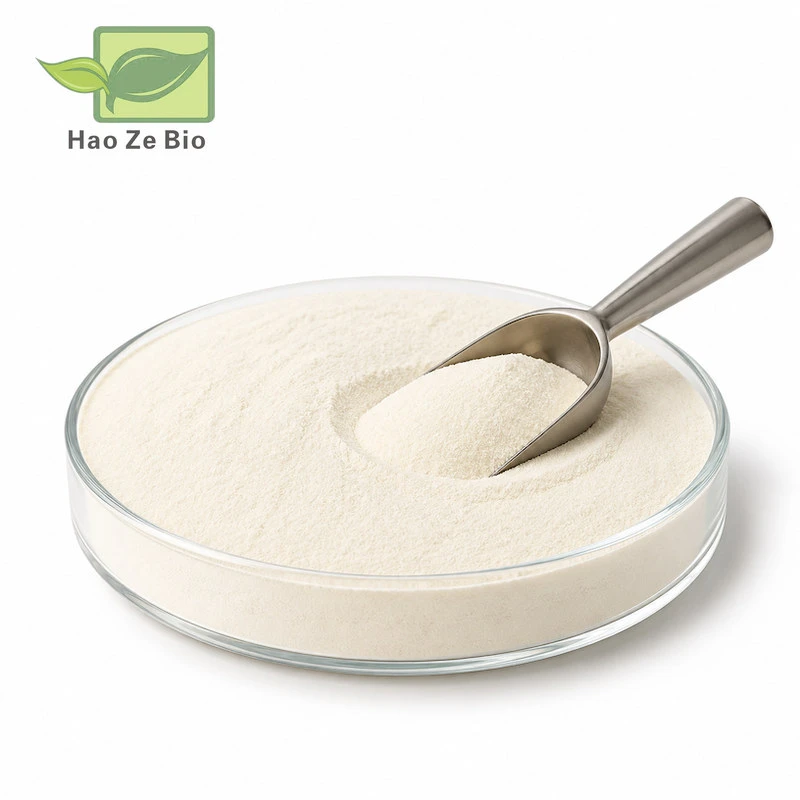
What the drum looks like when it arrives
Open a drum and you should see a level surface. No hard lumps, no threads, no mix of coarse and fine. That is the first check on a delivery, and it is the line the COA calls Appearance.
We hold particle size at 95% or more through 250 µm. So the powder should pour off a scoop instead of dusting the bench.
2. Why Buyers Choose Haoze Bio for This Fiber
Six things decide most fiber sourcing conversations: texture risk, route proof, order size, format, paperwork and whether the supplier will say something the data cannot hold. Here is how Haoze Bio answers each one, and how you can check us without taking our word for it.
✔ Texture risk is measured per lot, not promised. Every batch is released against a 5% viscosity limit and a 60-second cold-water dissolution test, and both figures print on your own lot COA.
✔ The enzyme route is provable. Furfural by HPLC is reported on every batch. An acid-hydrolyzed product shows up there, and no factory sheet can argue with a number.
✔ A first order can be a market test. Private label and OEM runs start at 100 bags (MOQ); wholesale bulk PHGG powder ships in 25 kg food grade lined drums.
✔ Your format, on our line. Sticks, stand-up pouches, bottles, drums and custom dry blends are handled in-house, on the same line that fills our sakura latte premix powder, with a print-ready artwork proof before printing.
✔ Audit papers arrive before the purchase order. COA, management-system certificates, allergen and source statements and the EtO report are assembled on request, not after you have committed.
✔ We publish the boundary with the benefit. The pH window we can document is pH 3.0 to pH 7.0. What has no published data stays marked untested, so nothing here surprises you on a shelf-life trial.

The four figures on that board are the same four we stand behind on every product page: years of operation, markets shipped, annual supply capacity and finished private-label projects.
Supply you can plan a production run around
Bulk PHGG powder ships from a free sample up to 25 kg food grade lined drums. Private label runs cover sticks, pouches, bottles and custom dry blends.
Artwork gets a print-ready proof before printing. Label tables are built from the COA of the lot that fills your order.
Years Experience
Global Markets Exported
Tons Annual Supply Capacity
Custom OEM/ODM Projects
Xi'an Haoze Biotechnology Co., Ltd. was founded in 2014 in Xi'an, China. We are a manufacturer and export supplier of plant extracts, botanical powders and food ingredients. Quality control is in-house: UV, HPLC and TLC testing, plus the release checks behind every viscosity and dissolution figure we publish. Bring your QA team and walk the line.
3. Why PHGG Powder Stays Thin While Guar Gum Thickens
A thickener works by holding water. Native guar does that very well. At 1% it reaches 2,000 to 3,000 mPa·s. On the same meter, water reads close to 1.
PHGG is the same sugar with much shorter chains. A 5% solution of this fiber powder stays under 12 mPa·s. Typical lots read near 6. In the tank, that is the difference between a liquid and a gel.
A formula can carry six grams of this fiber in one serving. It cannot carry six grams of native guar gum. That difference is why buyers stock two guar products, not one, and why a comparison of guar, xanthan and locust bean gum belongs beside any fiber quote.
| What a thin fiber powder buys you | What happens on the line |
|---|---|
| You dose in grams, not tenths of a percent | Your mixer and your filler stay as they are today |
| No gel skin when powder meets cold liquid | One dissolving pass at 20 °C, with no heat step |
| It stays clear in an acidic drink | No new haze to fight against fruit pulp or shelf deposit |
| It adds no taste worth masking | Sweetness and acid stay where your formula put them |
| It behaves as a powder in a dry blend | Sieving, stick dosing and pouch filling keep running normal |
| Pumps and filters see a liquid, not a gel | No under-filled vials, and no filter blinding mid-run |
Viscosity is measured at 20 °C on a rotational viscometer, and 1 mPa·s equals 1 centipoise (cP). Your own trial should run in your finished drink, not in water.
4. How Many Grams of PHGG Powder Do You Need per Serving?
Do this sum before you ask for a quote. Pick the grams of dietary fiber you want in one serving. Then divide by the fiber purity of the powder. At 84.0% dietary fiber purity, a 5 g fiber claim needs about 6 g of partially hydrolyzed guar gum powder. At our 80.0% floor, the same claim needs 6.3 g.
| Fiber per serving | PHGG powder at 84.0% typical | PHGG powder at the 80.0% floor |
|---|---|---|
| 2.5 g of dietary fiber | 3.0 g of powder | 3.1 g of powder |
| 3.0 g of dietary fiber | 3.6 g of powder | 3.8 g of powder |
| 5.0 g of dietary fiber | 6.0 g of powder | 6.3 g of powder |
| 7.0 g of dietary fiber | 8.3 g of powder | 8.8 g of powder |
The powder figures come from the fiber purity values registered for this ingredient. Daily Value rounding and claim wording differ between markets. Your label reviewer owns that call, not an ingredient sheet.
Two practical results follow. A stick pack that must carry 5 g of fiber is carrying about 6 g of PHGG powder. That leaves little room for sweetener, flavor and color in the same stick. Most teams move up to a larger stick or change format, and our guide to powder, stick pack, capsule and pouch walks through that choice on a first run.
In a ready-to-drink (RTD) beverage bottle, those same 6 g dissolve into the water phase. They add no body there. If your brief asks for body, it has to come from another part of the formula.
5. How PHGG Handles Acid, Heat, Salt and Carbonation
Heat and acid together keep cutting guar chains. So a stability answer is only useful with a pH, a temperature and a time attached. Published data for partially hydrolyzed guar gum covers pH 3.0 to pH 7.0. It does not cover alkali, and it does not cover long storage under pH 3.0.
| Condition in your process | Published behavior | What you should still test |
|---|---|---|
| pH 3.0 to pH 7.0 | Viscosity stable | Nothing, if your finished drink sits at pH 3.0 or higher |
| Under pH 3.0, long shelf life | No published data | Store a trial at your own pH, then measure viscosity |
| Heat up to 130 °C | Stable. Structure holds after long heating | Match your real time at temperature, not only the peak |
| Tunnel pasteurization: pH 3.9, 71 to 77 °C, 8 to 12 min | One supplier's own tunnel test reports under 3% chain loss | Repeat in your drink. Sugar and salts change the picture |
| Carbonated drinks | Carbonation itself does not attack the chain | Check pH instead. Cola sits at pH 2.4 to 2.8, under the floor |
| Salt up to 10% sodium chloride | Viscosity stable | Savory beverages and electrolyte mixes only |
| Amylase, pectinase, esterase | Not broken down by these enzymes | Still run a control in enzyme-treated juice |
| Above pH 7.0 (alkaline systems) | No published data for this fiber | Treat it as untested until you have your own result |
Rows 1, 3, 6 and 7 come from published data on this ingredient. Row 4 is another supplier's own result, so it counts as theirs, not as yours or ours. Factory leaflets sometimes claim alkali resistance as well as acid resistance; for this fiber the data stops at pH 7.0.
6. Mixing PHGG Powder into Cold Water or Cold Milk
Drop a pile of any hydrocolloid onto still water and it skins over. Water cannot reach the middle of the pile. You get a wet ball with dry powder inside it.
PHGG powder is far more tolerant than native guar gum here, because short chains dissolve before the surface can seal. Tolerant is not immune. A dosing step that works at 1% can fail at 6%.
So Haoze Bio releases every batch against one fixed dissolution test, not a general claim about solubility. Your receiving lab can repeat it with ordinary glassware.
| Step | How we run it | Pass rule |
|---|---|---|
| Water | 1 g powder into 99 g water at 20 °C | No heat, and no wetting agent added |
| Adding the powder | Thin stream into a stirring vortex | No pile may land on a still surface |
| Time | 60 seconds of stirring | Nothing left on a 250 µm sieve, no film on the glass |
| Looking at it | Read against a white sheet and a black sheet | Clear to light haze. No threads, no gel lens, no grit |
| Standing hold | 24 hours at 20 °C, untouched | No water layer on top, no sediment layer below |
For a scoop in a café or at home, the same rule applies: stir while you sprinkle. A shaker bottle with the dose sitting at the bottom is the usual way this ingredient gets a bad report. If the real job is keeping particles afloat rather than adding fiber, that is a xanthan gum in beverages decision.
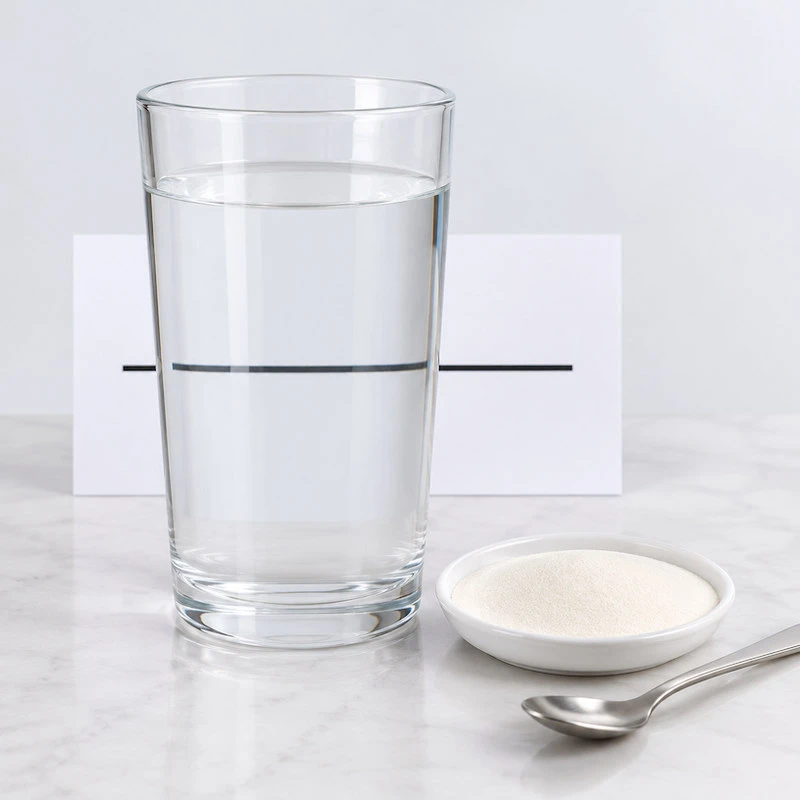
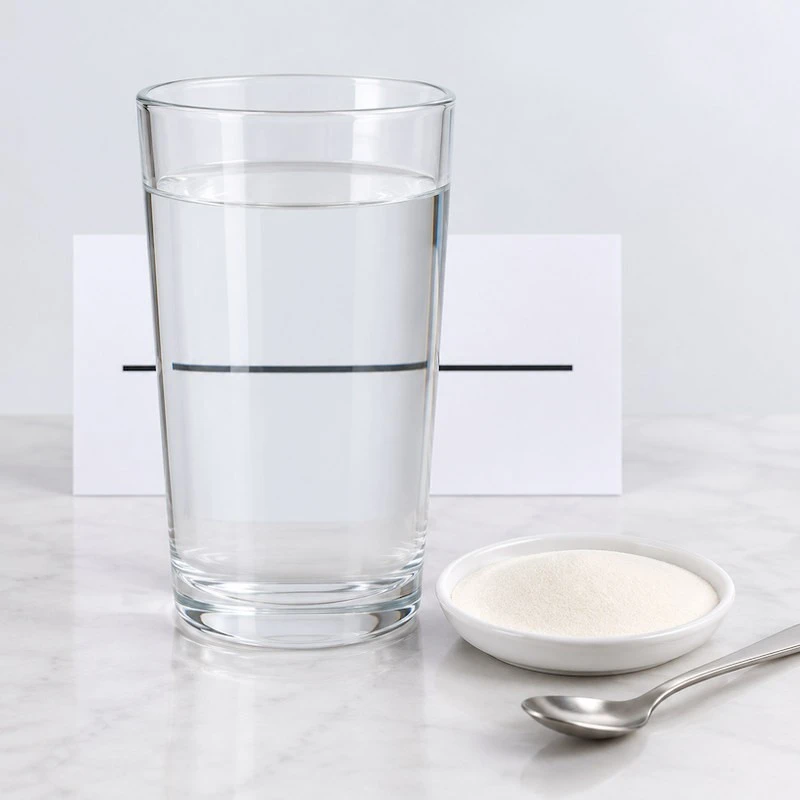
One percent, cold, sixty seconds
The glass behind this text was made with ordinary kit. One gram of powder into 99 g of water at 20 degrees, stirred for a minute.
Then it is read against white and against black, and poured through a 250 µm sieve. Clear to light haze, with nothing on the sieve, is a pass. Threads or grit are a fail, and the result goes back into the batch record.
7. PHGG vs Guar Gum vs Inulin: Which Fiber Should You Pick?
Most fiber quotes land on three powders: partially hydrolyzed guar gum, native guar gum, and chicory inulin. They are not interchangeable. The table lists only the handling differences that change a formula.
| Property | PHGG powder | Native guar gum | Chicory inulin |
|---|---|---|---|
| Thickening power | Near none. Under 12 mPa·s at 5% | Strong. 2,000 to 3,000 mPa·s at 1% | Low, and not sold as a thickener |
| Usable dose in a clear drink | Grams per serving | Tenths of a percent, then texture moves | Grams per serving |
| Sweet taste | None at use level | None | Mild, about one tenth of sugar |
| Body in the cup | None, by design | Strong, because it is a thickener | Short grades add a light creaminess |
| Acid window published | pH 3.0 to pH 7.0 | Acid thins it over shelf life | Breaks down in strong acid and heat |
| Tolerance at a big single dose | Studies report 20 to 40 g daily well tolerated | Never used at fiber doses | Often the limit above a few grams |
| Where it comes from | Guar seed, a legume | Guar seed, a legume | Chicory root |
The inulin and native guar columns describe published category behavior. They are handling context, not a specification for anyone's product. Where no supplier has published a figure, we say so instead of filling the cell.
What if you need fiber and body in the same cup? Then use two ingredients. The hydrolyzed fiber carries the grams, and a small dose of a guar gum beverage stabilizer carries the mouthfeel. Haoze Bio blends both to one specification sheet when you ask for it. The blend is sieved and packed as one lot, with one COA.
8. PHGG Powder Specification, COA and Testing
Why the method column matters: three lines move with the method, not with the powder. So each line names its method. The Specification column is what we release a batch against. The Typical Result column is what recent lots really showed. Every drum leaves with its own certificate of analysis.
| Test | Specification | Typical result | Method |
|---|---|---|---|
| Appearance | White to cream, free-flowing | Conforms | Visual, against a reference sample |
| Odor and taste | Normal, almost no character | Conforms | Sensory check on a 1% solution |
| Dietary fiber | at least 80.0 g per 100 g | 84.0 g | AOAC 991.33 |
| Viscosity, 5% solution | under 12 mPa·s at 20 °C | 6 mPa·s | Rotational viscometer. Spindle and speed on the COA |
| Solution look, 1% | Clear to light haze, no gel lens | Conforms | In-house, 20 °C, 60 seconds of stirring |
| pH of a 5% solution | 6.0 to 7.5 | 6.7 | pH meter |
| Moisture | up to 7.0% | 5.0% | Loss on drying |
| Ash | up to 2.0% | 1.2% | Gravimetric. Salts left behind by hydrolysis explain the level |
| Protein | up to 1.0% | 0.5% | Kjeldahl, with the nitrogen factor stated |
| Particle size | at least 95% through 250 µm | 98% | Rotary sieve, 60 mesh |
| Lead | up to 1.0 mg/kg | under 0.20 mg/kg | ICP-MS |
| Arsenic | up to 1.0 mg/kg | under 0.10 mg/kg | ICP-MS |
| Furfural | up to 1.0 mg/kg | under 0.50 mg/kg | HPLC. Marks an enzyme route instead of an acid route |
| Total plate count | up to 1,000 CFU/g | under 100 CFU/g | Plate count |
| Yeast and mold | up to 100 CFU/g | under 10 CFU/g | Plate count |
| Coliforms | under 10 CFU/g | under 10 CFU/g | Violet red bile agar |
| Salmonella | Absent in 25 g | Not detected | Enrichment, then plating |
Ethylene oxide (EtO) is not used at any step of this ingredient. On request, an EtO or 2-MCPD report travels with the export lot. The powder comes from a legume seed, and it is not a declared allergen on the United States FALCPA list or in Annex II of European Regulation 1169/2011.

Manufacturing and quality control. The identity, furfural and micro figures are produced on this site, by this team, on the lot you buy.
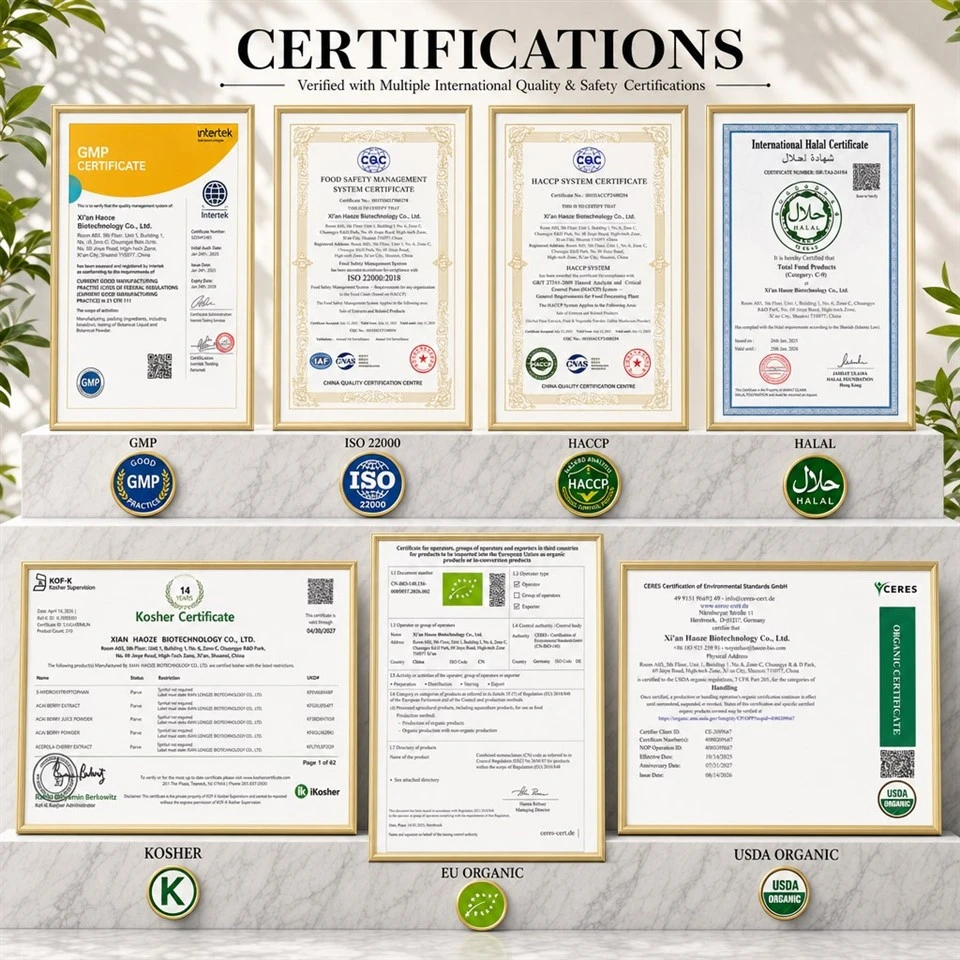
9. Certificates and Audit Papers That Ship With Your Drum
A first order usually dies in a supplier questionnaire, not in a taste panel. So the paper set is part of the product. Ask for a sample audit pack with your quotation, before any purchase order.
| Paper | What is on it | Who usually asks |
|---|---|---|
| Certificate of analysis (COA) | Every line in the spec table, for your lot | QA and receiving |
| ISO 9001 and ISO 22000 | Quality and food-safety management | Supplier audit |
| FSSC 22000 and HACCP | Hazard control across the site | Retail and brand owners |
| GMP | Clean-room handling of powder | Co-packers |
| Halal and Kosher | Cover current lots, as standard shipping documents | Market access |
| United States food facility registration | Facility number for import paperwork | Importer and broker |
| EtO or 2-MCPD report (on request) | Ethylene oxide is not used at any step | European buyers |
| Allergen and source statement | Guar is a legume seed, and not a declared allergen | Regulatory and label review |
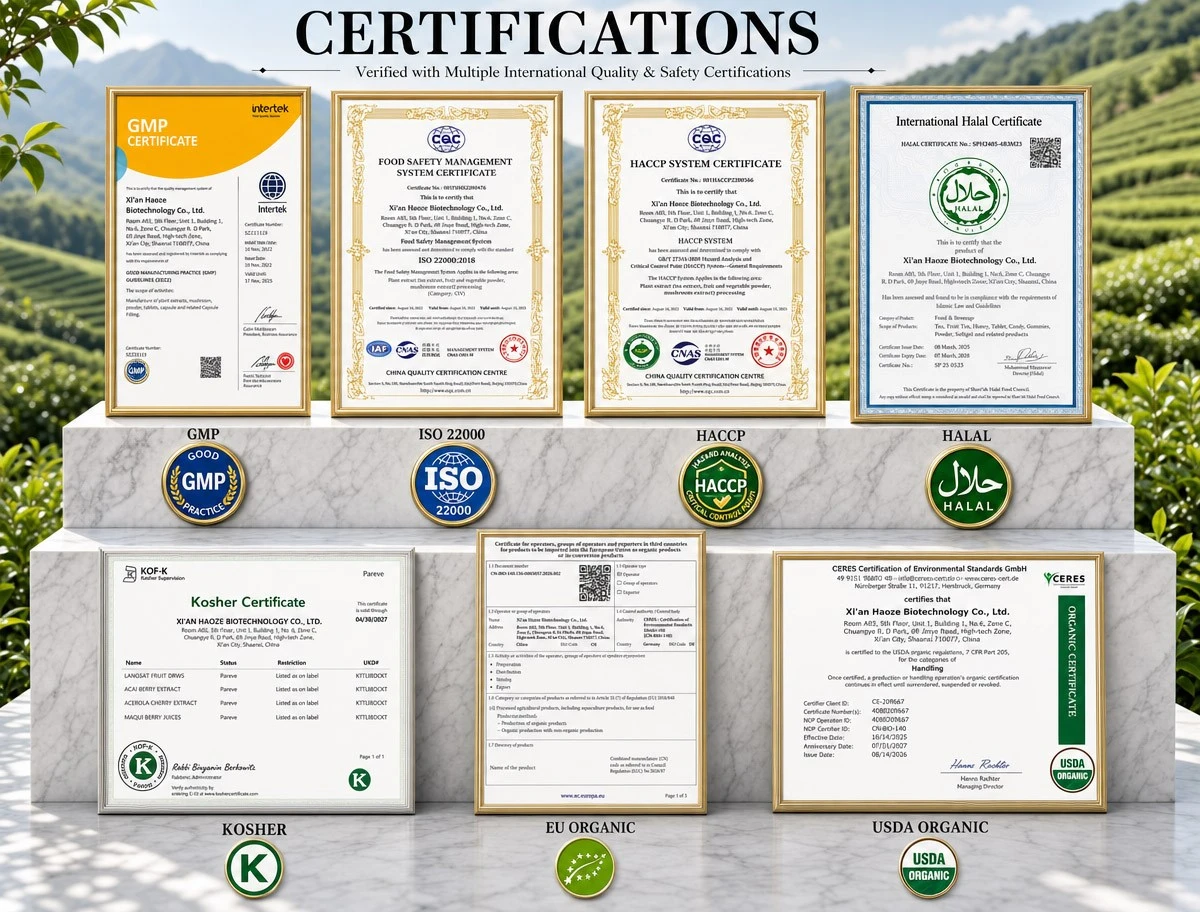
Certificate wall. Ask for the current scope and the expiry dates of any certificate that matters to your audit, and for the certificate that names your own product line.
10. What the Rule Text Covers in the USA and the EU
Buyers mix two questions into one. First: what is this material allowed to be? Second: what may a finished package say about it? An answer to the first does not answer the second. That gap is where late-stage artwork problems come from.
| Market | Where the identity sits | What a buyer should verify |
|---|---|---|
| USA, ingredient | Guar gum is a GRAS direct food substance under 21 CFR 184.1339 | That rule sets limits by food type. Ask which entry a gram dose sits under |
| USA, label | 21 CFR 101.9 lists guar gum among fibers counted as dietary fiber | How the name reads in the ingredient list, and whether fiber shows on the panel |
| European Union | The E 412 food-additive spec covers partially hydrolyzed guar gum | Whether your product is filed as an additive or as a food. The papers differ |
| Every market | No approved health claim belongs to this material | Gut, weight or glucose wording is your regulatory review, not our spec sheet |
The two United States lines quote 21 CFR 184.1339 and 21 CFR 101.9. The European line quotes the E 412 specification for guar gum. None of this is legal advice, and none of it travels to a market that is not named.
11. When Is Partially Hydrolyzed Guar Gum the Wrong Fiber?
Four briefs come back as a no. It is cheaper to hear that before you order a sample than after a line trial fails.
| Your brief | Why this fiber is the wrong tool | Ask us for this instead |
|---|---|---|
| One ingredient for fiber and body | It adds no thickness by design. More powder means more fiber, not more texture | A dry blend: fiber at grams, plus a colloid at tenths of a percent |
| A clear drink under pH 3.0, long shelf life | Published data stops at pH 3.0, and acid plus time shortens the chains | Accelerated data at your own pH first, or a platform above pH 3.0 |
| A gummy or set product that must hold shape | Hydrolysis is the step that removes gelling power | A gelling colloid such as locust bean gum, with the fiber carried separately |
| A short, clean ingredient list | A gram dose of fiber is a visible line on the label, not a trace addition | Decide the claim first. Clean label and a fiber claim are usually two products |
12. Bulk PHGG Powder: Formats, MOQ and Private Label
What can Haoze Bio own end to end? Formulation, dry blending, sieving, filling into your retail format, metal detection, packing and batch release. You send a target: grams of fiber, serving weight, format. We send back a specification sheet, a sample, and a label table built from your lot COA.
| Format | Who it suits | Order note |
|---|---|---|
| Free sample, 10 to 20 g | Bench trials, dissolution checks, taste panel | Free. Courier on your account |
| 1 kg foil pouch | Pilot batch, line trial, first artwork run | Pre-production size, arranged per order |
| 25 kg food grade lined drum or sack | Co-packers dosing from a hopper, in-house blending | Wholesale quantity. Pallet plan on request |
| 3 to 25 g stick sachet, your brand | A single-serve fiber stick with nothing else in it | Private label from 100 bags (MOQ) |
| 100 to 500 g stand-up pouch, your brand | Retail and direct-to-consumer guar fiber powder | Private label from 100 bags (MOQ) |
| Custom dry blend to your formula | Fiber, colloid and actives in one dosing step | OEM from your spec, ODM from a brief |

One line runs the drum order and the stick order. So a formula you prove today can change format later without changing supplier.
13. Packing, Lead Time and Storage of PHGG Powder
This powder pulls water out of a humid room. So packing is an engineering choice before it is a commercial one. A sealed foil liner inside a drum or sack keeps a free-flowing fiber powder free-flowing through ocean transit and a warm warehouse.
| Item | How we handle it |
|---|---|
| Inner layer | Sealed foil liner, heat closed |
| Outer layer | 25 kg lined drum or sack, 1 kg foil pouch |
| Pallet plan | Set with your carrier at the quote step |
| Freight | Courier for samples, air or sea for production lots |
| Lead time | Wholesale stock lots ship in 3 to 7 working days |
| Shelf life | 24 months, sealed, cool and dry |
| At your receiving dock | Keep liners closed between uses. Caking is handling, not a defect |
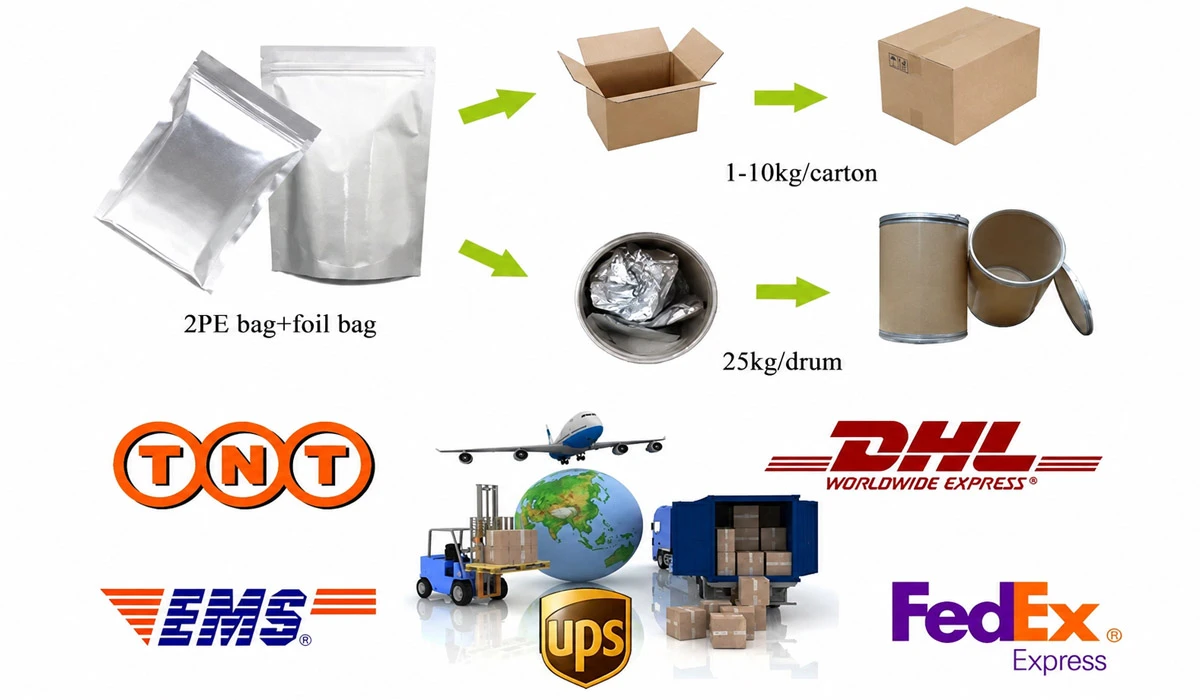
Export packing and staging. Foil liner, outer drum, pallet plan and carrier are settled once, at the quote step.
14. FAQ
Request Samples, the Batch COA and the Full Spec Sheet
Send four facts and we can answer in one pass. Tell us the grams of dietary fiber you want per serving, the serving weight, the pH of the finished product, and the heat step with its time at temperature. From those we work out the inclusion rate of the partially hydrolyzed guar gum powder, and we say in writing whether a second colloid belongs in your blend. Haoze Bio supplies the fiber powder in bulk and packs it under your own brand, from a minimum order quantity (MOQ) of 100 bags. A free sample of 10 to 20 g goes out for bench work.
Technical enquiries: info@haoze-bio.com
WhatsApp: +86 153 3912 2816
WhatsApp +86 153 3912 2816 Contact Haoze Bio Technical Team →