


Beverage and Dressing Application Summary: Xanthan gum (E415) hydrates in cold water, keeps its viscosity in acidic systems where guar gum thins out over shelf life, and flows under filling-line shear while regaining thickness at rest. Those three properties are why particulate and pulpy ready-to-drink formats, acidified beverages and pourable dressings are usually built on xanthan. This page covers the dose range by system, the dispersion rule that prevents lumping, what actually keeps particles suspended, where xanthan is the wrong choice, and how to verify a drum before a pilot batch. Grade selection, full specification and certificate-of-analysis items are held on the product page so both documents stay in one place.
1. What Xanthan Does in a Cold Beverage
Three behaviours decide whether xanthan is the right gum for a formulation, and all three can be checked in a beaker before any line time is booked.
It hydrates cold. Under normal agitation xanthan reaches working viscosity in water at room temperature, so a cold-batch process is possible: build the syrup or base, hydrate the gum, cool-fill. No cook step is required, which saves a heating and cooling cycle that guar or locust bean gum systems would otherwise need (locust bean gum requires roughly 80–85 °C held for two to three minutes before it develops viscosity, and only disperses in cold water below that).
It is acid-tolerant. Guar gum is practical above about pH 4.0, and below that threshold it hydrolyses and loses thickness progressively across storage. Xanthan holds its viscosity across the ranges a beverage actually sees, including citrus, coffee, and vinegar-based dressings. That difference, not thickening power, is the usual reason a formulator moves from one gum to the other.
It is strongly shear-thinning with recovery. Viscosity falls sharply while the liquid is moving and returns when movement stops. The practical consequence is a bottle that passes quickly through a filler and nozzle, then becomes still enough in the package to hold solids in place for months. A gum that is merely thick at rest either slows the line or, if it stays thin, lets particles settle.
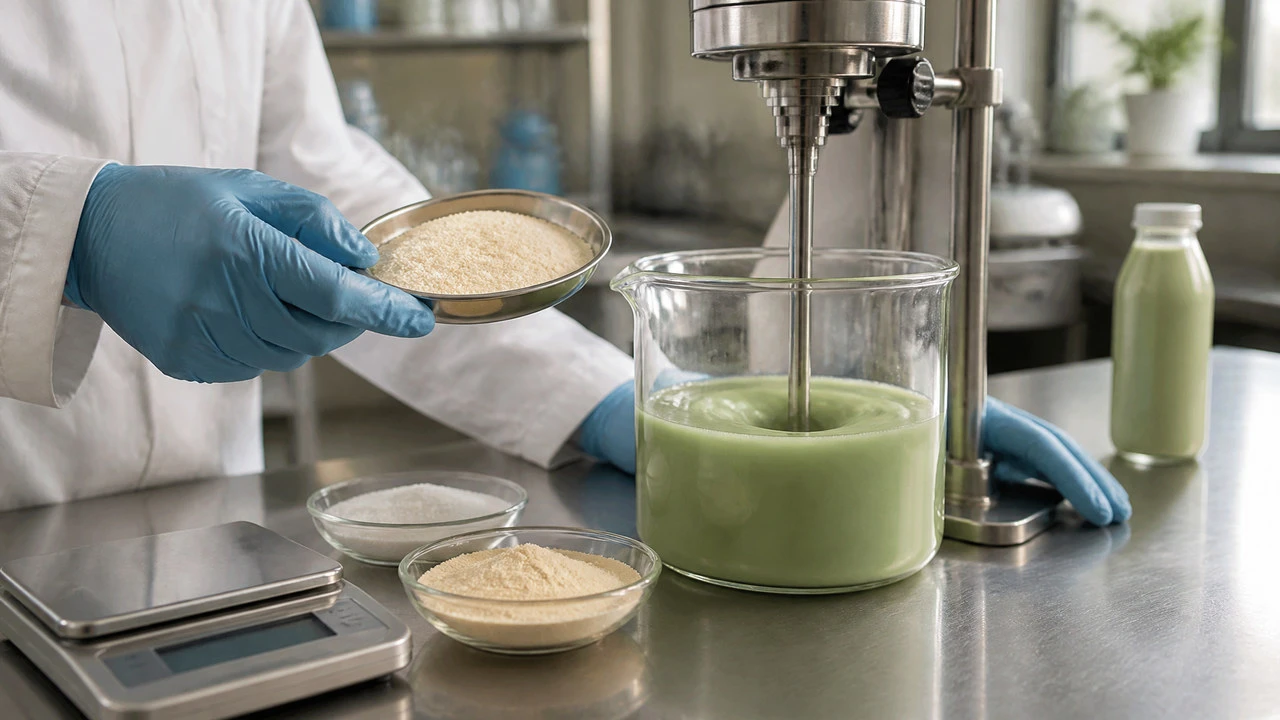
A cold-batch route is the default for most RTD work
Hydration completes at ambient temperature once the particles are separated before they meet free water. The constraint is dispersion quality, not water temperature.
Dosing starts at 0.05–0.30 percent of the finished system for beverage suspension, measured against total weight rather than volume.
Identity and specification are governed rather than negotiated. Xanthan is listed for direct use in food in the United States under 21 CFR 172.695, and carries E415 / INS 415 in the European Union under Regulation (EC) No 1333/2008, with purity criteria in Regulation (EU) No 231/2012. That regulation also fixes how a drum should be tested, which is useful when a supplier's number and your laboratory's number disagree. Two grades are stocked, XG-1000 and XG-1500, in 80 and 200 mesh; the full band, packaging and lot testing are stated on the xanthan gum product page, and this article does not repeat those tables.
2. How Much to Dose, by System Rather Than by Gum
Reported use levels for xanthan span a wide interval because the answer depends on what has to be held, how fine it is, and how the product is expected to pour. The ranges below are starting windows for bench trials, all expressed as percent of the finished system by weight. Every one of them has to be closed against a sensory panel and a settling check in your own matrix; salt, pulp load, protein and mineral content move the answer.
| System | Dose Window | What the Dose Is Buying | Where It Goes Wrong | First Check |
|---|---|---|---|---|
| Particulate or pulpy RTD, plant milk | 0.05–0.30% | Suspension of cocoa, nut particles, tea or botanical fines through ambient distribution | Above roughly 0.15% the drink starts to coat the tongue and pour slow | Sediment height against a filled-and-sealed control, checked on its side and upright |
| Pourable dressing or sauce | 0.10–0.30% | Oil-droplet stability and herb suspension in vinegar systems | Too much gives a short, gel-like pour instead of a ribbon | Creaming test in a graduated tube plus a pour-time measurement |
| Thick sauce, soup base, shot format | 0.30–0.80% | Body and coating on hot-filled, high-solids systems | Ropey strings at the nozzle; air entrainment that will not degas | Viscosity at two shear rates, not one, plus a visual string test on a spoon |
| Gluten-free bakery blend | 0.15–0.70% of flour weight | Batter structure and gas retention where gluten is absent | Dense, gummy crumb above the upper end; cake systems sit lower than bread systems | Loaf or crumb comparison against an untreated control on the same mix |
| Frozen dairy and nondairy bases | 0.10–0.30% | Freeze-thaw protection and ice-crystal control, often alongside locust bean gum | Alone it can leave a short texture; the classic pairing is xanthan with locust bean gum | Controlled freeze-thaw cycles with whey separation scored each cycle |
Why a Higher Dose Is Not a Safer Dose
Suspension and mouthfeel do not scale together. Once a system has enough rest-time thickness to hold its particles, additional gum adds coating on the palate, a slow pour, and trapped air that has to be degassed before filling. In drinkable formats the sensory ceiling is normally reached before the suspension requirement is exhausted, which is why the practical answer is a blend or a finer particle grind rather than more gum.
Cost behaves the same way. Because a low dose of xanthan buys more suspension than the same weight of most seed gums, the price per kilogram is the wrong comparison; the correct one is cost per unit of achieved stability, measured on the same settling test.
3. Why Xanthan Clumps, and the One Rule That Prevents It
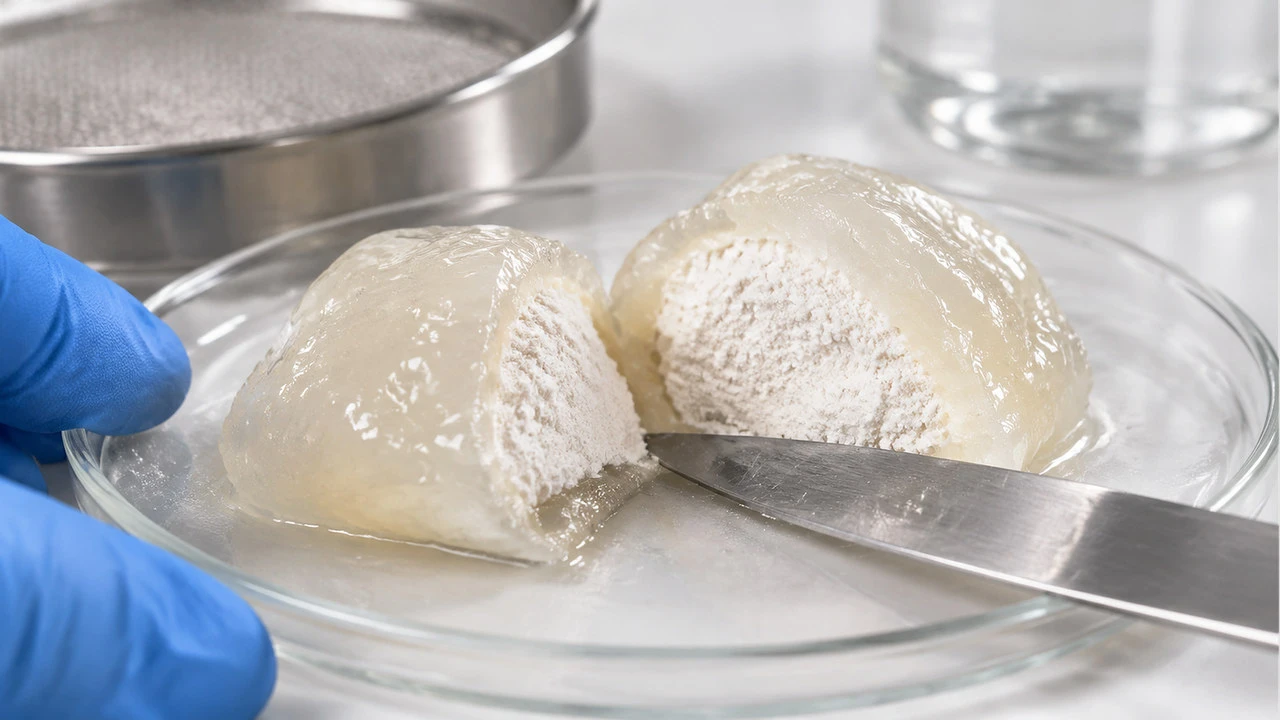
Xanthan added straight to still water forms lumps with dry white centres. The outer surface of each particle hydrates on contact and seals into a waterproof shell, so the powder inside never reaches water. These are the "fish eyes" that make a pilot batch look ruined and that block 5 and 10 micron filter bags later in the process. The gum is not defective; it hydrates too quickly for direct addition.
The prevention rule is a separation rule: keep every particle away from free water until it is already spread out. In practice there are two routes, and both are standard on production lines.
Dispersion sequence that holds at scale
- Dry pre-blend: one part gum to five to ten parts dry sugar or another bulk dry ingredient from the formula, blended dry before it meets water. This is the most common fix and needs no extra equipment.
- Non-solvent slurry: where the formula contains oil, or where no dry blend is possible, disperse the gum in cold oil first. Xanthan does not dissolve in oil, so it stays separable.
- Feed into a vortex, never into a still surface: add the pre-blend to the fast-moving zone created by the impeller, not to a calm pool.
- Shear time: two to five minutes of high shear is normally enough for full viscosity development at ambient temperature, followed by a short rest to let entrained air release.
- Order of ingredients: hydrate the gum before acids, salts, colourants and flavourings are dosed. Adding citric acid into a partially hydrated mix shifts the charge environment while the particles are still opening.
- Mesh choice: a 200 mesh grade builds viscosity faster than an 80 mesh grade, which suits cold instant systems; the same pre-blend rule applies to both.
What a Lump Actually Is
Cut one open and the centre is still dry powder. That is why extended stirring does not fix a batch once lumps have formed: the shell is already sealed, and the only remaining options are higher shear, re-screening, or discarding.
The same mechanism explains why a fine grade demands more dispersion discipline than a coarse one, and why the pre-blend step is not optional at pilot scale.
Can It Be Dispersed Without High Shear?
Yes, with a lower work rate and more patience, and only if the gum is pre-blended first. A slow paddle in a cold tank will disperse a sugar pre-blend eventually; it will not disperse raw powder, and it will not recover a batch that has already lumped. Small kitchens and coffee bars solve the same problem with a blender for the two to five minute window. Where no shear is available at all, an agglomerated or cold-dispersible grade, or switching to a system that tolerates simple stirring, is the honest answer rather than a longer mixing time.
4. What Keeps Particles Suspended Is Rest-Time Thickness
A rotational viscometer reports how fast a liquid flows while it is being turned. A bottle on a shelf is not being turned. What governs settlement in a still bottle is whether the liquid resists flow at all once movement stops - the property usually called yield value, and the reason two samples with identical measured viscosity can show different shelf behaviour.
Settlement rate for a particle depends on its size and density difference and on how much the continuous phase resists it, so the fine fraction is the problem: a five micron matcha or tea particle stays down far longer than a coarse grind, and a whole-cell algae ingredient such as spirulina settles even when the batch reads as thick on a viscometer - the same mismatch is described in our guar gum beverage guide, where the conclusion was that suspension needs a rest-state structure that viscosity alone does not supply.
This is where the two gums divide. Guar gum builds viscosity cheaply but contributes little rest-state resistance, so under heavy particulate load it is usually blended rather than pushed to a higher dose, where it would already be past the sensory limit. Xanthan contributes the rest-state structure directly, which is why a xanthan-dominant blend suspends better at a low total gum level than guar alone at a higher one. A common starting window for the blend is sixty to eighty parts xanthan to twenty to forty parts guar; at a total of 0.1 percent, a half-and-half blend reads thicker than either gum alone. Blending with guar produces higher viscosity, not a gel.

The same base at three doses. Under-dosing lets the solids compact at the bottom; the correctly dosed bottle stays uniform; over-dosing does not suspend better, it changes the pour and the mouthfeel.
5. Where Xanthan Is the Wrong Choice
Selection tables rarely say this, so it is worth stating plainly. Xanthan is not the default answer for every texture problem, and in the situations below it will disappoint on a production line.
| Situation | What Happens | What To Do Instead |
|---|---|---|
| High-salt systems: soya sauce style bases, brined products, electrolyte mixes | Xanthan is anionic, so dissolved salts change its coil state; viscosity can move in either direction depending on concentration and the other solids present. Neither direction is safe to assume. | Run the dose ladder on the finished formula, in plant water, not in distilled water. Report viscosity on the same instrument settings each time. |
| A neutral, clean, short texture is required | At the doses needed for heavy suspension, xanthan gives a long, coating texture; some systems read it as gummy. | Reduce the dose and address particle size first, or blend with guar where acid permits it, since guar reads shorter and cleaner. |
| A firm gel or a set structure is the target | Xanthan alone does not gel at any practical concentration. | Gelling needs other colloids; xanthan with locust bean gum is the exception that produces a thermoreversible gel. |
| Hot, low-solids liquids held at temperature for long periods | Prolonged high heat with agitation can degrade viscosity; the statutory method itself compares the reading at 75 °F with the reading at 150 °F for this reason. | Verify retention on a sealed bench heat test before committing the process step. |
| A clear, bright beverage is required | Xanthan is cloudy at working doses and can hold fine haze in suspension. | Choose a clarifying-compatible system for clear drinks and reserve xanthan for clouded or particulate formats. |
6. Acid, Heat and Salt: What the Matrix Does to the Dose
Three matrix factors decide whether a bench result survives distribution. They are worth treating as test conditions rather than as rules of thumb.
Acidity. Seed gums are the fragile ones. Guar gum is workable above about pH 4.0; below that, its chains hydrolyse and thickness declines over storage, with the decline accelerating with temperature, which is why hot-fill and acidified are a bad pair for guar. Xanthan was selected historically for exactly this job and keeps its viscosity through the acidity range in which drinks and dressings are actually sold. Treat that as a starting assumption and still run an acidic control in the trial.
Heat. The federal specification for xanthan compares one reading taken at 75 °F with a second taken at 150 °F and requires the ratio to sit between 1.02 and 1.45. That is a statement about heat behaviour written into the identity criteria: a compliant lot keeps its structure when warmed, and the ratio is a number a receiving laboratory can reproduce from the same statutory method.
Salt and minerals. This is the factor most often skipped. Xanthan carries a charge in solution, so dissolved salts change how its molecules coil and how much viscosity they generate. Published results move in both directions: at some concentrations and salt types viscosity and low-shear thickness increase, while higher ionic strength reduces the thickening contribution of the polymer itself. The practical consequence is a single instruction: dose on the finished formula, in plant water, and never extrapolate from a distilled-water bench trial in a savoury or mineral-rich system.
What to Measure Before Committing a Formula
- Prepare the finished formula at three doses spanning the recommended window, plus an untreated control, in the same water and the same order of addition every time.
- Hold sealed samples at cold, ambient and warm conditions and read them at the same intervals, on one instrument, with one decimal place of reporting.
- Record three things per sample rather than one: viscosity at a fixed shear rate, sediment or cream height, and a sensory note on coat and pour.
- Set the release specification from the outcome, not from the supplier's typical value, and keep the retained-sample comparison on file for incoming inspection.
7. How to Verify a Drum Before You Run a Pilot
Three criteria from the United States food-additive regulation are enough to establish identity and to reject a substituted or diluted lot, and two of them need nothing more than a balance, a thermometer and a beaker.
| Criterion | Requirement | Why a Buyer Should Care |
|---|---|---|
| Statutory viscosity | Minimum 600 cP: 1% gum plus 1% potassium chloride, stirred two hours, read at 75 °F on a Brookfield LV with spindle 3 at 60 rpm | The added salt standardises the reading, so a plant laboratory and a supplier laboratory can compare the same number instead of arguing about a method |
| Heat-recovery ratio | Reading at 75 °F divided by reading at 150 °F between 1.02 and 1.45 | Screens out lots that will lose body in a hot-fill or pasteurisation step |
| Pyruvic acid content | At least 1.5% for a positive identification | Pyruvate is a structural marker of fermentation-derived xanthan, so a diluted or replaced product shows low |
| Solvent residue | Isopropyl and ethyl alcohol together not more than 750 ppm; our lots typically report below 200 ppm, with the recovery route declared per lot | This is the line item an audit asks for first, and the one that varies most between factories |
The Two-Minute Check That Needs No Laboratory
The same regulation describes an identity test that uses one other gum, and the result is visible to the naked eye. Xanthan does not gel on its own, but combined with locust bean gum it forms a firm, rubbery, thermoreversible gel.
- Blend one gram of the test sample with one gram of locust bean gum dry.
- Add 200 ml of purified water at about 80 °C while stirring briskly, and keep the temperature near 60 °C while stirring continues for about thirty minutes.
- Let the mixture cool undisturbed to below 40 °C.
- Read the result: a firm rubbery gel confirms xanthan; a thick liquid with no set indicates the sample is not what the label says, or has been replaced.
For reference, the structural ratio that distinguishes the two seed gums in the same family is about two mannose units to one galactose unit in guar gum and roughly four to one in locust bean gum, which is why the locust bean gum behaves as it does in cold water and why it is the correct partner for this test.
8. Sourcing, Packing and the Document Set
Xanthan is a fermentation product. Our role in the chain is screening, blending and quality control of finished gum produced on an accredited partner fermentation line, with lot-level traceability back to that line; the gum is not produced in our own plant, and we say so on every specification sheet. Two viscosity grades and two mesh ranges are held, selected against the application table in section 2.
Packing is 25 kg net in a polyethylene-lined board drum, palletised on heat-treated ISPM-15 stock with corner boards and stretch film, because xanthan is the most hygroscopic of the gums we handle and an open bag in a humid warehouse will consolidate into a block. Sealed and stored cool and dry, the declared shelf life is 24 months, with retained samples kept against every shipment.
What arrives with each consignment
- Lot certificate of analysis covering statutory viscosity by the 1% plus 1% potassium chloride method, the heat-recovery ratio, pyruvic acid, solvent residue, and the heavy-metal panel for lead, arsenic, cadmium and mercury by ICP-MS.
- Microbiology on our own release limits, which are stricter than the commodity norm: total aerobic count at or below 5,000 CFU per gram, yeast and mould at or below 500, Escherichia coli absent in 10 g, Salmonella absent in 25 g.
- An ethylene-oxide statement for the lot: no EO treatment is applied to this product, and a headspace gas-chromatography report is provided showing non-detect. This matters because the European Union sets the maximum residue for ethylene oxide at the limit of quantification of 0.1 mg per kg, which in practice means not detectable, and because the additive purity rules do not allow sterilisation of food additives by ethylene oxide.
- Substrate declaration for the fermentation, with an ELISA report on request where a gluten-free statement is needed downstream.
- Commercial invoice, packing list, certificate of origin and phytosanitary certificate. Evaluation samples of 100–500 g are provided free, and stock grades dispatch within 3–7 working days of order confirmation.
Two claims are deliberately absent from our documents. This grade is not supplied as organic and no organic claim is made for it, since fermentation-derived gums fall outside the certification scope we hold. And a regulatory listing is not an approval: xanthan is permitted for direct use under the sections cited above, which is a different statement from an agency endorsement, and any supplier who words it the other way is worth questioning.
9. Frequently Asked Questions
Q1: How much xanthan gum should I use in a beverage?
A: Start between 0.05 and 0.30 percent of the finished system for suspension work, taking the low end for fine botanicals in a light base and the high end for pulp and coarse particles. Most drinkable formats reach a sensory limit before 0.15 percent, so the dose is closed by tasting panel and settling test in the actual formula rather than by a target viscosity number.
Q2: Why does xanthan gum clump when it is added to water?
A: The outer surface of each particle hydrates on contact and seals into a shell, leaving dry powder inside, and those lumps will not redisperse however long stirring continues. Pre-blending one part gum with five to ten parts dry sugar from the same formula, or slurrying it in cold oil first, keeps the particles separated until they are dispersed; two to five minutes of high shear then develops full viscosity.
Q3: Does xanthan gum work in cold water?
A: It hydrates in cold water given agitation and a pre-dispersed powder, and working viscosity is reached at room temperature with no cook step. Cold water will not undo a batch that has already lumped, and it will not hydrate locust bean gum, which needs roughly 80 to 85 degrees C before it develops.
Q4: Is xanthan gum affected by salt?
A: Yes, and not in one direction. Xanthan carries a charge in solution, so dissolved salts change how its molecules coil; published work reports viscosity rising at some salt concentrations and the polymer's thickening contribution falling at higher ionic strength. Soya-sauce bases, electrolyte drinks, brined and mineral-rich systems should therefore be dosed on the finished formula in plant water, not extrapolated from a distilled-water bench trial.
Q5: How can I check that a drum is genuine xanthan gum?
A: Three regulatory criteria do most of the work: the statutory viscosity test on a one percent gum solution with one percent potassium chloride, minimum 600 centipoise read at 75 degrees F; the ratio of that reading to one taken at 150 degrees F, between 1.02 and 1.45; and a pyruvic acid content of at least 1.5 percent. There is also a bench version: heated with locust bean gum at one to one and cooled, genuine xanthan sets into a firm rubbery gel, which xanthan alone never does.
Q6: What is xanthan gum fermented from, and can it be called gluten-free?
A: Xanthan is produced by fermentation of a carbohydrate substrate, and the gum itself carries no gluten protein. Where a gluten-free statement matters commercially, our position is a substrate declaration for the lot together with an ELISA report on request; the claim for a finished retail product remains with the brand owner, because it depends on the whole formula and not on one ingredient.
Talk to the Technical Team
Send the application, the target pH, the particle load and the viscosity you are working to, and the reply comes back with a suggested dose ladder and the grade that fits. Sample sizes of 100–500 g are available free with the lot certificate attached.
Technical enquiries: info@haoze-bio.com
Request Samples and a Dose LadderReferences and Standards Cited
- U.S. Food and Drug Administration, 21 CFR 172.695 - Xanthan gum: definition, statutory viscosity and heat-ratio criteria, solvent residue, locust bean gum gel test, pyruvate test and conditions of use. https://www.law.cornell.edu/cfr/text/21/172.695
- Commission Regulation (EU) No 231/2012 laying down specifications for food additives, xanthan gum (E415) purity criteria; and Regulation (EC) No 1333/2008 on food additives.
- European Food Safety Authority, re-evaluation of xanthan gum (E415) as a food additive, EFSA Journal (2017).
- Whitcomb, D. and Macosko, C. W., Rheology of Xanthan Gum (1978), on the effect of salt form and concentration.
- Higiro, A. and colleagues (2007) on the reduction of xanthan intrinsic viscosity with increasing ionic strength, and related xanthan and galactomannan mixture rheology literature.
- Regulation (EC) No 396/2005 on maximum pesticide residue levels, applied to ethylene oxide as the limit of quantification.