


Beverage Formulation & Sourcing Summary: Guar gum (E412) is the cheapest way to hold botanical solids in suspension inside a ready-to-drink beverage, and one of the easiest ways to ruin one. This guide settles the three arguments that stall commercial trials - whether guar really hydrates in cold water, how much a drinkable product can actually carry before mouthfeel fails, and what happens to viscosity below pH 4.0 across a twelve-month shelf life - then gives the dispersion protocol, the dosing ladder and the paperwork a gum import should arrive with.
1. What Guar Gum Actually Is, and the Three Axes That Define a Grade
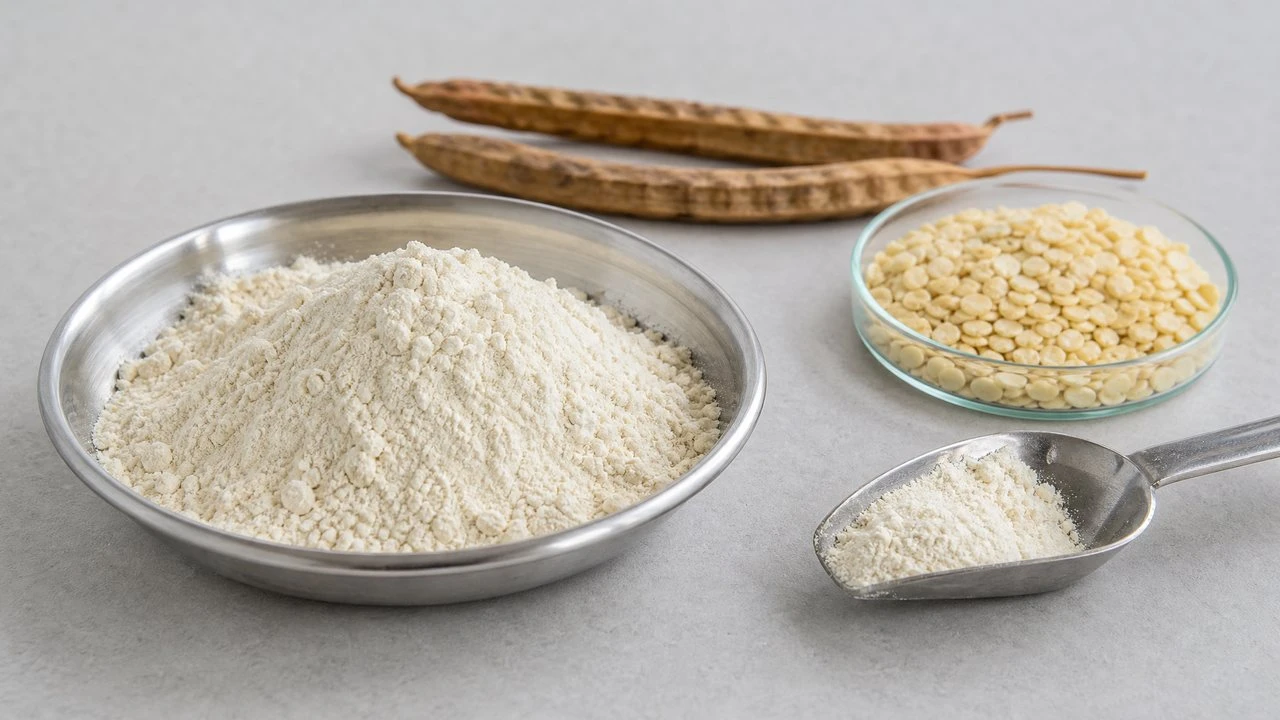
Guar gum is milled from the endosperm of the guar bean, Cyamopsis tetragonoloba (L.) Taub., a drought-tolerant legume grown mainly in Rajasthan, Gujarat and across the border in Pakistan. The seed is roasted, dehusked, split and air-classified into a free-flowing off-white powder. Regulatorily it is listed as E412 (INS 412) in the European Union under Regulation (EC) No 1333/2008 with purity criteria in Regulation (EU) No 231/2012, carries CAS 9000-30-0, GRAS-affirmed in the United States under 21 CFR 184.1339 at levels consistent with current good manufacturing practice, and classified for customs under HS 1302 32 alongside locust bean gum.
Chemically it is a non-ionic galactomannan: a backbone of β-(1→4)-linked mannose with α-(1→6)-linked galactose branches hanging off roughly every second mannose, giving a mannose-to-galactose ratio near 2:1. Two practical consequences follow from that structure, and both of them explain most of the field complaints we hear from beverage plants. First, because the chain carries no charge, salt and mineral content in your process water barely move its viscosity - a real advantage over anionic gums in mineral-fortified or hard-water plants. Second, all of its stability comes from the chain itself rather than from electrostatic repulsion, so once acid or heat cleaves that chain, nothing in the system holds the viscosity up afterwards.
Mesh, Viscosity and Hydration Rate Are Three Separate Numbers
Buyers routinely specify guar gum with one number - "200 mesh, 3500 cps" - and then treat every supplier quoting that line as interchangeable. They are not. Mesh, 1 percent solution viscosity and hydration rate vary independently, and a milling line can hit the same particle cut with different damage to the granule surface, which changes wetting behaviour more than most QA sheets admit.
There is also a trade-off nobody puts in the quotation. A fine powder swells quickly but resists full wetting-out, so it needs real dispersion energy. A coarse powder disperses cleanly and gives fewer fish-eyes, then takes longer to reach its declared viscosity. Choose the cut against your mixer, not against the datasheet.
For beverage work, our own release practice is a 200 mesh superfine cut (≥98 percent pass) verified against a declared viscosity band on a 1 percent solution at 25 °C, 20 rpm, after a two-hour hydration, read on a calibrated Brookfield RVT. The 3,000–3,800 cps tier is the beverage grade; the 4,800–5,500 cps tier is where bakery, dressing and frozen work sits. Full specification and lot data live on our food-grade guar gum powder page, and we will not repeat the COA table here.
| Specification Line | What It Controls on Your Line | Failure Mode If It Drifts |
|---|---|---|
| 1 % viscosity, declared grade | How much gum you need to reach target apparent viscosity | Under-batch: sediment. Over-batch: mouth-coating, and it is discovered at the filling line, not the lab |
| Particle size (mesh and distribution) | Wetting speed, dispersion energy demand, strainer loading | Fish-eyes, blinding of inline screens, inconsistent batch-to-batch rheology |
| Hydration rate / grade type | Whether your cold-process line can reach full viscosity inside tank time | Batch passes on viscosity at 4 hours, fails on sediment at day 3 |
| Galactomannan content and acid-insoluble residue | How much of the bag is functional polymer versus husk and germ debris | Gritty sediment, off-note, and a specification that never agrees between lots |
| Loss on drying | Shelf stability of the dry powder and declared net weight | Caking in the bag before you ever open it, plus a paid-for-water argument |
2. Is Guar Gum Cold-Water Soluble? The Part Nobody Writes Down
Open three sources and you get three answers. Gum traders say guar hydrates fully in cold water and reaches near-final viscosity within minutes. Independent formulation consultants say the opposite: that guar needs 60–80 °C for complete hydration and performs badly in cold water. Classical hydrocolloid literature sits in between, stating that guar hydrates without heat but more slowly, and to a lower final viscosity, as temperature drops. All three positions are honest. They are describing different grades, different water temperatures and different amounts of dispersion energy, and the disagreement is exactly why cold-process guar trials fail in the pilot plant and succeed at the supplier's bench.
Here is the engineering version. Guar does not require a thermal step the way locust bean gum does - that is a real difference, and it is why guar is the default in cold-blended beverage bases. But cold hydration is rate-limited and incomplete if you give it no time and no work. Water at 5 °C wets the granule far more slowly than water at 22 °C, and the final apparent viscosity is lower at the end of the cold route than at the end of a warm one. Push the water hot and the effect reverses again in a milder form: above about 80 °C the final viscosity is slightly reduced, which is usually acceptable, unlike the acid problem discussed in section 5.
What we ask customers to hold constant before they blame the gum
Cold processing works when four things are true at once: process water is at 20–25 °C rather than straight off the chilled line, the powder is dry-blended with a carrier or pre-dispersed in a non-solvent before it meets water, agitation is high-shear rather than a slow paddle, and the batch is given 15–20 minutes to finish building viscosity before it is homogenised and filled. Break any one of the four and you get the classic complaint: the tank reads thin at fill, thickens overnight, and the second shift finds a gel layer on the filler plate.
| Water Temperature | Granule Wetting | Time to Full Viscosity | What Goes Wrong |
|---|---|---|---|
| 2–8 °C (chilled blend tank) | Slow; surface gel forms before water penetrates | Long, and the plateau may never be reached | Fish-eyes and a thin reading at fill that thickens hours later |
| 20–25 °C (ambient, the working window) | Adequate with shear and a dry carrier | Roughly 15–20 min to full build | Little, if dispersion practice is correct |
| 40–60 °C (warm phase, optional) | Fast and even | Minutes | Cost of a warm step; aroma loss in delicate bases |
| >80 °C (hot-fill / retort territory) | Instantaneous | Immediate | Final viscosity slightly reduced; sustained heat plus acid is where real damage starts |
If your line runs genuinely cold and you cannot change it, buy the problem away rather than fighting it. Fluidised-bed agglomeration with a sugar binder measurably changes the particle structure, wettability and dispersion behaviour of guar powder, which is why fast-hydrating and instantised grades exist as a purchasable specification rather than as a marketing adjective. That is a legitimate line on a specification sheet, and a supplier who cannot name their agglomeration route is selling you ordinary mill-run powder under a better brochure.
3. How Much Guar Gum to Dose Before Mouthfeel Kills the Product
Guar binds a great deal of water for a very small addition - roughly eight times the water-binding of a typical starch thickener - which is exactly why dosing it by instinct goes wrong. Functional ranges in drinks run from about 0.05 to 0.15 percent of formula weight, and independent beverage guidance puts the practical ceiling lower still, near 0.05–0.08 percent, because the second wall you hit is sensory rather than functional. Drink a 0.12 percent guar solution and you can taste the polymer: a coating, slightly slimy body that sits on the tongue after the swallow. In a shake it reads as "thick". In a premium plant-milk latte it reads as artificial, and the panel says so.
The other thing to understand is that suspension is not a viscosity question in the way most spec sheets frame it. What holds a 5 µm matcha particle at rest in a bottle for ninety days is the low-shear structure of the continuous phase - its yield stress - not its mid-shear thickness. Guar builds viscosity efficiently but has a modest low-shear plateau compared with a rigid, strongly shear-thinning gum. That is the whole reason a guar-and-xanthan blend suspends better than either gum alone at the same total dose: the guar supplies bulk, the xanthan supplies the resting structure that stops particles moving. The same physics explains why a greens base can settle out even though a rheometer still reports it as "thick", which is the failure mode we worked through when formulating with whole organic spirulina powder.
Read the ladder below as starting points to be falsified in your own matrix, not as specifications. Sugar and soluble solids, the mineral load of your water, protein content, whether there is an oil phase, and the order in which you add everything will each shift the row you land on.
| Addition (w/w) | What It Buys | Sensory Risk | Hydration Requirement | Verification Action |
|---|---|---|---|---|
| 0.03–0.05 % | Body and wateriness correction in low-solids drinks; almost no suspension help | Low - clean finish | Ambient water, standard dry blend | Triangle test against control |
| 0.05–0.08 % | The working window for chilled RTD and plant-milk bases with fine insolubles | Manageable; the last row that usually passes a panel unaided | 20–25 °C water, shear, 15–20 min build | Sediment height at day 0 / 7 / 30 at 4 °C and 25 °C |
| 0.08–0.15 % | Heavy particulate load (cocoa, botanicals, added fibre) and frozen or chilled dessert bases | Real. Mouth-coating appears; blending with xanthan is the usual escape | Warm phase or fast-hydration grade strongly advised | Panel plus full accelerated shelf, not viscosity alone |
| 0.20–0.35 % | Pourable sauces, dressings and dairy spreads - no longer a beverage dose | Not applicable to drinks | Standard | Serum separation and freeze-thaw cycling |
| >0.40 % | Bakery dough and binder systems | - | Pre-blend mandatory | Out of scope for this guide |

The same formula, two outcomes. The bottle on the right did not fail on viscosity - it failed on resting structure, which is what actually decides shelf performance in an unshaken retail bottle.
4. Fish-Eyes, Lumps and Blocked Strainers: Dispersion Engineering
Almost every complaint we receive about guar gum is a dispersion complaint wearing a quality complaint. Tipping dry powder onto a water surface is the failure: the outer layer of each aggregate hydrates instantly, forms a gel skin, and seals a pocket of dry powder inside. The result is a soft transparent lump - a fish-eye - that will survive twenty minutes of paddle mixing and pass straight into your filler, then show up as a defect in a consumer's glass a week later. Undissolved gum also blinds inline strainers and inflates tank dwell time, which is how a small ingredient decision becomes a throughput problem.
Three Routes That Actually Work at Production Scale
Dry carrier pre-blend. Disperse the gum into ten to twenty times its own weight of sugar, flour, starch or protein isolate before it sees water. The carrier particles physically separate the gum particles so wetting happens evenly instead of all at once. This is the cheapest fix available and the one most plants skip.
Non-solvent slurry. Wet the powder in oil, liquid sugar syrup or another phase your formula already contains, then introduce water. Suited to emulsified and cloudy systems, and useful when dry blending is not possible on a shared line.
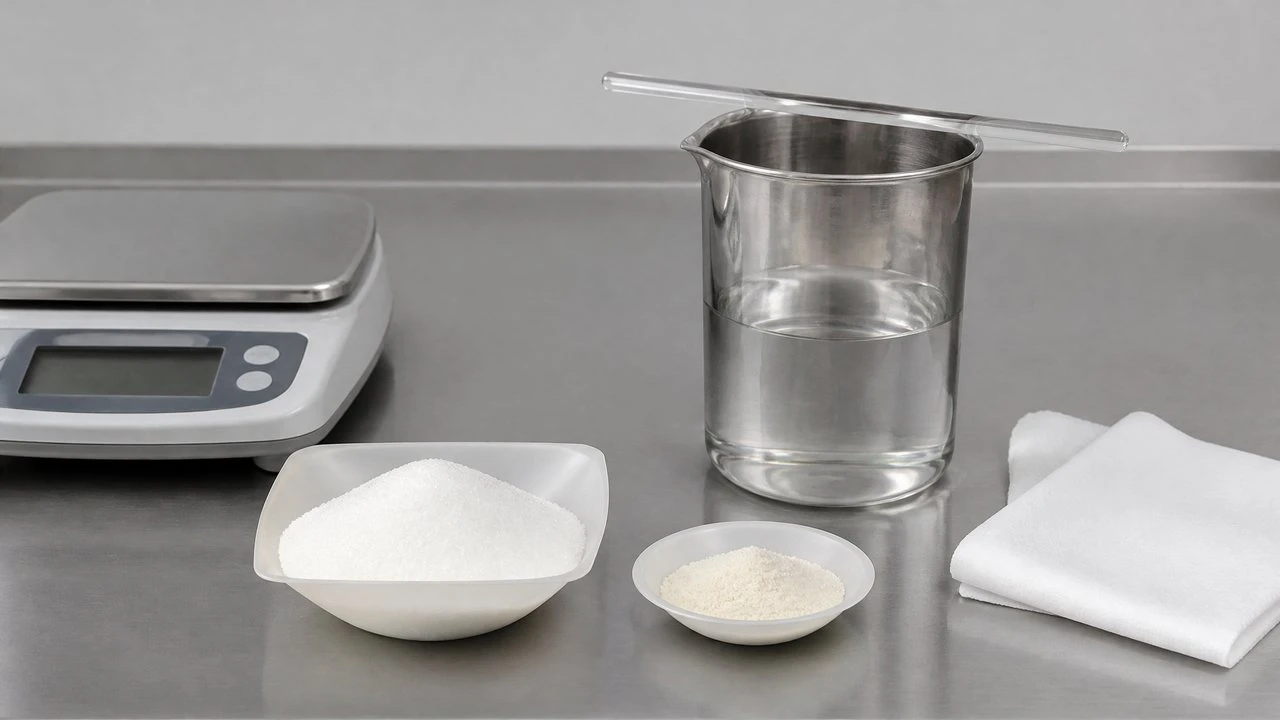
Mechanical dispersion. A rotor-stator running between roughly 3,000 and 8,000 rpm, or an in-line powder-induction unit, will do what a paddle cannot. If your co-packer has no in-line hydration capability, hydrate the gum as a concentrated slurry in part of the formula water and blend that into the main batch; it is less elegant but it is reproducible, and reproducibility is what a QA file needs.
Dispersion SOP Checklist, Bench to Production
- Never introduce dry gum to a still water surface. Establish agitation first, then feed.
- Pre-blend 1:10 to 1:20 with a dry carrier from the formula, or slurry into oil or syrup.
- Hold process water at 20–25 °C for cold work; use a warm phase or a fast-hydration grade if your water is genuinely chilled.
- Give it the time the polymer needs. Judge viscosity only after 15–20 minutes at 20–25 °C, not at the moment of addition.
- Add acid last. Every minute a partially hydrated chain sits at pH 3 in a warm tank costs you molecular weight you cannot recover.
- Size the strainer for the worst case, and log pressure drop - a rising delta-P is an under-hydration warning, not a filter problem.
- Close the bag. A 200 mesh hydrocolloid pulls moisture from ambient air fast; re-seal the PE liner or expect caking and a viscosity reading that never matches the COA.
On the documentation side, this is what we ship with a lot and what we would want to see if we were the buyer: lot-specific COA with galactomannan content, 1 percent Brookfield viscosity against the declared grade, mesh analysis, loss on drying, total ash, acid-insoluble residue, heavy metals quantified by ICP-MS, and microbiological limits including Escherichia coli and Salmonella spp. Ethylene oxide is treated separately and deliberately, because for EU-bound consignments the residue limit for ethylene oxide and its 2-chloroethanol metabolite is set at the limit of quantification - effectively zero under Regulation (EC) No 396/2005 - and Regulation (EU) No 231/2012 rules out ethylene oxide sterilisation of food additives altogether. Gum and seed-derived hydrocolloids have appeared in EU alerts on exactly this residue, which is why we ask for the EO screen as standard rather than on request.
5. Acid and Heat: Where Guar Quietly Fails on the Shelf
This is the section that saves the most money, because the failure it describes passes every incoming inspection. Guar gum works comfortably above pH 4.0 and holds across the near-neutral band where dairy, coffee, oat and most botanical bases live. Push it below pH 4.0 and the acetal linkages in the mannan backbone begin to hydrolyse. Hydrolysis is not dramatic. It is a slow downward drift in molecular weight, and therefore a slow downward drift in apparent viscosity and in whatever resting structure you were relying on to hold particles up. Kinetics rise with temperature, so a warehouse at 30 °C in July does far more damage than a chiller.
The pattern we see most often in reformulation requests: a citrus or acidified tea formula approved on day-one QC, sitting correctly in the pilot rack, and delivering a sediment cake and a thin nose at month six. Nothing about the gum changed. The chain did. Heat processing tells the same story in a faster register - steam sterilisation depolymerises guar solutions and costs viscosity, which is why hot-fill and retort work is usually handed to a thermally tougher primary gum with guar in a supporting role.
| Your System | Guar Alone? | What We Would Bench First | The Test That Decides |
|---|---|---|---|
| Cold-process, pH 4.5–7, refrigerated, 30–90 days | Yes - guar's home ground | 0.05–0.08 % guar; add xanthan only if resting structure is short | Sediment height plus panel at hold date |
| Acidified, pH 3.5–4.0, ambient shelf | Marginal - prove it or do not ship it | Acid-tolerant primary gum with guar as body only, or PGA in the low doses acid beverages tolerate | Viscosity at day 0 / 7 / 30 / 90 at 25 °C and 40 °C |
| pH below 3.5, 12-month ambient | No | Change the primary stabiliser; keep guar out of the load-bearing role | Accelerated shelf with a documented switch trigger |
| Hot-fill 85–95 °C or retort | Only as a supporting gum | Thermally tougher gum carrying the suspension, guar for body and cost | Viscosity recovery measured after the thermal step, not before |
| Frozen or chilled dessert base | Yes, and it is a strong fit | Guar binds free water and slows ice-crystal growth through cold-chain cycling; locust bean gum for the elastic network | Freeze-thaw cycling plus overrun and scoopability |
Write the failure threshold into the trial protocol before the trial starts. If viscosity at 90 days at 40 °C falls below your target band, what is the action - dose increase, blend change, or stabiliser switch? A team with that answer in writing ships a formula. A team without it ships a surprise.
6. Guar, Locust Bean Gum, Xanthan and PGA: Which Synergy Is Real
Hydrocolloid marketing treats every gum pair as "synergistic", which leaves formulators unable to predict what a blend will do. The useful distinction is between synergy in viscosity and synergy in gelation, and guar only has the first.
Guar and xanthan together produce more apparent viscosity than the sum of the parts, most visibly at low shear, which is precisely the regime that keeps particles from moving in a still bottle. A fifty-fifty blend at 0.1 percent total gum will out-thick 0.1 percent of either gum alone, and a xanthan-dominant starting ratio of 60:40 to 80:20 is the conventional place to begin. The commercial value is real: same function, lower total hydrocolloid, and a cheaper bill of materials. What the blend does not buy is acid or thermal protection. The guar fraction still hydrolyses below pH 4.0 inside the blend, on the same clock it keeps on its own.
Gel synergy belongs to a different molecule. Locust bean gum, with far fewer galactose branches - a mannose-to-galactose ratio nearer 4:1 - has long bare mannan stretches that other polymers can bind onto, and it is LBG, not guar, that builds the firm elastic gels with carrageenan or xanthan that dessert and soft-cheese specifications depend on. The price of that behaviour is process heat: LBG needs to be brought up past roughly 80 °C to hydrate, and it trades at several times the cost of guar. Where you need the elastic network and the freeze-thaw behaviour it brings, it earns the money; where you only need a pourable beverage to stay homogeneous, it is an expensive way to buy what guar delivers cold. Our locust bean gum powder is listed with its own lot documentation for that second job.
The fourth option rarely appears in gum comparison articles because most writers sell only three: propylene glycol alginate (E405). PGA is the gum we steer acid-beverage work toward, because it stays functional at pH 3–5, it adsorbs at the oil-water and air-water interface instead of merely thickening the continuous phase, and it stabilises both cloud and foam - which makes it worth benching in citrus RTD, lactic drinks and nitro-charged formats where guar is chemically disqualified. It is a different tool, not a better one, and in a neutral oat base it has no business displacing guar.
| Gum | Cold Hydration | Practical pH Floor | Gel Synergy | Role in a Beverage Line |
|---|---|---|---|---|
| Guar (E412) | Yes, with time and shear | About pH 4.0 | No | Body and suspension at the lowest cost per functional unit |
| Locust bean (E410) | No - needs ≥80 °C | About pH 4.0 | Yes, with carrageenan or xanthan | Elastic network, freeze-thaw and syneresis control |
| Xanthan (E415) | Yes | Far below pH 3 | Yes, with LBG or tara | Resting structure and acid tolerance; stringy above about 0.10 % |
| PGA (E405) | Yes | About pH 3.0 | Not the point | Acid beverages, cloud and foam stabilisation |
7. Frequently Asked Questions (Beverage Formulation & Procurement FAQ)
Q1: How much guar gum should I use in a beverage?
A: Start at 0.03-0.05 percent w/w for body, 0.05-0.08 percent for particle suspension in most chilled RTD and plant-milk bases, and only go to 0.08-0.15 percent when the insoluble load is heavy or the system is frozen. Above roughly 0.08 percent, guar produces mouth-coating and sliminess that consumer panels reject in a drinkable format, so higher doses must clear a sensory panel before they clear a specification.
Q2: Is guar gum really cold water soluble?
A: Partly, and the shorthand costs batches. Guar hydrates without heat, but the rate and the final viscosity both fall as water temperature drops, and a fine 200 mesh powder that wets quickly also resists full wetting-out unless dispersion energy is applied. Cold processing works when water is 20-25 degrees C, the powder is dry-blended or non-solvent pre-dispersed, shear is adequate, and 15-20 minutes of hydration time is allowed. Below that, pre-heating part of the water or specifying a fast-hydration grade is the reliable route.
Q3: Why does my guar gum form fish eyes instead of dissolving?
A: Surface hydration seals a dry core. Each particle gels on contact with water and the gel skin prevents further water entry, leaving soft transparent lumps that survive long mixing. Prevent it by dry-blending the gum into 10-20 times its weight of sugar or another dry carrier, by making a non-solvent slurry in oil or syrup first, or by feeding through a high-shear powder induction hopper at rotor-stator speed rather than paddling.
Q4: Can guar gum be used in an acidic drink with a 12 month shelf life?
A: Not on trust alone. Guar is practical above pH 4.0; below that the galactomannan backbone hydrolyses and apparent viscosity drifts downward for the whole shelf life, and the effect accelerates with storage temperature. At pH 3.0-3.5 with 12 months ambient storage, either move to an acid-stable primary stabiliser, accept refrigerated distribution, or prove the formula with accelerated storage sampling at day 0, 7, 30 and 90.
Q5: Does blending guar with xanthan solve the acid and heat problem?
A: No. Guar and xanthan do give a genuine viscosity synergy, so a blend reaches target viscosity at lower total gum, but synergy adds viscosity, not acid or thermal stability. The guar fraction in the blend still hydrolyses below pH 4.0. Gel synergy is a different story again: guar is too densely substituted to form the elastic gels that locust bean gum builds with carrageenan or xanthan.
Q6: What documents should a guar gum shipment arrive with?
A: A lot-specific COA covering galactomannan content, 1 percent Brookfield viscosity against the declared grade, mesh analysis, loss on drying, ash, acid-insoluble residue, heavy metals by ICP-MS and microbiological limits, plus ethylene oxide and 2-chloroethanol testing for EU destinations, since Regulation (EC) 396/2005 sets the residue limit at the quantification limit and Regulation (EU) 231/2012 rules out ethylene oxide sterilisation of food additives. Also expect Non-GMO, Halal and Kosher status, and be aware guar is a legume-derived ingredient.
8. Commercial Sourcing, Packaging and Documentary Hygiene
Guar gum sits in an awkward procurement position. The multinational ingredient groups will support you at tonnage, with lead times and audit paperwork sized for a global account. The spot market will sell you a re-bagged drum at an attractive rate, with an analytical history that begins and ends at the reseller. Between those two extremes sits most of the market that actually needs us: beverage brands scaling a second SKU, co-packers taking on a suspension job they have not run before, and private-label programmes that need one drum validated this month and pallets in the next quarter.
- Grade selection before volume. Beverage tier at 3,000–3,800 cps and high-viscosity tier at 4,800–5,500 cps, both 200 mesh superfine, each lot read on a calibrated Brookfield RVT against the declared band rather than assumed from the previous shipment.
- Trial and pilot quantities without a negotiation. Bench samples for formulation work, then a single 25 kg drum to prove the line before anyone commits to volume.
- Custom dry blending. Guar-xanthan and guar-LBG premixes blended to your ratio, which also solves the dispersion problem upstream at the carrier stage instead of in your blend tank.
- Packaging engineered for a hygroscopic superfine powder. Hermetically heat-sealed food-grade PE inner inside multi-wall laminated kraft bags or fibre drums, 25 kg net, palletised and corner-boarded for ocean transit.
- Documentation that survives a customer audit. Lot COA, ethylene oxide and 2-chloroethanol screen for EU destinations, Non-GMO, Halal and Kosher status, Certificate of Origin and phytosanitary paperwork, HS 1302 32 classification support.
Three limitations, stated plainly because they cost less to read than to discover: guar is not a cold-soluble miracle, and a chilled tank with a slow paddle will defeat a good specification. It is not a shelf-life answer below pH 4.0. And it is not a gelling gum - if your specification calls for an elastic, sliceable set, you are buying the wrong galactomannan and we will point you at the right one.
Request Evaluation Samples, Full Batch COA and the Dosing Worksheet
Send us your pH, your fill temperature, your insoluble load and your target viscosity band. We will return a starting dose, a dispersion sequence and bench material from the beverage tier, with the lot documentation attached.
Official Technical Inquiry: info@haoze-bio.com
Contact Haoze Bio Technical Team →Scientific References & Analytical Benchmarks
- The stability of guar gum in an aqueous system under acidic conditions. Food Hydrocolloids, 14(2), 129–134 (2000). https://www.sciencedirect.com/science/article/abs/pii/S0268005X99000582
- Lee, D., & Yoo, B. (2022). Changes in structural and rheological properties of guar gum particles in fluidized-bed agglomeration: Effect of sucrose binder concentration. Foods, 11(1), 73. https://doi.org/10.3390/foods11010073
- EFSA Panel on Food Additives and Nutrient Sources added to Food (ANS) (2017). Re-evaluation of guar gum (E 412) as a food additive. EFSA Journal, 15(2), 4669. No numerical ADI required.
- JECFA. Guar gum (INS 412) - safety evaluation and specification summary, synonyms guar flour and gum cyamopsis. https://www.inchem.org/documents/jecfa/jeceval/jec_946.htm
- U.S. Food and Drug Administration. 21 CFR 184.1339 - Guar gum, generally recognized as safe for use at levels consistent with current good manufacturing practice.
- Regulation (EC) No 396/2005 on maximum pesticide residue levels (ethylene oxide and 2-chloroethanol set at the limit of quantification), and Commission Regulation (EU) No 231/2012 laying down specifications for food additives.
- U.S. Patent 5,997,907 - Enhancement of guar solution stability (background: steam sterilization of guar solutions causes polymer degradation and viscosity loss).