


Direct Formulation Takeaways: Engineering Stable Natural Blue Beverages
Formulator's Bottom Line: Blue Phycocyanin Powder (commercially known as Blue Spirulina extract) is a water-soluble phycobiliprotein complex isolated from Arthrospira platensis. Unlike whole green spirulina biomass, purified phycocyanin dissolves completely into brilliant, crystal-clear sapphire solutions with zero marine off-notes, making it the premier clean-label replacement for synthetic FD&C Blue No. 1 (Brilliant Blue FCF / E133).
Critical Processing Thresholds: Native C-phycocyanin maintains peak chromatic stability between pH 5.5 and 6.5 and temperatures below 47°C–50°C. Formulating acidic functional drinks (pH < 4.5) or thermal-pasteurized RTDs requires selecting a trehalose-buffered E18 grade, pairing with electrostatic shielding hydrocolloids (Propyleneglycol Alginate Powder), or utilizing single-serve dry stick packs and cold-chain HPP bottling.
1. Decoding Commercial Grades: E18 vs. E25 Color Value and Purity Ratios
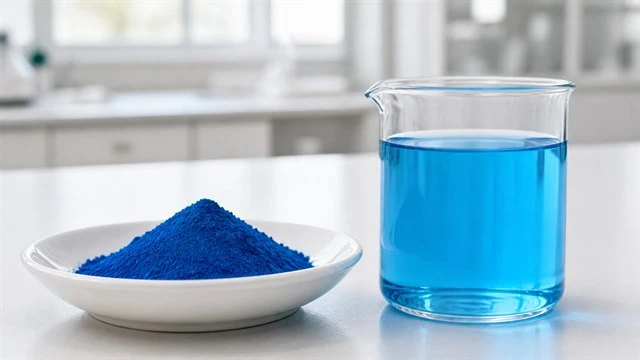
True Aqueous Clarity vs. Whole Biomass: Unlike insoluble green microalgae powder, cold-membrane filtered phycocyanin forms a 100% transparent, sediment-free hydrocolloidal protein solution. Specifying the exact spectrophotometric color value (E18 vs. E25) ensures batch-to-batch shade reproducibility across high-speed beverage and confectionery dosing lines.
In B2B ingredient procurement, purchasing blue spirulina by generic weight percentage leads to severe batch-to-batch color drift. Industrial specifications are governed by Color Value (E1cm1% at 618 nm)-which measures the optical absorbance of a 1% aqueous solution through a 1 cm quartz cuvette-and the Purity Index (A620/A280), reflecting the ratio of active phycocyanobilin chromophores to total aromatic proteins.
At Haoze Bio, we utilize a solvent-free physical aqueous extraction process combining controlled hypotonic cell lysis, multi-stage ceramic microfiltration, and low-temperature ultrafiltration. By avoiding harsh chemical precipitants, our extracts retain native hexameric protein conformation while stripping away insoluble cell walls and volatile earthy aldehydes. Below is the commercial selection matrix comparing our core grades alongside whole Organic Spirulina Powder:
| Specification Grade | Color Value (E10%, 618nm) | Carrier & Composition | Target Commercial Applications |
|---|---|---|---|
| Phycocyanin E18 (Standard Food Grade) | E ≥ 180 (E1% ≥ 18.0) | Phycocyanin + Trehalose & Sodium Citrate (~25%–30% functional thermal buffers) | Workhorse grade for RTD functional drinks, gummies, ice cream, and bakery frostings; enhanced thermal resistance. |
| Phycocyanin E25 (High-Potency / Clean-Label) | E ≥ 250 (E1% ≥ 25.0) | 100% Pure Phycocyanin Isolate (Carrier-Free or Organic-Compliant Grade) | Beauty-from-within collagen shots, hydration stick packs, nutraceutical capsules, and ultra-low dosage coloring. |
| Phycocyanin E30+ (Nutraceutical / Cosmetic Grade) | E ≥ 300 (A620/A280 ≥ 2.5) | Ultra-purified protein monomer/trimer fraction, zero excipients | High-potency antioxidant serums, specialty dietary supplements, and diagnostic biomarker formulations. |
| Whole Organic Spirulina Powder | N/A (Opaque Deep Green) | Intact whole-cell biomass (60%–70% protein, chlorophyll, carotenoids) | Superfood greens blends, opaque protein smoothies, and compressed nutritional tablets. |
2. How to Overcome Acidic Precipitation and Thermal Fading in Beverage Processing?
Because C-phycocyanin owes its intense blue hue to an open-chain tetrapyrrole chromophore covalently bound to an apoprotein backbone, any processing stress that unfolds the tertiary protein structure immediately alters light absorption. Published kinetic studies demonstrate that at pH 6.0 and 47°C, native phycocyanin exhibits a slow degradation half-life (t1/2 ≈ 309 minutes), whereas heating above 55°C–60°C triggers rapid polypeptide denaturation and color bleaching.
pH Matrix & Botanical Blending Spectrum: Native phycocyanin maintains vivid sapphire clarity across pH 5.0–7.0. When co-formulated with natural yellow botanicals or plant-based milk bases, beverage developers can unlock a complete clean-label palette-ranging from electric aqua hydration waters to vibrant emerald green and pastel blue barista lattes.
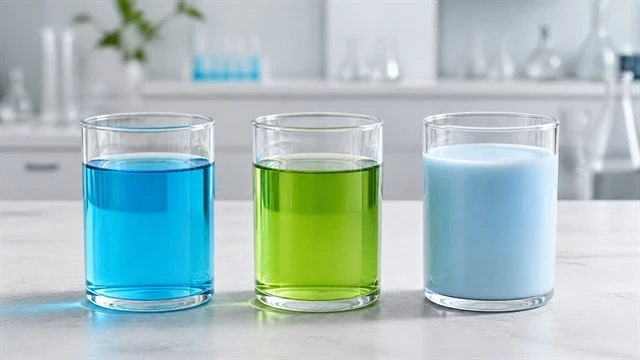
To commercialize shelf-stable or refrigerated blue beverages without synthetic stabilizers, Haoze Bio's application lab recommends three proven engineering interventions:
1. Electrostatic Shielding Below pH 4.5
The isoelectric point (pI) of C-phycocyanin sits between pH 4.2 and 4.5. In acidified fruit drinks or sour beauty shots, net surface charge drops to zero, causing blue flocculation. Pre-complexing phycocyanin with 0.15%–0.25% Propyleneglycol Alginate Powder (PGA) or high-methoxyl pectin creates an anionic steric barrier around the protein, preventing acid aggregation down to pH 3.6.
2. Cosmotropic Sugar Hydration Shells
Adding low-molecular-weight sugars-specifically trehalose, sucrose, or sorbitol (20%–40% w/w in syrup bases)-increases water surface tension and preferentially hydrates the protein surface. This thermodynamic stabilization raises the thermal denaturation threshold by 8°C to 12°C, allowing E18 phycocyanin to survive short-time HTST pasteurization (72°C for 15s) or post-boil gummy dosing.
3. High-Margin Commercial Applications: Beauty Shots, Hydration Stick Packs & Natural Green Blends

Figure 3: Clean-label commercial applications featuring carrier-free E25 phycocyanin in single-serve electrolyte sachets and functional wellness shots.
Beyond simple synthetic dye replacement, mid-sized F&B and nutraceutical brands leverage blue phycocyanin to command premium retail pricing across three fast-growing product categories:
- Beauty-from-Within Collagen & Antioxidant Shots (60 mL Cold-Fill / HPP): Phycocyanin provides dual value-acting as a clinically recognized peroxyl radical scavenger while imparting an unmistakable "marine hydration" aesthetic. When formulated at 0.03%–0.06% (E25 grade) alongside hydrolyzed marine collagen, hyaluronic acid, and sodium ascorbate (as a photoprotective oxygen scavenger) under High-Pressure Processing (HPP), brands achieve vibrant shelf stability without heat damage.
- Electrolyte Hydration Stick Packs & BCAA Sports Premixes: Dry single-serve sachets completely bypass aqueous thermal and light degradation during warehousing. Blending 15 mg to 40 mg of E25 phycocyanin per 5 g serving with Monk Fruit Sugar or Stevia Powder delivers instant cold-water dispersion for "Blue Raspberry" or "Ocean Breeze" electrolyte drinks with zero artificial dye warnings.
- Clean-Label "Blue + Yellow" Natural Green Formulations: When chlorophyllin is unsuitable due to copper regulations or olive browning, formulators blend Blue Phycocyanin Powder with water-soluble Gardenia Yellow (crocin). Adjusting the ratio from 1:3 to 1:1 produces vibrant lime, pistachio, and mint greens for confections and syrups.
- Aesthetic Café Lattes & Functional Creamers: Pairing E18 phycocyanin with dairy-free Bulk Coconut Milk Powder creates the viral "Blue Velvet Coconut Latte." Along with our flagship Purple Yam Powder Organic UBE Powder, Haoze Bio supplies complete turnkey botanical color systems for specialty coffee chains.
4. Global Regulatory Compliance (FDA 21 CFR 73.530 & EU Coloring Foodstuff) and COA Standards
Navigating international color additive regulations is mandatory before commercial launch. Because Haoze Bio extracts phycocyanin exclusively using purified water without organic solvents, our material meets the strictest global clean-label standards:
- United States (FDA 21 CFR § 73.530): Approved as a color additive exempt from batch certification ("Spirulina Extract") for coloring confections, frostings, ice cream, frozen desserts, beverage mixes, yogurts, custards, and dietary supplements under Good Manufacturing Practice (GMP).
- European Union (Regulation EC No 1333/2008 & Natcol Guidelines): Classified as a non-selective aqueous "Coloring Foodstuff" (Food with Coloring Properties) rather than an E-number chemical additive. Brands can declare clean labels such as "Coloring Food: Spirulina Extract" or "Concentrate of Spirulina."
- Contaminant & Toxin Assurance: Fully compliant with EU 2023/915 heavy metal limits and verified free of microcystins (<0.5 ppm), polycyclic aromatic hydrocarbons (PAHs), and ethylene oxide (EtO).
Below is the standard analytical specification benchmark for Haoze Bio Bulk Blue Phycocyanin Powder (E18 & E25). Every commercial shipment includes a batch-specific COA verified by UV-Vis and ICP-MS:
| Analytical Parameter | Standard Benchmark (E18 / E25) | Test Methodology |
|---|---|---|
| Botanical Source & Solvent | Arthrospira platensis | 100% Purified Water Extraction | Manufacturing Batch Record / TLC |
| Appearance & Odor | Vibrant Sapphire Blue Fine Powder | Neutral, Mild Odor | Organoleptic Inspection |
| Color Value (E1cm10% at 618 nm) | E18 Grade: ≥ 180 | E25 Grade: ≥ 250 | UV-Vis Spectrophotometry (pH 6.0 Buffer) |
| Water Solubility | 100% Soluble in Cold/Warm Water (Clear Blue, Zero Sediment) | 1% Aqueous Solution Visual Test |
| Particle Sizing / Mesh | 100% through 80 Mesh | USP <786> Analytical Sieve |
| Loss on Drying & Ash | Moisture ≤ 7.0% | Total Ash ≤ 8.0% | USP <731> / USP <561> |
| Heavy Metals (Pb, As, Cd, Hg) | Pb ≤ 1.0 ppm, As ≤ 1.0 ppm, Cd ≤ 0.5 ppm, Hg ≤ 0.1 ppm | ICP-MS (USP <233>) |
| Microbiological Control | Total Plate Count < 1,000 CFU/g | Yeast/Mold < 100 CFU/g | Salmonella/E. coli Negative | USP <2021> & <2022> |
5. Frequently Asked Questions: Phycocyanin Formulation & Bulk Sourcing
Q1: What is the typical dosage of E18 or E25 Blue Phycocyanin in commercial beverages?
A: Dosage depends on desired color depth and optical path length. For a pastel sky-blue hydration water, 0.01% to 0.03% (100–300 mg/L) of E18 powder is sufficient. For deep sapphire wellness shots or opaque coconut milk lattes, formulators typically dose 0.05% to 0.12% of E18, or 0.03% to 0.08% of high-potency E25 powder.
Q2: How can we prevent blue phycocyanin from fading under retail store LED lighting?
A: Photobleaching is driven by singlet oxygen generation when light excites the tetrapyrrole chromophore. Adding 0.02% to 0.05% sodium ascorbate or ascorbic acid (buffered above pH 5.0) quenches dissolved oxygen radicals and extends light stability by 300%. For long-shelf-life RTDs, UV-blocking PET sleeves, aluminum cans, or amber glass bottles are strongly recommended.
Q3: Why does E18 phycocyanin contain trehalose or sodium citrate, and do you offer carrier-free options?
A: During commercial spray drying, native algal biliproteins are susceptible to thermal unfolding. Co-drying with food-grade trehalose and sodium citrate forms a protective glassy matrix that locks in the vibrant blue conformation and accelerates cold-water wetting. For strict 100% pure label claims or organic certifications, Haoze Bio supplies carrier-free E25 and Organic E18 grades processed via gentle low-temperature drying.
Q4: When should a brand choose Blue Phycocyanin over Butterfly Pea Flower or Indigo powder?
A: Butterfly pea flower anthocyanins shift rapidly from blue to purple/pink as soon as pH drops below 6.0, whereas phycocyanin remains a true, pure sky-blue down to pH 4.5 (and lower when hydrocolloid-buffered). Furthermore, phycocyanin enjoys broad FDA 21 CFR 73.530 approval across dairy, confectionery, and dietary supplements, offering superior regulatory versatility and zero herbal aftertaste.
6. Scientific References & Analytical Benchmarks
- Adjali, A., Clarot, I., Chen, Z., Marchioni, E., & Boudier, A. (2022). Physicochemical degradation of phycocyanin and means to improve its stability: A short review. Journal of Pharmaceutical Analysis, 12(3), 406-414. (PMCID: PMC9257648).
- Pan-utai, W., & Iamtham, S. (2019). Enhanced stability of C-phycocyanin colorant by extrusion encapsulation. Journal of Food Science and Technology, 56(11), 5013-5021. (PMCID: PMC6801235; DOI: 10.1007/s13197-019-03955-8).
- U.S. Food and Drug Administration (FDA). Code of Federal Regulations Title 21, Section 73.530 (21 CFR 73.530): Spirulina extract-Listing of color additives exempt from certification.
- European Commission. (2023). Commission Regulation (EU) 2023/915 on maximum levels for certain contaminants in food. Official Journal of the European Union.
Partner with Haoze Bio: Wholesale Phycocyanin & Turnkey Formulation Support
Formulating a Clean-Label Blue Beverage, Gummy, or Beauty Wellness Shot?
From 1 kg aluminum foil R&D pouches to 25 kg export fiber drums of standardized E18, E25, and Organic Blue Phycocyanin Powder, Haoze Bio provides rapid lab sampling, custom trehalose/hydrocolloid pre-blending, and complete US/EU regulatory documentation.
Request E18/E25 Samples & Batch COA
Official Direct Inquiry Email: info@haoze-bio.com