


Formulator's Direct-Answer Takeaway: To eliminate clumping and bottom sedimentation in commercial iced and hot ube lattes without adding artificial dyes (FD&C Red No. 40 / Blue No. 1), commercial beverage developers must pair a controlled 80–100 mesh spray-dried or micro-milled Purple Yam Powder Organic UBE Powder with clean-label emulsion carriers like Bulk Coconut Milk Powder and cold-water-soluble hydrocolloids such as Guar Gum Powder at 0.15%–0.25% w/w. Maintaining the drink matrix at pH 5.8–6.4 protects natural acylated cyanidin structures against thermal browning, delivering instant cold dispersion and 120-minute visual suspension stability.
1. Why Pure Ube Powder Clumps in Cold Milk and How Baristas Can Solve It
Commercial baristas and automated beverage operators frequently encounter instant clumping when introducing pure dehydrated ube powder into cold dairy, oat milk, or iced water. Unlike soluble spray-dried dairy powders or maltodextrin-diluted colorants, authentic purple yam (Dioscorea alata) contains 65%–75% native root starches and high-molecular-weight mucilaginous polysaccharides. When water molecules strike dry powder clusters, surface polysaccharides hydrate instantaneously, generating an impermeable gelatinous shell around the core-a phenomenon known in food physics as the "fish-eye" effect.
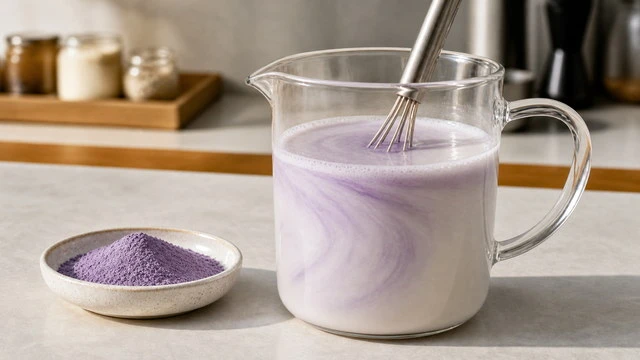
Physical Wettability Dynamics: Sub-micron raw yam powder suffers from excessive surface energy and poor flowability, promoting agglomeration. Conversely, over-coarse milling (>60 mesh) settles instantly. The industrial solution relies on dry dispersion spacing: blending standardized 80–100 mesh ube powder with pre-emulsified plant lipid powders or clean-label soluble fibers prevents localized hydration bottlenecks, allowing liquid to penetrate dry particles uniformly within 15 seconds of gentle stirring.
In busy retail cafe operations, preparing drinks from pure raw root powder requires baristas to whisk with warm water before pouring over ice, creating order bottlenecks during morning rushes. For growing cafe chains, switching to a cold-dispersible pre-blended formula allows staff to combine one pre-measured scoop directly with cold oat milk or dairy, hand-shake for 10 seconds, and serve with zero residue.
2. Preventing Heavy Sedimentation Across Plant-Based Milk Bases
Settling velocity in beverage suspensions is governed by Stokes' Law: v = 2r²(ρp - ρf)g / (9η). In an unbuffered iced latte, dense starch particles (ρp ≈ 1.45 g/cm³) rapidly overcome the low dynamic viscosity (η) of chilled liquid (≈ 1.2–1.8 mPa·s), producing visible purple phase separation and unpalatable gritty sludge at the bottom within 10 minutes. For commercial cafés and packaged RTD bottlers, suspension stability requires a targeted clean-label stabilizer synergy.
Hydrocolloid Network Synergy
Incorporating 0.15%–0.25% Guar Gum Powder alongside micro-dosed locust bean gum builds a pseudoplastic, shear-thinning fluid network. The drink pours fluidly through commercial straw valves while maintaining yield stress at rest to suspend purple yam particulates for over 120 minutes.
Plant-Lipid Carrier Stabilization
Pairing ube with high-fat, spray-dried Bulk Coconut Milk Powder coats hydrophobic yam particles with medium-chain triglycerides (MCTs). This creates a stable creamy emulsion that masks residual earthiness and enhances mouthfeel in vegan, dairy-free barista formulas.
Different plant milk bases interact uniquely with purple yam solids. Oat milk contains natural beta-glucans that provide mild native suspension, making it very forgiving. Conversely, almond milk has lower native viscosity and tends to drop solids faster unless buffered with clean-label gums. Whole dairy milk provides robust micellar casein networks that naturally stabilize emulsions but can slightly soften the visual purple contrast compared to bright, neutral coconut milk bases.
3. How Beverage pH and Heat Processing Impact Natural Purple Color
The signature purple hue of authentic ube is driven by mono- and di-acylated cyanidin and peonidin glycosides. Acylation with ferulic and sinapic acids confers superior stability compared to ordinary berries, yet commercial pasteurization (UHT 135°C for 4 seconds or retort canning at 121°C) presents thermal degradation risks if the drink's chemical matrix is unbuffered.
pH Matrix Window: At pH < 4.0, cyanidin shifts to red flavylium cations; at alkaline pH > 7.2, quinonoidal bases shift to an unappealing green-blue. The optimal beverage formulation window sits firmly between pH 5.8 and 6.4. In high-temperature RTD processing, micro-adjusting organic acidity with buffered potassium citrate prevents polyphenol oxidase browning while maintaining natural violet radiance without artificial dyes.
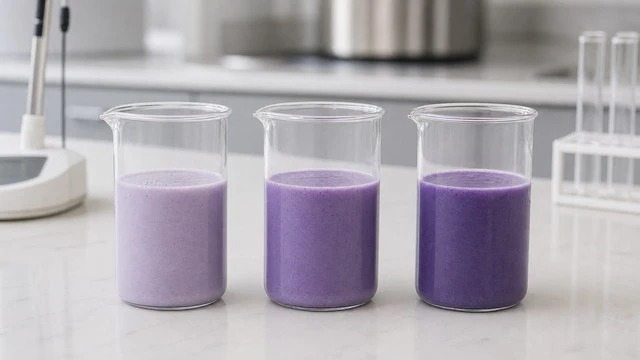
For refrigerated cold-fill bottles (HTST 72°C–75°C for 15–20 seconds), natural ube color holds beautifully for up to 30 days under refrigeration when protected in light-barrier packaging. If formulating high-acid fruit-tea crossovers (such as ube-lemonade or ube-passionfruit), formulators must expect a dramatic color shift toward bright magenta-fuchsia due to the low pH acidic environment, rather than traditional lavender-violet.
4. Raw Bulk Powder vs. Turnkey Instant RTM Premix: Sourcing Trade-Offs
Emerging beverage brands and scaling multi-unit café chains often struggle to decide between raw bulk ube powder and complete instant ready-to-mix (RTM) dry premixes. The following commercial matrix outlines operational, labor, and formulation trade-offs across typical volume scales:
| Formulation Parameter | 100% Pure Raw Ube Powder | Turnkey Instant RTM Premix |
|---|---|---|
| Active Botanical Content | 100% Dehydrated Purple Yam (Zero Carriers) | 25%–40% Ube + Coconut Milk + Inulin + Gums |
| Dispersion Performance | Requires warm slurry pre-whisking (1:2 water) | Instant cold-water / cold-milk soluble (<15s) |
| In-Store Barista Prep Time | 45–60 seconds per cup (high labor variance) | 10–15 seconds per cup (one-scoop standard) |
| Finished Serving Cost ($/16 oz) | $0.28–$0.38 (requires separate syrup/milk bases) | $0.42–$0.55 (all-in-one base, reduced SKU count) |
| Ideal Packaging Format | 25 kg Fiber Drum / 1 kg Barrier Foil Bags | 15 g/30 g Single-Serve Stick Packs or 500 g Tins |
When brand owners purchase pure raw ube powder, they enjoy full control over final sugar and dairy levels. However, in-store staff must maintain consistent recipe discipline to prevent lumpy or watery drinks. Conversely, choosing an RTM pre-blend shifts the technical labor into the powder formulation itself, enabling fast, foolproof cup prep across multi-store franchise operations.
5. Scaling with Private-Label Stick Packs and Low-MOQ Sachet Copacking
A primary hurdle for independent CPG brands and boutique coffee roasters is the prohibitive contract manufacturing threshold imposed by traditional packing giants. Demanding 100,000-unit minimum runs and charging exorbitant tooling fees stifles agile formula iterations. Haoze Bio bridges this gap by functioning as a dedicated formulation system supplier, delivering fully integrated ingredient sourcing, dry pre-blending, and flexible small-batch packaging.
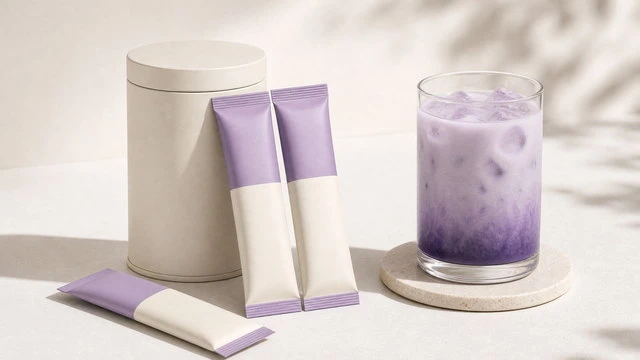
Scalable Packaging Configurations: From 15 g / 30 g high-barrier nitrogen-flushed stick packs (preventing moisture caking and anthocyanin oxidation) to composite retail composite cans and 1 kg food-service barrier pouches, brands receive shelf-ready SKUs. Backed by certified food safety documentation and pilot run options starting as low as 1,000 cartons, indie brands can validate retail channels rapidly without tying up capital in excessive dead inventory.
Single-serve sachets offer practical operational advantages for regional coffee roasters and subscription beverage startups. Pre-portioned sticks protect moisture-sensitive anthocyanins from air exposure every time a container is opened, ensuring consistent purple color from the first serving to the last.
6. Commercial Batch COA Specifications and Quality Control Baseline
To ensure regulatory compliance for international export into North America and European markets, every industrial lot of purple yam powder is subjected to third-party validated testing protocols. The table below represents our standard commercial batch release criteria:
| Analytical Parameter | Industrial Release Specification | Testing Methodology |
|---|---|---|
| Botanical Identity | 100% Dioscorea alata Rhizome (Non-GMO) | TLC / Microscopic Morphology |
| Moisture Content | ≤ 7.0% w/w | USP <731> Loss on Drying |
| Particle Mesh Size | 100% pass 80 mesh; ≥ 95% pass 100 mesh | Analytical Sieve Analysis |
| Total Ash Content | ≤ 5.0% w/w | USP <281> Residue on Ignition |
| Synthetic Colorants (Dyes) | Not Detected (Zero Allura Red / Brilliant Blue) | HPLC-DAD Analysis |
| Heavy Metals (Lead, Arsenic, Cadmium, Mercury) | Pb ≤ 1.0 ppm, As ≤ 1.0 ppm, Cd ≤ 0.5 ppm, Hg ≤ 0.1 ppm | ICP-MS (USP <233>) |
| Microbiological Profile | Total Plate Count ≤ 10,000 CFU/g; Yeast/Mold ≤ 100 CFU/g; Salmonella Negative/25g | USP <2021> / USP <2022> |
Note: Each commercial delivery is accompanied by an official lot-specific Certificate of Analysis (COA). Standard export packaging is 25 kg multi-wall fiber drums with hermetic double food-grade polyethylene liners.
7. Frequently Asked Questions (FAQ)
Q: Can 100% pure ube powder dissolve completely in cold oat or soy milk without a blender?
A: 100% pure dehydrated ube powder contains natural botanical fibers and starch, meaning it forms a colloidal suspension rather than a clear chemical solution. Without pre-dispersion carriers, cold plant milk can cause surface clumping. For hand-shaken beverage bars, we recommend either pre-whisking the powder with warm water (1:2 ratio) into a smooth concentrate, or opting for our turnkey cold-water dispersible instant RTM premix formulated with clean-label hydrocolloids.
Q: How does ube powder differ from purple sweet potato powder in commercial lattes?
A: While both provide natural purple pigmentation, ube (Dioscorea alata) delivers an authentic nutty, vanilla-like profile with subtle earthy undertones highly prized in Filipino and modern Asian specialty beverages. Purple sweet potato (Ipomoea batatas) exhibits higher natural sweetness, denser starch body, and a slightly redder undertone. For brands seeking cost-optimized beverage bases, blending ube with standardized Purple Sweet Potato Powder is a viable commercial strategy.
Q: What is the typical shelf life and storage protocol for bulk ube powder drums?
A: Standard unopened shelf life is 24 months when stored in sealed double-liner drums in a cool, dry warehouse below 25°C and away from direct UV sunlight. Because natural anthocyanins are sensitive to atmospheric moisture and light oxidation, keeping containers tightly sealed between production batch pulls is essential to prevent caking and hue degradation.
Q: What are the minimum order quantities (MOQ) for custom private-label ube stick packs?
A: To support growing and mid-sized CPG innovators, our turnkey contract manufacturing pilot runs start at 5,000 to 10,000 single-serve stick packs with unprinted high-barrier foil and custom branded retail cartons. For standard 25 kg bulk drum export orders, our standard MOQ is a single 25 kg fiber drum, with complimentary 100 g laboratory samples available for active R&D trials.
8. Partner with Haoze Bio for Turnkey Beverage Formulation and Sourcing
Accelerate Your Next Purple Beverage Launch
Whether engineering an RTD iced ube latte line, debugging plant milk sedimentation, or scaling private-label single-serve sachets, Haoze Bio provides responsive technical debugging, certified batch COAs, and agile pilot-scale fulfillment.
Direct Technical Inquiries: info@haoze-bio.com | Batch COA, Specification Sheets & Pilot Quotes Dispatched Promptly.
Technical References & Quality Documentation
- Fang, Z., & Bhandari, B. (2010). Encapsulation of polyphenols - a review. Trends in Food Science & Technology, 21(10), 510-523.
- Mishra, R. K., et al. (2021). Extraction and stability evaluation of anthocyanins from purple yam (Dioscorea alata) for natural food colorants. Food Chemistry, 342, 128286.
- United States Pharmacopeia (USP). General Chapter <233> Elemental Impurities - Procedures; Chapter <2021> Microbial Enumeration Tests.