


Café & RTD Beverage Technical Summary: Beverage brands scaling taro and ube menus keep hitting the same wall: commodity "taro mixes" hide maltodextrin, creamer, and synthetic dyes behind a purple label. This guide shows how emerging-market cafés and RTD brands formulate clean-label purple drinks from 100% pure root powders, verify authenticity on intake, and lock in flexible, documentation-ready bulk sourcing.
1. From Manila Street Carts to Baghdad Café Counters: The Purple Root Window Is Open
Between 2021 and 2025, ube moved from a niche Filipino specialty to roughly tripled representation on US restaurant menus, and trend trackers now project the category as one of the fastest-rising dessert flavors of the decade. International outlets covered the phenomenon through 2026, and the wave has since propagated through Indian metro cafés and Gulf dessert counters - the same corridor that reaches emerging markets across the Middle East.
A Menu Category Already Educated For You
For beverage brand owners in growth markets, the timing math is unusually favorable. Western chains have already completed the consumer education phase; local cafés now only need to execute the menu translation. Taro sits at the center of that translation: it carries a decade of brand recognition inside bubble tea culture, while ube brings the newer, social-media-native "purple dessert" halo.
First-mover local brands that lock supplier documentation now will own the shelf position before the category matures into price competition.
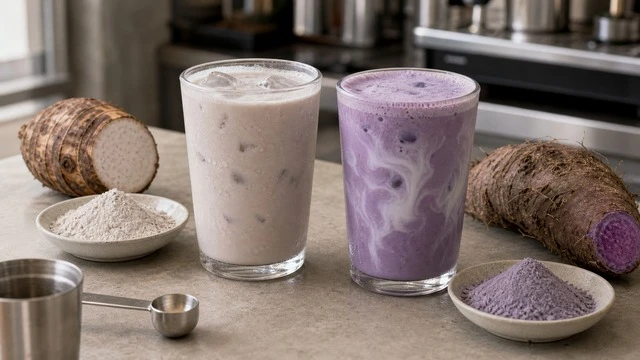
But the demand spike came with a supply-side shock. Philippine ube production contracted from more than 15,000 metric tons in 2021 to around 12,500 metric tons in 2025, tuber prices in the source region more than doubled, and Manila imposed an export suspension on raw ube to protect domestic supply. Processed ingredients such as spray-dried powder remain exportable - but the era of casually sourcing oversized tuber lots is over.
For emerging-market beverage brands, this creates a concrete sourcing brief: lock in processors of finished root powders - with documentation, staged trial quantities, and export flexibility built in - before the local purple category window closes to late entrants.
2. The Authentic Color Problem: Why Pure Taro Powder Is Not Purple
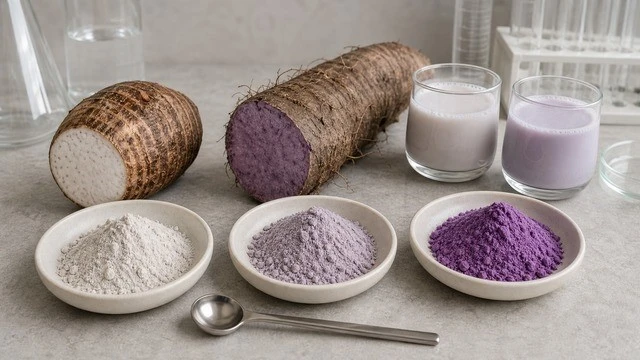
Few specification disputes in root-powder procurement end as quickly and as disappointingly as this one: a buyer opens a bag labeled "100% taro powder" and finds an off-white to pale grayish-lilac dust that looks nothing like a milk tea shop's signature violet cup.
The botanical reality: Colocasia esculenta tuber flesh contains no purple anthocyanin pigments worth the name. Genuine corm flesh is cream-white with faint violet-gray fibrous flecks, and low-temperature drying of that flesh yields a muted beige to lilac-gray powder. There is no cultivar or milling trick that changes this.
The bright violet taro cup sold worldwide is manufactured from one of three possible inputs:
| Color Strategy | Input Used | Label Declaration | Clean-Label Status |
|---|---|---|---|
| Synthetic dye blend (commodity taro mix) | FD&C Red 40 + Blue 1 | "Colors (Red 40, Blue 1)" | Lost - restricted in several markets |
| Purple sweet potato blending | Ipomoea batatas powder | "Coloring Food" / sweet potato | Conditional - tone shifts warm-red |
| True ube co-blend | Purple yam (Dioscorea alata) powder | "Purple Yam Powder" | Yes - royal violet with flavor synergy |
A brand that demands "no colors" on its own packaging cannot inherit a supplier's hidden dye load. Gulf and Mesopotamian import authorities have grown notably stricter on undeclared synthetic colorants in beverage powders, and a single failed port test can strand an entire shipment.
The honest formulation paths: (1) True-tone taro - accept the natural muted mauve-gray cup and market it as "no artificial colors," letting flavor and branding carry the visual identity; (2) Clean purple system - formulate the drink on taro flavor and color it with declared ube powder, where acylated cyanidin pigments deliver royal-violet bloom on hydration at inclusion rates far below the base powder; (3) Ube-forward menu - skip the compromise and launch ube as the hero flavor, with taro as the secondary SKU.
Which root belongs in which cup is a formulation decision, not a labeling accident. Beverage programs building a true violet system typically specify authentic ube powder (Dioscorea alata) as the declared coloring ingredient.
The QC Counter Test You Can Run in 60 Seconds
Stir 1 g of the powder into two clear cups: acidified water (pH ~3) and neutral buffered water (pH ~7). Genuine anthocyanin root systems visibly shift hue between the cups; a static electric-violet in both is a synthetic colorant system, not a root powder.
Run the same check on incoming drums at goods-in. Rejected dye loads caught at your dock cost a re-order; caught at customs, they cost the container.
3. Instant Mix Engineering: Dispersion, Anti-Caking, and the No-Filler Brief
Pure root powders are hygroscopic starch matrices. Tossed directly into a liquid, exterior granules gelatinitize within seconds, sealing dry cores inside waterproof shells - the same fish-eye clumps that ruin shaker cups and clog commercial beverage dispensers.
Commodity "instant" mixes solve this by diluting the root with 40–70% creamer, sugar, and maltodextrin before agglomerating. The disciplined buyer's brief - no added sugar, milk, flavors, colors, fillers - rejects that shortcut. Engineering without fillers means controlling four levers:
- Mesh & particle distribution. Beverage-grade root powders in the 80–200 mesh range (supplier spec, batch COA confirmed) balance wetting speed against sedimentation. Finer than ~300 mesh, static and aeration make dosing messy in humid shops.
- Agglomeration over dilution. Fluid-bed agglomeration binds fine particles into porous granules that wet in seconds while staying single-ingredient. Ask suppliers specifically for "instantized" lots rather than raw milled powder.
- Dry-blend architecture. In-house premix builders should blend root powder with 3–5 parts fine sugar or dextrose before liquid contact; each sugar crystal physically separates starch granules and buys seconds of workable wetting time.
- Humidity defense at retail end. In Gulf-climate service environments, 60%+ ambient humidy will cake any open drum within days. Nitrogen-flushed inner liners, resealable zip constructs, and desiccant-striped pails are not luxuries - they are the difference between batch one and batch two being reordered.
| Parameter | Pure Taro Powder | Pure Ube Powder | Commodity Taro Mix |
|---|---|---|---|
| Typical dry color | Beige / gray-lilac | Muted lilac-gray | Uniform electric violet |
| Rehydrated cup color | Gray-mauve (natural) | Royal violet bloom | Static violet (no pH shift) |
| Dairy / cream dependency | Optional - recipe controlled | Optional - recipe controlled | Built-in (hidden creamer) |
| Clean-label declaration | Taro powder | Purple yam powder | 8+ ingredients |
4. Suspension & Mouthfeel: Hot Water, Cold Milk, and the Shake-Test Window
A café line drinks its purple products across a brutal service spread: 90°C water for instant cups, 4°C milk shaken over ice, and stabilized bottles sitting under counter lighting for days. One powder, three physics problems.
Service-Lane Engineering Notes
- Hot service (90–95°C): root starches pasteurize almost instantly, viscosity spikes, and scorched grit settles. The workable window for hand-stir formats is a slurry pre-hydrated at 50–60°C, then finished with hot liquid - never powder dropped into boiling water.
- Cold shaken service (4–10°C): cold dispersion demands instantized granules plus shear (shaker or 10–15 second blend). Un-gelatinized starch surviving the shake reads as chalk on the back palate; a 10-minute rest lets residual granules finish hydrating and rounds the body.
- RTD bottles (2–8°C shelf): sedimentation follows Stokes' Law - settling speed scales with particle size squared. Specify 200-mesh-plus grades for suspended formats and, where the label allows, a micro-dose (typically 0.02–0.05%, per formulation trials) of gellan gum to build a weak fluid gel that holds starch particles in suspension for days.
- Mouthfeel anchoring: pure root powders deliver body but no fat coating. For cream structure without hidden dairy creamer inside your "taro powder," many brands split the system on the recipe card: pure root powder plus a declared separate coconut milk powder.
Benchtop Acceptance Protocol for Every Incoming Lot
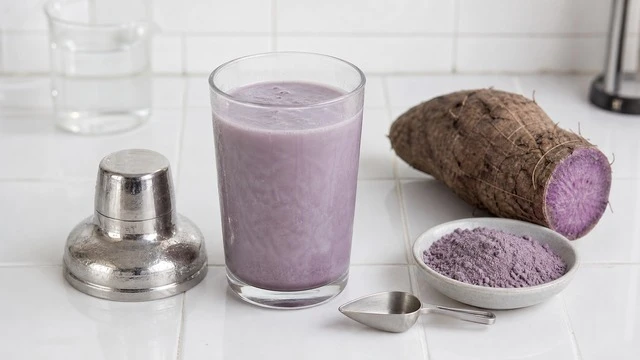
One 30 g dose into 250 ml whole milk at 4°C. Shake 15 seconds, rest 10 minutes. Score three failure modes: (1) visible undissolved shells against the cup wall, (2) rim ring formation at 30 minutes, (3) chalk persistence on swallow.
All three must pass before a production lot is released to service. Photograph the cup on white tile; the ring and sediment pattern becomes your batch-to-batch comparison archive.
5. Documentation & Screening: Importing Purple Root Powders Without Getting Stranded
Emerging-market beverage brands rarely lose deals on flavor; they lose them at customs. The documentation layer below is what a serious supplier pack should contain before a first shipment is booked:
- Batch-specific COA: botanical identity, mesh distribution, moisture, heavy metals, total plate count, yeast & mold - and, for dyed-adulteration defense, confirmation that no synthetic colorants (Allura Red, Brilliant Blue) are present.
- Third-party verification: independent laboratory screening (SGS, Eurofins, or equivalent) before your first bulk order - a single historical test from a broker does not represent your incoming lot.
- Trade & market certificates: certificate of origin and halal certification from internationally accepted certification bodies are standard in our export documentation for Iraq, Gulf, and wider MENA destinations. Confirm the exact certificate format your customs broker requires before - not after - quotation.
- Incoming screening you can run yourself: the two-cup pH test and hot-water bloom test from Section 2, applied to every incoming drum.
COA parameters issued with Haoze Bio commercial shipments:
| COA Parameter | Specification | Notes |
|---|---|---|
| Botanical Identity | Declared single species (Colocasia esculenta / Dioscorea alata) | Microscopy + starch granule verification per lot |
| Ingredient Purity | 100% root powder - no sugar, milk, carriers, flavors or fillers | Single-ingredient declaration on label |
| Synthetic Colorants | Not detected (Allura Red, Brilliant Blue) | Targeted screening on every export lot |
| Moisture | ≤ 7.0% | Caking & shelf-life protection in humid climates |
| Particle Size | 80–200 mesh, ≥ 95% pass | Custom mesh available per application |
| Heavy Metals | Pb ≤ 1.0 · As ≤ 0.5 · Cd ≤ 0.2 · Hg ≤ 0.1 mg/kg | Aligned to EU/US import limits |
| Microbiology | TPC ≤ 10,000 CFU/g · Yeast & mold ≤ 100 CFU/g · E. coli negative · Salmonella negative/25 g | Standard food-safety panel |
| Shelf Life | 24 months, sealed & cool-dry stored | Nitrogen-flushed liners recommended for humid lanes |
6. Flexible Sourcing for Growth-Stage Brands: From Bench Trials to Recurring Drums
Most supplier catalogues are built around two extremes: sample shops with no traceability, or conglomerates whose minimum order quantity is a full container before you may even taste the product. Growth-stage beverage brands live between those extremes, and their sourcing rhythm should look like this:
- Laboratory qualification (sample scale): COA pack review, pH-shift screening, sensory bloom test.
- Benchtop pilot (2–5 kg): recipe development in your actual shakers, batch freezers, and dispensers; menu costing locked in.
- Production validation (10–25 kg): first served volume; packaging-line and humidity behavior in real retail conditions.
- Recurring replenishment (drum or pouch scale, scheduled): contracted cadence with per-batch documentation, adjusted to your sell-through - not to someone else's annual tonnage target.
Haoze Bio supports exactly this ladder for single-ingredient botanical powders: 100% Colocasia esculenta taro root powder and authentic Dioscorea alata ube powder with no carriers, creamers, sweeteners, or colorants unless you commission a custom premix. Mesh, drying process, and packaging formats - from pilot pouches to nitrogen-lined 25 kg drums - are matched to your production reality. Every shipment includes a batch-specific COA, and export documentation (certificate of origin and halal certification from accepted international bodies) is ready for your destination - with freight quoted door-to-door to your city, whether that is Baghdad, Erbil, Riyadh, or Cairo.
Start With a Documented Pilot Batch
Send your target drink format, serving temperature, and required certificates to our technical team. We will return sample options, incoming-screening protocols, and a route-quoted landed-cost estimate for your review - no container commitments required to start.
Official Technical Inquiry: info@haoze-bio.com
References
- The Economist (2026, June 18). From Philippine staple to global sensation: the rise of ube.
- Fructidor (2026, September 21). Philippines suspends fresh ube exports.
- Inquirer Global Nation (2026, May 7). A violet revolution, but who profits from the ube market? (national ube production declined from more than 15,000 MT in 2021 to about 12,483 MT in 2025)
- Content Kitchen (2024, January 5). 2024 food trends: what we'll eat & drink this year (maybe!)
- Kaushal, P., Kumar, V., & Sharma, H. K. (2015). Utilization of taro (Colocasia esculenta): a review. Journal of Food Science and Technology, 52(1), 27–40. doi.org/10.1007/s13197-013-0933-y
- Brandão, N. A., Tagliapietra, B. L., & Clerici, M. T. P. S. Taro [Colocasia esculenta (L.) Schott]: a critical review of its nutritional value and potential for food application. Food Science and Technology. doi.org/10.5327/fst.00118
- Aboubakar, N. et al. (2008). Physicochemical, thermal properties and microstructure of six varieties of taro (Colocasia esculenta L. Schott) flours and starches. Journal of Food Engineering, 86(2), 294–305. doi.org/10.1016/j.jfoodeng.2007.10.006
- Tamaroh, S., & Purwani, T. (2023). Chemical and functional properties of preparation before drying purple yam flour (Dioscorea alata L.). AIP Conference Proceedings, 2596, 040027. doi.org/10.1063/5.0119218
- Im, Y. R., Kim, I., & Lee, J. (2021). Phenolic composition and antioxidant activity of purple sweet potato (Ipomoea batatas (L.) Lam.): varietal comparisons and physical distribution. Antioxidants, 10(3), 462. doi.org/10.3390/antiox10030462
- Yun, D. et al. (2024). Recent advances in purple sweet potato anthocyanins: extraction, isolation, functional properties and applications in biopolymer-based smart packaging. Foods, 13(21), 3485. doi.org/10.3390/foods13213485