


Commercial Bakery Technical Summary: Scaling commercial ube bread and pastries requires solving flour hydration competition, gluten weakening, and crust browning. This technical guide explores purple yam starch rheology, pre-hydration slurry protocols, natural crumb color stabilization, and agile factory-direct sourcing for commercial bakeries.
The global artisan bakery and commercial pastry market is experiencing an unprecedented surge in demand for vibrant, botanical-based specialty baked goods. Among botanical colorants and functional flavor bases, authentic purple yam-widely known as ube (Dioscorea alata)-has transitioned from an ethnic Southeast Asian heritage staple into a high-margin centerpiece for modern Western artisan bakeries, brioche doughnut specialists, and fast-growing regional pastry chains. Modern café consumers and pastry enthusiasts actively seek the eye-catching, natural lavender-to-violet hues, subtly sweet nutty-vanilla flavor notes, and clean-label appeal that authentic ube imparts.
However, moving from small-batch benchtop baking to standardized, commercial-scale production reveals profound food science and physical chemistry challenges. Bakery formulators and production managers frequently encounter severe dough performance failures when incorporating standard dehydrated purple yam powders: severe dough tightening and gluten breakdown caused by extreme starch hydration competition, loaf volume collapse from non-gluten protein dilution and particulate shearing, and unappealing muddy-brown crusts resulting from surface heat caramelization. This technical guide provides commercial bakers, central kitchen production managers, and clean-label formulators with an actionable, science-based roadmap for mastering ube dough rheology, optimizing pre-hydration hydration protocols, securing vibrant crust-to-crumb color contrast, and establishing agile, factory-direct sourcing channels.
1. The Chemistry of Purple Yam Flour: Starch Fractions, Water Affinity, and Gluten Dilution
Understanding the physical behavior of ube powder in a bakery environment requires examining its macromolecular composition. Unlike refined wheat flour-which typically contains 11.5% to 14.0% protein with optimized viscoelastic glutenin-gliadin networks-100% pure organic ube powder is predominantly composed of complex carbohydrates, native yam starch granules, soluble dietary fibers (mucilage polysaccharides), and moisture-sensitive phenolic compounds.
| Parameter | Strong Bread Flour (Hard Red Wheat) | Pure Dehydrated Ube Powder |
|---|---|---|
| Protein Content (%) | 12.5% – 14.0% (Gluten-forming) | 6.5% – 8.5% (Non-gluten) |
| Starch Content (%) | 68.0% – 72.0% | 72.0% – 78.0% |
| Amylose / Amylopectin Ratio | ~25% Amylose / 75% Amylopectin | ~21% Amylose / 79% Amylopectin |
| Dietary Fiber / Mucilage | 2.0% – 3.0% | 6.5% – 9.5% (High viscosity) |
| Water Absorption Index (WAI) | 60% – 64% water retention | 180% – 260% water retention |
| Starch Gelatinization Peak | 60°C – 68°C | 72°C – 81°C |
| Pigment System | Carotenoids (trace pale yellow) | Cyanidin/Peonidin Anthocyanin |
The Hydration Competition Phenomenon: When dry ube powder is tossed directly into a commercial spiral mixer alongside high-protein bread flour and cold hydration liquid, a kinetic competition for free water immediately unfolds. The water absorption index of dehydrated purple yam starch granules (amplified by high-molecular-weight mucilage and native cell wall pectic polysaccharides) is between 2.5 and 3.5 times higher than that of wheat endosperm flour. Yam starch granules possess a remarkably porous, hygroscopic outer matrix that absorbs unbound water molecules significantly faster than the compact, hydrophobic domains of gliadin and glutenin polypeptides can unfold.
Consequently, the wheat gluten proteins remain severely under-hydrated during the critical initial 3 to 5 minutes of low-speed mixing. The baker observes a dry, crumbly, tearing dough mass. If the mixer operator instinctively adds excess free water to soften the dough, the dough rapidly transitions from under-hydrated to structurally slack and sticky once mechanical shear forces break down the fragile yam mucilage networks later in the mixing cycle.
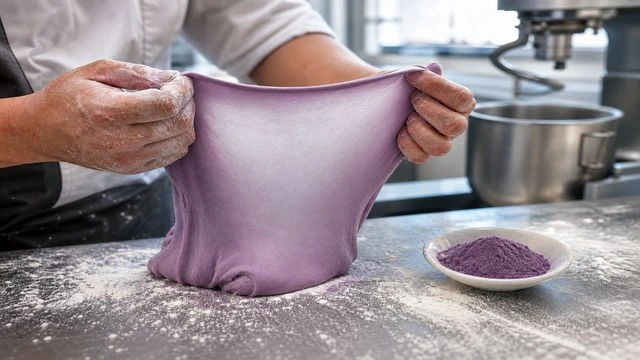
Visualizing Hydration Competition in Commercial Doughs
The microscopic comparison reveals how ultra-fine, micro-milled bulk purple yam powder (200–500 mesh) integrates seamlessly into gluten matrices when pre-hydrated into a slurry, preventing localized water-starvation zones and yielding fully developed, translucent gluten windowpanes.
2. Dough Rheology & Farinograph Performance: Farinograph Curves and Elasticity
In commercial bakery facilities operating high-speed planetary or dual-arm spiral mixers, consistency in dough rheology is the foundation of automated line machinability. Introducing ube powder alters the Farinograph curve characteristics of commercial dough batches in four predictable ways:
- Water Absorption (WA) Increase: For every 1.0% addition of commercial pure ube powder, the Farinograph water absorption of the flour blend increases by approximately 1.4% to 1.8% to reach the standard 500 Brabender Unit (BU) consistency line.
- Dough Development Time (DDT) Prolongation: Because gluten proteins are starved of free water during initial hydration, the time required for the dough to reach peak consistency lengthens from a standard 5.5 minutes up to 9.0–11.5 minutes if dry powder is added directly without pre-treatment.
- Stability Time (ST) Deterioration: The total dough stability-the duration the curve remains at or above 500 BU-decreases by 25% to 40%. The non-gluten botanical solids interfere with disulfide cross-linking, reducing tolerance to over-mixing.
- Degree of Softening (DS) Acceleration: After passing peak development, dough containing dry-blended ube exhibits rapid softening due to enzymatic breakdown of yam starches and structural shear degradation.
3. The Pre-Hydration Slurry Protocol: Step-by-Step Batching for Artisan Bakeries
To eliminate hydration competition, protect gluten film elasticity, and achieve maximum purple dispersion without localized speckling, commercial production lines must adopt the Pre-Hydration Slurry Protocol (PHSP):
- Step 1 (Precision Weighing): Measure 100% pure micro-milled ube powder (200–500 mesh) at 4.0% to 7.0% on total flour weight.
- Step 2 (Thermal Slurry Activation): Blend ube powder with liquid phase (water or plant milk) at a 1:1.8 to 1:2.2 ratio. Use lukewarm liquid at 28°C–32°C and whisk for 90 seconds until fully hydrated and lump-free.
- Step 3 (Starch Rest & Equilibration): Allow the slurry to rest for 15–20 minutes at ambient room temperature (18°C–22°C). This allows starch granules to reach equilibrium swelling without gelatinizing.
- Step 4 (Primary Dough Autolyse): Combine high-protein bread flour and base hydration water in the mixer. Mix 3 minutes on low speed and rest 25–30 minutes for unobstructed gluten autolyse.
- Step 5 (Slurry Incorporation): Add the fully hydrated ube slurry, yeast/levain, and salt. Spiral mix 3 minutes on low speed and 5–6 minutes on medium speed until reaching a translucent violet windowpane.
4. Overcoming Heat Degradation and pH Shifts: Crust-to-Crumb Color Optimization
A primary commercial failure in ube baking is the "Muddy Crust / Gray Crumb" dilemma. The natural violet pigments in authentic purple yam consist of acylated anthocyanins-predominantly cyanidin-3-glucoside and peonidin derivatives. Anthocyanins are notoriously labile food colorants governed by temperature, oxidation, and pH equilibrium.
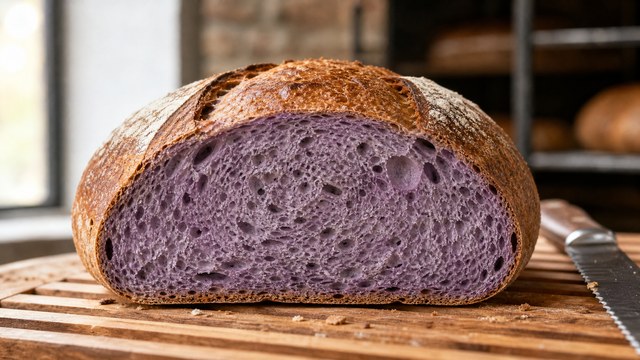
Mastering Crust-to-Crumb Color Contrast
By implementing the temperature step-down baking method and buffering dough pH to 5.4–6.0 with trace ascorbic acid, commercial bakers achieve an exquisite golden-blush crust that slices open to reveal an all-natural, vibrant lavender-violet crumb without synthetic food dyes.
Protecting Crumb Vibrancy While Preventing Scorched Crust: In yeast-fermented artisan loaves, sandwich breads, and babkas, bread interior temperatures rarely exceed 98°C to 100°C during baking, allowing heat-sensitive anthocyanins within the crumb to survive intact. However, bread crust is exposed to oven chamber air temperatures of 180°C to 230°C, where surface amino acids and reducing sugars undergo rapid Maillard browning and sugar caramelization that mask the purple hue with unappealing muddy-brown tones.
- The Steamed Initial Bake: Injecting 4 to 6 seconds of saturated steam during the first 6 minutes creates a thin, flexible liquid film on the loaf surface, delaying crust formation and preventing premature scorching of surface yam solids.
- Temperature Step-Down Protocol: Start baking at 210°C–215°C for initial oven spring, then immediately drop deck or convection temperature to 170°C–175°C. This allows core crumb baking without driving surface temperatures into dark melanoidin caramelization.
- Acidic Wash Barrier: Brushing loaves with an acidic oat-milk or whole-milk wash (pH 5.8) enriched with 0.05% natural ascorbic acid creates a transparent protective moisture shield that reflects direct radiant heat.
5. Heat-Resistant Commercial Ube Fillings: Halaya, Pastry Cream, and Starch Retrogradation
For laminated croissants, brioche buns, and filled doughnuts, commercial bakeries require high-stability, bake-proof ube fillings (commercial Ube Halaya or purple yam pastry creams) that can withstand 200°C oven baking without boiling over, blistering, or separating into liquid oil and gummy curds.
1. Starch Retrogradation Prevention
Incorporate low-acyl gellan gum (0.3%) alongside Bulk Coconut Milk Powder. Medium-chain triglycerides (MCTs) coat amylose chains, preventing crystalline re-alignment and moisture syneresis during 4°C refrigeration.
2. High-Temperature Bake Stability
Utilize a dual-starch network pairing native yam starch with modified waxy maize starch to maintain a firm, non-boiling gel structure under direct 200°C pastry baking temperatures.
3. Lipid Emulsion & Gloss
Pairing 8%–12% organic spray-dried coconut milk powder with 4%–6% European-style butter imparts a rich, velvety mouthfeel and luxurious visual gloss that accentuates authentic floral notes.
4. Clean-Label pH Buffering
Adding 0.05% natural ascorbic acid buffers filling pH to a stable 5.6, locking in bright violet hues throughout extended 7-day refrigerated pastry display.
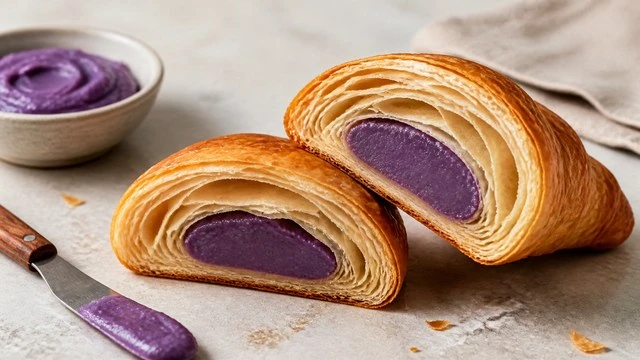
Commercial Bake-Stable Ube Halaya Pastry Applications
Cross-sectional view of a laminated flaky croissant and brioche bun filled with rich, bake-stable ube halaya. The filling retains a smooth, glossy violet consistency without oil leakage, skin cracking, or bubble rupture during high-heat commercial baking.
6. Agile Sourcing for Commercial Bakeries: Factory-Direct Supply vs. Trader Markups
For independent wholesale bakeries, central bakery commissaries, and emerging specialty brands, raw material procurement often represents an operational bottleneck. Commercial bakeries rarely require multi-ton container loads on day one, yet sourcing small quantities through retail distributors or secondary brokers presents major financial and quality hazards.
Why 25 kg – 100 kg (1 to 4 Drums) Is the Commercial Sweet Spot: The vast majority of regional commercial bakeries operate on monthly production cycles requiring between 25 kg and 100 kg of specialty botanical powder. Purchasing 25 kg fiber drums lined with heavy-gauge, food-grade double polyethylene bags provides significant operational benefits:
- Moisture-Proof Storage Integrity: Commercial ube powder is highly hygroscopic. Bulk drums prevent ambient humidity absorption, clumping, and microbial proliferation, ensuring a verified 24-month shelf life.
- Reduction of Kitchen Handling Waste: Replacing hundreds of non-recyclable 1 kg foil pouches with a single reusable, airtight fiber drum significantly streamlines production line handling and reduces kitchen prep labor.
- Factory-Direct Cost Advantage: Purchasing direct from an established manufacturer eliminates 40% to 60% broker margins, providing the cost-in-use flexibility necessary to maintain profitable wholesale pastry margins.
Haoze Bio operates modern botanical dehydration and ultra-fine micro-milling facilities dedicated to supporting agile food and bakery manufacturers. By bridging the gap between rigid multinational suppliers and unverified middleman re-packagers, Haoze Bio provides commercial bakeries with flexible batch dispatch (25kg–100kg drums), tailored mesh specifications (200–500 mesh), verified batch COAs, and complimentary R&D trial samples.
7. Frequently Asked Questions (Commercial Bakery & Formulation FAQ)
Q1: Can ube powder completely replace synthetic purple food coloring in commercial baking?
Yes, provided formula pH is maintained between 5.4 and 6.2 and high-heat surface browning is managed. In interior crumb applications (breads, sponges, fillings), 4% to 6% pure micro-milled ube powder provides a rich, natural lavender-violet shade with zero artificial additives.
Q2: How does ube powder differ from purple sweet potato powder in dough performance?
While both botanical powders contain purple anthocyanins, they originate from entirely different plant families (Dioscorea alata yam vs. Ipomoea batatas sweet potato). Purple sweet potato powder contains higher levels of reducing sugars, causing fast surface scorching and earthy vegetable notes. True ube powder features higher native starch, lower free sugars, superior neutral-sweet vanilla aroma, and a softer pastel-violet tone.
Q3: Why is my ube bread dough tearing during mechanical lamination?
Dough tearing during sheet lamination indicates either hydration competition or coarse particle shearing. If dry ube powder was mixed directly into flour, it absorbed free moisture from the gluten network. Transition to the Pre-Hydration Slurry Protocol and specify ultra-fine 300 to 500 mesh powder to ensure smooth, tear-free sheeting.
Q4: What is the optimal storage protocol for open 25 kg ube powder drums in a bakery?
Keep the inner heavy-duty polyethylene liner tightly twisted and sealed with a heavy-duty bag clamp. Store drums in a cool, dry raw-material staging room maintained below 22°C (72°F) and under 55% relative humidity to ensure optimal flowability and color vibrancy for up to 24 months.
Q5: Can we develop a customized, turn-key ube brioche or pancake dry premix with your facility?
Yes. In addition to supplying pure botanical powders, Haoze Bio provides contract OEM and ODM dry-blending services. Our application lab pre-blends micro-milled ube powder with specified ratios of organic coconut milk powder, clean-label leavening agents, and specialty sugars, delivering standardized, ready-to-mix batch bags tailored to commercial kitchens.
8. Summary & Commercial Sourcing Inquiries
Mastering the use of ube powder in commercial bakery formulations bridges ancient botanical culinary traditions with modern clean-label food engineering. By understanding purple yam starch hydration dynamics, implementing the Pre-Hydration Slurry Protocol, and balancing batter pH to protect natural anthocyanin structures, artisan bakeries and commercial pastry brands can reliably produce stunning, all-natural violet baked goods that capture premium consumer attention.
Contact Our Food Application & Sourcing Team
Official Commercial Portal: Haoze Bio Official Botanical Ingredients
Direct Technical Sourcing Email: info@haoze-bio.com
Primary Product Page: Organic Purple Yam / Ube Powder Technical Details