

Commercial Frozen Dessert Technical Summary: Scaling commercial ube gelato requires overcoming sub-zero starch retrogradation, ice crystal sandiness, and fat-induced color masking. This technical guide explores purple yam starch thermodynamics, lipid-phase pigment bloom, and agile factory-direct sourcing for frozen dessert makers.
1. The Chemistry of Purple Yam Starch in Sub-Zero Systems
The foundational building block of authentic ube powder is natural starch, constituting roughly 70% to 80% of the dried tuber solids. Unlike purified starches or synthetic colorant blends, whole dried purple yam contains a complex native matrix of linear amylose (approximately 28%–32%) and highly branched amylopectin (68%–72%), tightly bound within fine tuber cellular fiber.
Gelatinization Thermodynamics in Frozen Dairy Bases
When formulating standard ice cream or gelato mixes, ingredients are pasteurized (typically 75°C–85°C for 15–30 seconds). Purple yam starch granules possess an onset gelatinization temperature of approximately 69°C to 73°C, with peak viscosity occurring between 78°C and 82°C.
If organic ube powder is dry-blended into cold milk and insufficiently heated, the starch granules remain ungelatinized and unswollen. In finished frozen gelato, these unhydrated particles create a distinct chalky, raw-starch mouthfeel. Proper thermal swelling absorbs 10 to 14 times its dry weight in free water, creating a smooth, velvety hydrogel that stabilizes the entire frozen matrix.
2. Preventing Starch Retrogradation & Ice Crystal Sandiness
While gelatinized starch provides desirable chewiness and density in fresh gelato, its physical behavior at commercial display temperatures (-12°C to -14°C) and long-term storage (-18°C to -23°C) introduces significant physical instability known as starch retrogradation.
The Sub-Zero Syneresis Cascade:
- Amylose Crystallization: Linear amylose chains rapidly diffuse out of swollen granules below freezing, losing thermal kinetic energy and aligning parallel via intermolecular hydrogen bonds.
- Moisture Exclusion (Syneresis): As amylose re-crystallizes into rigid double helices, it expels bound water from the gel network.
- Ice Crystal Ripening: Expelled free water migrates to adjacent micro-ice crystals. Through Ostwald ripening, small crystals merge into coarse, sharp structures (>55 µm), creating a gritty texture frequently mistaken for lactose crystallization.
| Stabilizing Agent | Dosage (% mix) | Functional Anti-Retrogradation Mechanism |
|---|---|---|
| Locust Bean Gum (LBG) | 0.15% - 0.25% | Cryoprotective galactomannan; binds free water, retards ice crystal migration during thermal cycles. |
| Low-Acyl Gellan Gum | 0.04% - 0.08% | Forms fluid gel network; immobilizes starch-water phase under static frozen storage. |
| Medium-Chain Triglycerides (via Bulk Coconut Milk Powder) |
1.5% - 3.0% (fat basis) | Lipid barrier; intercalates between amylose chains, sterically hindering hydrogen-bond alignment. |
| Trehalose / Maltitol | 2.0% - 4.0% (sugar repl.) | Depresses freezing point without cloying sweetness, preserving amorphous glass around starch granules. |
3. Optical Physics: Real Dry Powder vs. Hydrated "Color Bloom"
A persistent industry misconception surrounds the visual appearance of authentic bulk purple yam powder. Commercial product developers must understand the spectrophotometric reality separating genuine botanical powder from adulterated blends.
The Physics of Dry State Diffuse Scattering
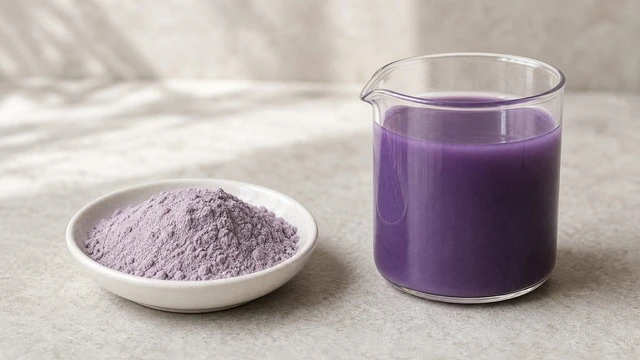
In its dry state, micro-milled (200–500 mesh) pure ube powder consists of millions of microscopic starch and cellulose facets. These micro-facets scatter incoming white light in all directions (diffuse reflectance). This scatters significant white light back to the human eye, elevating lightness (CIE L* 58–65) and diluting saturation.
The Golden Authenticity Rule: Genuine 100% ube dry powder appears as a muted, dusty lavender or grayish-lilac. Dry powders exhibiting screaming neon purple or dark electric magenta invariably contain synthetic FD&C dyes (Red 40 and Blue 1). Once hydrated in warm liquid, diffuse scattering drops by over 80%, instantly blooming into deep, velvety taro purple.
4. Lipid-Phase Emulsification & Homogenization Protocols
In commercial dairy processing, mixes undergo two-stage high-pressure homogenization (150–200 bar / 30–50 bar) to reduce milkfat globules below 1 µm. While essential for a silky mouthfeel, high homogenization creates an enormous fat surface area. Newly created fat droplets adsorb casein micelles, generating an intense "whitening effect" that can mask natural anthocyanins, shifting vibrant purple gelato into an uninspiring grayish-tan.
The Proven Two-Stage Processing Workflow:
- Phase A (Dairy/Plant White Base): Blend milk, cream/coconut oil, SMP, and primary sugars. Pasteurize (82°C) and homogenize at 180 bar.
- Phase B (Ube Slurry Pre-Hydration): Separately disperse fine ube powder (4.5%–5.5% of total mix) into 2.5x warm water (70°C) with 0.1% ascorbic acid buffer. Agitate until fully gelatinized into a deep violet gel.
- Post-Homogenization Blending: Introduce Phase B slurry into the pasteurized Phase A base when cooled below 45°C.
- Dynamic Aging: Age the blended mix at 4°C for 4 to 12 hours. This ensures complete protein and hydrocolloid hydration without exposing delicate anthocyanins to extreme mechanical shear.
5. Controlling Meltdown Resistance & Overrun Dynamics
For gelato display cases, visual presentation is paramount. Gelato must hold firm sculpted wave peaks and melt slowly on the tongue without collapsing into a watery pool. Natural dietary fiber in whole ube powder (3%–5% of dry weight) acts as a physical structural reinforcer within foam lamellae (liquid walls separating air cells), mechanically preventing bubble coalescence during churning.
Overrun and Meltdown Benchmarks
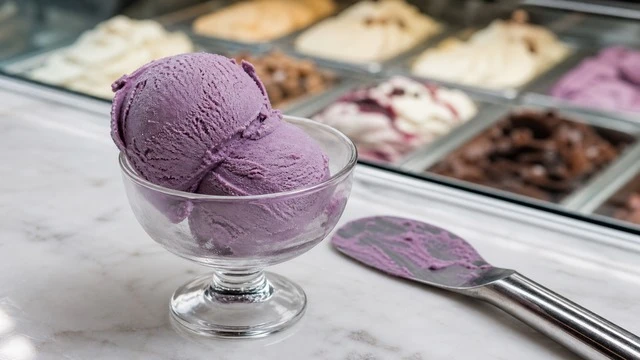
While commercial industrial ice cream incorporates 70% to 100% overrun, artisan Italian gelato targets 25% to 35% overrun for dense, elastic scoopability.
- Total Solids (TS): 36.5% – 38.5% (prevents icy crystallization)
- Fat Level: 7.0% – 8.5% (clean flavor release, non-greasy)
- Freezing Point Depression (PAC): Balanced with dextrose to maintain -12°C scoopability
- 60-Min Drip Loss (22°C): Under 15% (3x more stable than standard dairy ice cream)
6. Commercial Master Formulations: Gelato & Soft-Serve Base
Formula A: Commercial Artisan Ube Gelato
- Whole Milk (3.5% fat): 56.80 kg
- Heavy Cream (36% fat): 14.50 kg
- Skim Milk Powder (SMP): 4.20 kg
- Fine Sucrose / Dextrose: 13.00 kg / 3.50 kg
- Pure Ube Powder (200-500 mesh): 5.00 kg
- Bulk Coconut Milk Powder: 2.50 kg (MCT anti-crystallizer)
- Locust Bean Gum / Ascorbic Acid: 0.35 kg / 0.15 kg
- Target Parameters: 37.8% Total Solids | 8.2% Fat
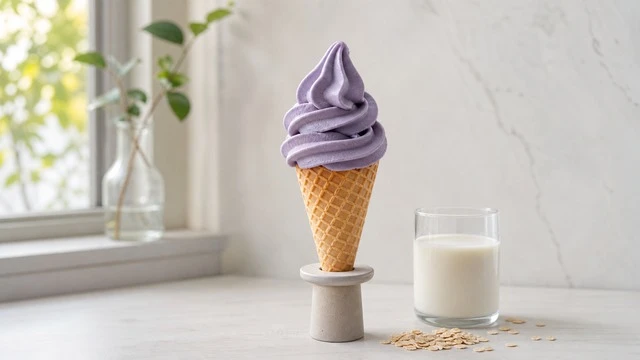
Formula B: Vegan Plant-Based Soft-Serve Base
- Filtered Oat Milk Base: 65.20 kg
- Coconut Cream (24% fat): 12.00 kg
- Cane Sugar / Maltodextrin: 12.50 kg / 4.00 kg
- Pure Ube Powder (200-500 mesh): 4.80 kg
- Sunflower Lecithin: 0.30 kg
- Tara Gum / Carrageenan Blend: 0.30 kg
- 10% Citric Acid Buffer (pH 5.9): 0.80 kg
- Target Parameters: 35.5% Total Solids | 5.6% Plant Fat
7. Medium-B Sourcing: Agile Batches, Sampling, and COA Verification
For regional ice cream brands, gelato workshops, and central kitchen dessert manufacturers, sourcing raw ube powder presents frustrating operational extremes: multinational ingredient conglomerates demand 5-to-10-ton minimums with months of bureaucratic auditing, while local spot-market brokers charge 80% markups on repacked bags lacking analytical documentation.
Haoze Bio bridges this divide directly, serving as a dedicated factory-direct manufacturing partner for medium-scale commercial runs (ordering 25 kg to 100 kg per batch):
- 25 kg Fiber Drum Packaging with Dual Poly-Liners: Heavy-duty industrial drums with hermetic, heat-sealed food-grade PE moisture barriers, eliminating humidity absorption and starch clumping during transit.
- Batch-Specific Analytical COAs: Every commercial shipment includes complete lot verification for mesh fineness (200–500 mesh >98%), moisture content (≤7.0%), heavy metal limits (Lead ≤1.0 mg/kg, Arsenic ≤0.5 mg/kg), and zero synthetic dye (Allura Red / Brilliant Blue) adulteration.
- Complimentary Pilot R&D Samples: 20 g to 50 g trial samples dispatched directly to customer culinary labs for benchtop freezing trials prior to volume commitments.
8. Frequently Asked Questions (Formulator & Buyer FAQ)
Q1: Why does our ube gelato turn grayish-blue instead of rich violet?
A: This indicates an alkaline pH shift. Anthocyanins express luminous violet at pH 5.4–6.1. Above pH 6.6 (common in alkaline municipal water or certain buffered plant milks), anthocyanins transform into an anhydrobase with a dull gray-blue hue. Buffering the base with 0.1% ascorbic acid or citric acid back to pH 5.8–6.1 restores vibrant purple tones.
Q2: Can we use raw ube puree instead of dehydrated ube powder in commercial gelato?
A: Raw ube puree contains 75% to 80% uncontrolled water. Adding enough puree for flavor drastically lowers mix total solids, causing severe icy crystallization and rapid meltdown. Micro-milled powder introduces concentrated solids, flavor, and color without disrupting balanced water-fat-sugar freezing points.
Q3: How do we prevent powder from clumping during mix pasteurization?
A: Always dry-blend fine ube powder with 3 to 5 times its weight of granulated sugar before incorporation, or disperse it directly into the liquid phase using a high-shear immersion blender at 40°C–50°C before heating past the 75°C gelatinization threshold.
Q4: How long does the natural purple color remain stable in display dipping cases?
A: In opaque pints at -18°C, color remains stable for 12 to 18 months. In open dipping cabinets under fluorescent lighting, photo-oxidation can cause surface fading over 5 to 7 days. Adding natural ascorbic acid (oxygen scavenger) and managing display turn-around cycles mitigates surface fading effectively.
9. Summary & Commercial Inquiry
Scaling signature clean-label Ube Gelato bridges visual allure with physical precision. By controlling starch gelatinization, adding hydrocolloid-lipid cryoprotectants against sub-zero amylose retrogradation, and understanding the optical physics between dry scattering and wet bloom, frozen dessert brands can produce award-winning purple yam creations with velvety scoopability.
Request Commercial Evaluation Samples & Technical Support
Xi'an Haoze Biotechnology Co., Ltd supplies premium botanical powders and customized formulation solutions for commercial food processors. Contact our technical team for application protocols, trial samples, or wholesale inquiries:
Official Technical Inquiry: info@haoze-bio.com