


B2B Tuber Formulation & Sourcing Summary: Formulating commercial beverages, pastries, or dairy alternatives with purple tubers often leads to unexpected flavor clashes, thermal browning, and adulteration risks. This technical guide contrasts authentic Ube (Dioscorea alata), purple sweet potato (Ipomoea batatas), and taro (Colocasia esculenta) across botanical profiles, sensory chemistry, and processing rheology to streamline commercial ingredient sourcing.
1. Botanical Origins & The Chemistry of Purple: Why Dioscorea alata is Not a Sweet Potato
In commercial food and beverage procurement, few ingredients suffer from as much naming confusion and deliberate market substitution as purple tuber powders. Global ingredient buyers frequently encounter product listings labeling purple sweet potato or artificially dyed taro as "pure Ube powder." To formulate shelf-stable commercial products, product development teams must first establish clear botanical definitions.
Authentic Ube is derived exclusively from Dioscorea alata, a perennial climbing vine belonging to the Dioscoreaceae (yam) family, native to tropical Southeast Asia and traditionally cultivated across the Philippines. In contrast, commercial purple sweet potato originates from Ipomoea batatas, a member of the Convolvulaceae (morning glory) family. Taro stems from Colocasia esculenta, a wetland herbaceous plant in the Araceae (arum) family. These three species share neither genetic genus nor post-processing physicochemical behavior.
Chromophore Diversity & Natural Pigment Chemistry
The underlying chromophores govern color stability across production lines. True Ube synthesizes acylated cyanidin diglucosides complexed with ferulic and sinapic acids. These multi-acylated molecular bridges resist cellular collapse during spray drying or mild pasteurization, yielding an elegant, natural violet hue upon aqueous reconstitution.
Conversely, purple sweet potato accumulates predominantly peonidin-3-caffeoylsophoroside-5-glucoside complexes. While nutritionally dense, these pigments shift rapidly toward warm reddish-plum tones under standard thermal baking conditions.
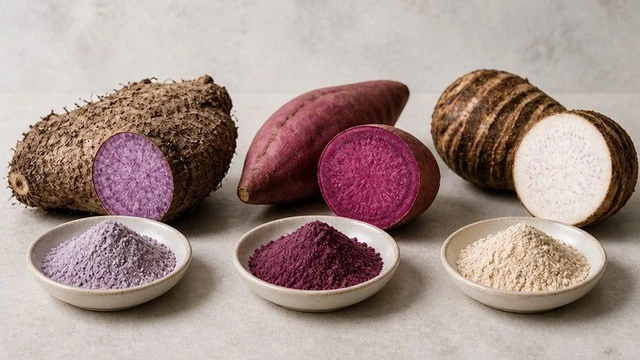
Most critically for quality control teams, genuine culinary taro flesh possesses virtually no native purple anthocyanins. Commercial taro powder that displays an intense, vibrant violet hue in dry form indicates the addition of certified artificial colorants (typically FD&C Red No. 40 and Blue No. 1) or blended purple sweet potato filler, both of which trigger regulatory non-compliance in Clean Label product architectures.
| Quality Parameter | Pure Ube Powder | Purple Sweet Potato | Commercial Taro Powder |
|---|---|---|---|
| Botanical Species | Dioscorea alata | Ipomoea batatas | Colocasia esculenta |
| Plant Family | Dioscoreaceae (Yam) | Convolvulaceae | Araceae (Arum) |
| Endogenous Pigments | Acylated Cyanidin Glycosides | Peonidin & Cyanidin Complexes | Non-pigmented Starch Flesh |
| Raw Dry Color (100 mesh) | Muted Pale Lilac-Gray | Reddish Magenta-Brown | Off-White / Beige Cream |
| Hydrated Pigment Hue | Saturated Royal Violet | Warm Plum Red / Magenta | Grayish Beige (Artificially Dyed) |
| Native Flavor Tone | Vanilla, Sweet Cream, Nutty | Baked Caramel, Dense Sweet | Earthy Root, Starchy Astringent |
2. Flavor Profiles & Sensory Reality: Authentic Vanilla-Nut Notes vs. Earthy Caramel Undertones
Ingredient formulators frequently report that pilot production batches fail consumer sensory panels despite matching targeted spectrophotometer color values. This failure typically traces back to unverified tuber substitution. Substituting purple sweet potato for authentic Ube alters the volatile aromatic baseline of the food matrix.
Gas Chromatography Profiling & Top-Note Volatiles
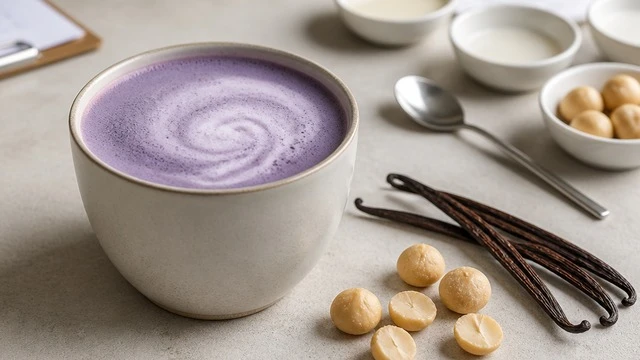
Authentic Dioscorea alata delivers a naturally mild, delicate aromatic bouquet characterized by subtle Madagascar vanilla, sweet cream, and toasted macadamia nut notes. Gas chromatography-mass spectrometry (GC-MS) profiles of processed Ube pulp reveal significant concentrations of trace lactones, ionone derivatives, and maltol-precursor compounds.
Because its flavor profile lacks aggressive vegetal pungency, pure Ube integrates smoothly with dairy cream, coconut milk, oat milk, and delicate confectionery ganache without clashing with background stabilizers.
In stark contrast, purple sweet potato (Ipomoea batatas) carries high endogenous beta-amylase activity. During commercial steaming and thermal drying, starch fractions convert rapidly into free maltose and caramelized furfural compounds. The resulting powder exhibits a pronounced "baked root vegetable" and caramelized molasses taste. When injected into chilled beverage emulsions, artisan gelatos, or fine dessert glazes, this heavy sweet potato note overpowers delicate flavor systems, creating a heavy, discordant mouthfeel.
Taro (Colocasia esculenta) introduces a third distinct sensory axis: a pronounced earthy, starchy root profile with lingering nutty astringency. Raw taro also carries calcium oxalate raphide crystals that must be thoroughly inactivated through thermal processing to avoid pharyngeal irritation.
For commercial brand owners seeking a genuine Asian-Pacific flavor profile, sourcing authentic pure Ube powder (Dioscorea alata) is essential to eliminate artificial ethyl-vanillin additives while achieving a rounded, authentic top note.
3. Rheology & Processing Physics: Starch Water-Absorption, Pasting Temperature, and Gluten Interaction
In industrial bakeries, RTD bottling facilities, and dry-mix blending plants, dry tuber powders must be evaluated as functional hydrocolloidal systems rather than simple inert coloring agents. The molecular architecture of tuber starches directly dictates batch viscosity, hydration speed, and shelf-life texture.
| Rheological Attribute | Pure Ube Powder | Purple Sweet Potato | Native Taro Powder |
|---|---|---|---|
| Amylose Content (% dry starch) | 21.0% - 24.5% | 15.0% - 18.5% | 12.0% - 14.5% |
| Cold Water Swelling Ratio (g/g) | 3.2 - 4.1 | 5.8 - 7.2 (Aggressive) | 2.8 - 3.5 |
| Pasting Peak Temperature | 78.5°C - 82.0°C | 69.0°C - 73.5°C | 72.0°C - 76.0°C |
| Gel Retrogradation Tendency | Moderate / Stable Network | High Starch Stiffening | Rapid Syneresis Risk |
| Freeze-Thaw Syneresis Loss (%) | ≤ 4.5% | ≥ 11.2% | ≥ 9.8% |
High-Hydration Pastry & Laminated Dough Workflows
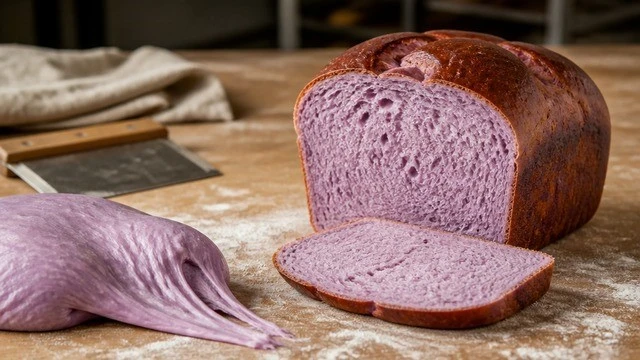
When added to high-speed bakery dough mixers, purple sweet potato powder exhibits aggressive hydrophilic affinity, pulling up to 7.2 times its dry weight in water away from developing wheat gluten matrices. If formulas are not adjusted with supplementary water, the dough suffers incomplete gluten network development, causing collapsed crumb structures and accelerated staling.
Pure Ube powder demonstrates a balanced cold-water swelling ratio (3.2–4.1 g/g). Its amylose-to-amylopectin ratio supports steady hydration alongside flour proteins, preserving dough elasticity, oven spring, and tender crumb grain.
Thermal Pasting & Emulsion Suspension in Beverages
For ready-to-drink (RTD) plant-based lattes and dairy formulations, pure Ube starch displays a relatively high pasting temperature onset (78.5°C–82.0°C). Under standard high-temperature short-time (HTST) passes, Ube particles swell without early premature gelatinization, preventing pipe-fouling viscosity spikes. When dispersed at 80–120 mesh particle sizes and paired with micro-dosed hydrocolloids (0.03%–0.05% high-acyl gellan gum), Ube forms a stable, non-gritty suspension that resists sedimentation.
4. B2B Authentication & Quality Verification Protocol: How to Screen Adulteration & Synthetic Dyes
Due to yield differentials and harvest cycles, farm-gate pricing for authentic Philippine and Southeast Asian Dioscorea alata yams is regularly 2.5 to 4 times higher than industrial purple sweet potatoes. This cost gap creates significant economic incentives for unethical raw material dilution.
The Proven 4-Tier Raw Material Screening Protocol:
- The Spectrophotometric pH Differential Test: Genuine Ube anthocyanins exhibit a reversible bathochromic shift. In an aqueous solution buffered to pH 3.0, the color presents as a soft pinkish-violet; when adjusted to pH 7.0–8.0, it shifts toward slate blue-green. In contrast, synthetic dyes such as FD&C Red No. 40 and Blue No. 1 remain chemically unresponsive to pH variations, preserving static artificial violet tones across acidic and alkaline buffers.
- Polarized Starch Granule Morphometry: Under polarized light microscopy, Dioscorea alata starches present as elongated, ovate-to-triangular granules (20–45 μm) featuring distinct eccentric hila. Ipomoea batatas starches appear smaller (10–25 μm) and predominantly spherical with central stellate fissures. Taro starch granules are exceptionally minute (2–5 μm) and densely polygonal.
- High-Performance Thin-Layer Chromatography (HPTLC): Provides definitive botanical fingerprint identification against certified reference standards, detecting unannounced sweet potato or maltodextrin blending even at threshold concentrations under 5%.
- Third-Party Laboratory Contaminant Verification: Strict compliance monitoring for heavy metal thresholds (Lead ≤ 1.0 mg/kg, Arsenic ≤ 0.5 mg/kg, Cadmium ≤ 0.2 mg/kg, Mercury ≤ 0.1 mg/kg) and multi-screen pesticide residue screening adhering to EU Regulation (EC) No 396/2005 and US FDA standards.
Third-Party Quality Verification: Authentic Batch SGS Test Report (Page 1 Excerpt)

Official third-party SGS screening covering heavy metals (Pb, As, Cd, Hg), microbiological parameters, and multi-residue pesticide limits. Verified laboratory COA documents are attached to every commercial export shipment.
5. Sourcing Matrix & Turnkey Manufacturing: Choosing the Right Purple Tuber for Your Product Line
Selecting the ideal purple tuber powder depends directly on the commercial target: fine pastry, plant-based dairy, frozen desserts, or bulk functional dry mixes.
| Formulation Scenario | Preferred Ingredient | Recommended Specification | Key Processing Note |
|---|---|---|---|
| Artisan Bakery & Brioche | Pure Ube Powder | 80-100 Mesh, Raw Dry Powder | Pre-blend with base flour; stable hydration |
| Commercial Soft Serve & Gelato | Micro-milled Pure Ube | 120-200 Mesh, Spray Dried | Pre-hydrate at 60°C–65°C in warm liquid phase |
| Budget Extruded Snacks | Purple Sweet Potato | 60-80 Mesh, Drum Dried | Monitor Maillard browning; cost-efficient volume |
| RTD Milk Teas & Instant Lattes | Pure Ube / Custom Premix | Instantized Cold-Dispersible | Include buffer salts (pH 5.4–5.8) for purple bloom |
| Clean-Label Confectionery | Pure Ube Extract Powder | Water-soluble Anthocyanin | Direct replacement for FD&C synthetic colorants |
Application A: Commercial High-Yield Bakery
- Base Flour Blend (11.5% protein): 100.0 kg
- Pure Ube Powder (80-100 mesh): 5.0 - 8.0 kg
- Supplemental Water Hydration: +3.5 kg per kg ube
- Ascorbic Acid / Tartaric Buffer: 0.12 kg (pH 5.4)
- Target: Uniform crumb cell porosity, vibrant crust contrast
Application B: Barista RTD Premix Base
- Instantized Pure Ube Powder: 18.0 kg
- Spray-Dried Coconut Milk Powder: 35.0 kg
- Agglomerated Oat Flour / Maltodextrin: 25.0 kg
- High-Acyl Gellan / Dipotassium Phosphate: 0.45 kg / 0.80 kg
- Target: Cold-water dispersibility, smooth suspension release
6. Frequently Asked Questions (Formulator & Procurement FAQ)
Q1: Can purple sweet potato powder directly replace ube powder in a 1:1 ratio?
A: No. Purple sweet potato exhibits a significantly higher cold-water swelling ratio (up to 7.2 g/g) and a strong caramelized molasses flavor. A 1:1 replacement will dehydrate gluten structures in bakery dough and overpower delicate vanilla notes with an intense sweet potato aroma.
Q2: Why does commercial taro powder often look bright purple if taro flesh is white?
A: Real taro (Colocasia esculenta) contains no native purple anthocyanins. Commercial taro powders displaying bright electric purple are almost universally blended with synthetic dyes (FD&C Red 40 and Blue 1) or secondary sweet potato carriers, presenting major labeling compliance risks for clean-label brands.
Q3: How do we prevent natural ube baked goods from turning greenish-gray?
A: Genuine ube anthocyanins are natural pH indicators that shift to blue-green above pH 6.2. In commercial bakery formulas, buffer the baking powder system by replacing alkaline leavening agents with calcium acid pyrophosphate (SAPP) or cream of tartar to maintain internal crumb pH between 5.2 and 5.6.
Q4: What third-party testing parameters should we require on our batch COA?
A: A verified B2B import COA must confirm botanical identity via HPTLC fingerprinting, heavy metal thresholds (Lead ≤ 1.0 mg/kg, Arsenic ≤ 0.5 mg/kg), microbiological clearance (BAM criteria), and multi-screen pesticide residue compliance (EU Reg 396/2005).
7. Turnkey Technical Support & Commercial Sourcing
For regional food manufacturers, commercial bakery workshops, and growing beverage brands, sourcing raw ube powder presents frustrating operational extremes: multinational ingredient conglomerates demand 5-to-10-ton minimums with months of bureaucratic auditing, while local spot-market brokers charge steep markups on repacked bags lacking analytical documentation.
Haoze Bio bridges this divide directly, serving as a dedicated factory-direct manufacturing partner for medium-scale commercial runs (ordering 25 kg to 100 kg per batch):
- 100% Dioscorea alata Botanical Guarantee: Batch-traceable raw material sourcing verified against unannounced sweet potato or maltodextrin dilution.
- 25 kg Fiber Drum Packaging with Dual Poly-Liners: Heavy-duty industrial drums with hermetic, heat-sealed food-grade PE moisture barriers, eliminating humidity absorption and starch clumping during transit.
- Batch-Specific Analytical COAs: Every commercial shipment includes complete lot verification for mesh fineness (80鈥?00 mesh >98%), moisture content (≤7.0%), heavy metal limits, and zero synthetic dye adulteration.
- Complimentary Pilot R&D Samples: 20 g to 50 g trial samples dispatched directly to customer culinary labs for benchtop freezing trials prior to volume commitments.
Request Commercial Evaluation Samples & Full SGS Batch COA
Xi'an Haoze Biotechnology Co., Ltd supplies verified botanical powders and customized formulation solutions for commercial food processors. Contact our technical team for application protocols, trial samples, or wholesale inquiries:
Official Technical Inquiry: info@haoze-bio.com
Scientific References & Analytical Benchmarks
- Matsuda, T., et al. (2020). Acylated anthocyanins from purple yam (Dioscorea alata L.) and their comparative color stability against brassica pigments in food matrices. Journal of Agricultural and Food Chemistry, 68(22), 6145-6153.
- Moorthy, S. N. (2002). Physicochemical and functional properties of tropical tuber starches: A review. Starch/Stärke, 54(12), 559-592.
- Cevallos-Casals, B. A., & Cisneros-Zevallos, L. (2004). Stability of anthocyanin-based aqueous extracts of Andean purple corn and red-fleshed sweet potato. Food Chemistry, 86(1), 69-77.
- European Commission. (2013). Guidance notes on the classification of food extracts with colouring properties. Standing Committee on the Food Chain and Animal Health (SCoFCAH), Version 1.0, 1-22.
- Srichuwong, S., et al. (2005). Starches from different botanical sources II: Contribution of amylopectin fine structure to thermal and pasting properties. Carbohydrate Polymers, 60(4), 529-538.