


Coconut Beverage Formulation Summary: Commercial coconut milk powder can add the creamy body that a plant-based latte needs, but the wrong carrier system may introduce milk-derived caseinate, while direct cold mixing can leave clumps or a surface oil ring. This guide explains how to assess fat level, carrier declaration, reconstitution method, and botanical pairings such as Ube, Matcha, and Taro before scaling a beverage concept.
1. Why Is Commercial Coconut Milk Powder Often Not Truly Dairy-Free? (The Caseinate Dilemma)
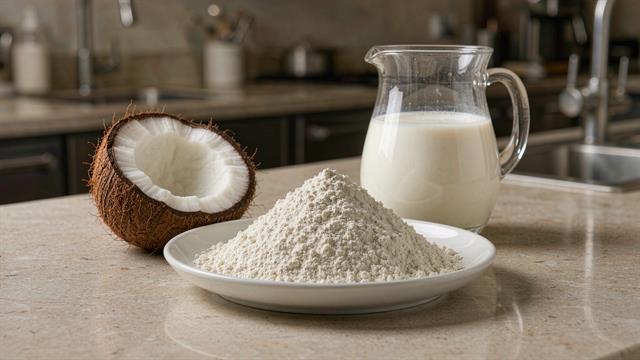
In the global plant-based and barista sectors, coconut milk powder is specified as the foundational dairy-free creaming agent. Yet commercial buyers reviewing supplier specifications frequently encounter a costly regulatory paradox: powders marketed broadly as "coconut powder" often carry allergen warnings for milk derivatives.
Raw coconut milk extracted from mature coconut endosperm (Cocos nucifera) is a natural oil-in-water emulsion comprising 30% to 40% water and 50% to 55% fat on a dry basis, alongside native carbohydrates and a modest 2% to 3% protein fraction. During industrial spray drying, dehydrating high-fat droplets presents an immediate engineering barrier: coconut fat has a low melting threshold (approximately 24°C to 26°C). Without an effective encapsulating wall material and surface-active emulsifier, atomized droplets deposit onto the drying chamber walls as an unrecoverable, sticky molten paste.
To overcome this, commodity manufacturers routinely introduce sodium caseinate (a milk-derived protein) at 1% to 3% inclusion rates alongside maltodextrin. Sodium caseinate migrates rapidly to the oil-water interface, lowering interfacial tension and forming a robust viscoelastic steric barrier that prevents droplet coalescence during spray atomization.
While technologically efficient for commodity coffee whiteners, this processing aid destroys the product's vegan and dairy-free status. For clean-label and functional beverage brands exporting to North America, the European Union, and the Gulf region, importing a coconut powder containing undeclared or declared sodium caseinate introduces severe regulatory risk, including mandatory allergen labeling under FALCPA, costly cross-contamination recalls, and immediate loss of vegan certification.
A true clean-label procurement specification decouples high-fat encapsulation from animal proteins. By pairing native coconut fat with hypoallergenic plant polysaccharides-specifically non-GMO tapioca starch, hydrolysed plant dextrins, or native acacia gum-specialized spray-drying facilities achieve robust emulsion encapsulation while maintaining absolute dairy-free compliance.
2. How Does Fat Content (60%–65% vs. Low-Fat Formats) Dictate Emulsion & Mouthfeel?
Specifying coconut milk powder requires aligning the fat fraction with the target beverage's hydrodynamic structure and serving temperature. Commercial grades are divided into two primary functional tiers:
- Full-Fat Creamer Grade (60%–65% Fat): Mirrors the organoleptic profile of heavy coconut cream. The lipid profile is heavily dominated by medium-chain saturated fatty acids (MCFAs), predominantly lauric acid (C12:0, representing roughly 48% to 50% of total fatty acids), accompanied by myristic acid (C14:0) and caprylic/capric acids (C8:0/C10:0). Lauric acid triglycerides provide an immediate melting sensation on the palate without the greasy aftertaste associated with hydrogenated palm oils. Best suited for ready-to-drink (RTD) barista bases, premium coconut lattes, and vegan dessert blends requiring rich opacity and velvety coating.
- Low-Fat Dispersible Grade (25%–35% Fat): Standardized by blending pressed coconut milk with higher ratios of soluble plant carriers prior to atomization. Yields a lighter, refreshing viscosity with minimal surface oil release, functioning primarily as a flavor-and-clouding agent for instant powdered fruit teas, hydration powders, and functional protein blends where excessive fat fractions could hinder cold rehydration or exceed calorie budgets.
| Functional Attribute | Full-Fat Grade (60%–65% Fat) | Low-Fat Dispersible (25%–35% Fat) | Commodity Whitener (Blended) |
|---|---|---|---|
| Total Fat (Dry Basis) | 60.0% – 65.0% | 25.0% – 35.0% | 40.0% – 50.0% |
| Protein & Carrier System | Tapioca / Plant Polysaccharide | Soluble Maltodextrin / Plant Fiber | Sodium Caseinate (1%–3%) + Glucose |
| Dairy Allergen Status | 100% Dairy-Free / Non-Dairy | 100% Dairy-Free / Non-Dairy | Contains Milk Protein (Casein) |
| Solubility in 50°C Water | ≥ 95% (Rich milk state) | ≥ 98% (Instant clear-to-cloudy) | ≥ 98% (Engineered quick-dissolve) |
| Viscosity in 10% Solution | Medium-Heavy, Velvety | Light, Water-like | Medium, Emulsified |
| Primary Commercial Use | Barista latte bases, clean-label premixes | Vending, instant blends, dry tea mixes | Low-cost commodity coffee creamers |
3. Why Does Coconut Milk Powder Clump in Cold Shakers - and How to Overcome Free-Oil Bloom?
In busy commercial café environments and pilot formulation kitchens, prep staff frequently report that adding raw coconut milk powder directly to iced espresso, chilled cold brew, or iced shakers results in stubborn, hydrophobic agglomerates ("dough balls") and an unsightly surface sheen of solidified fat droplets.
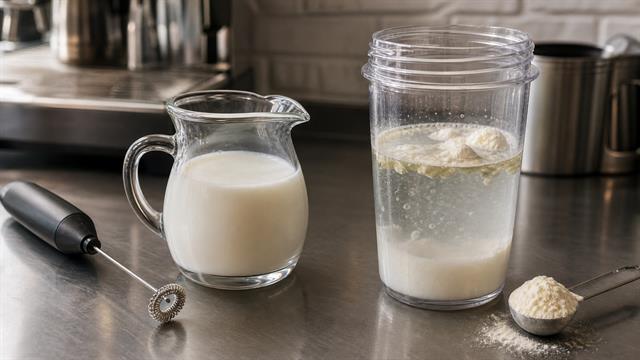
This behavior is governed by the physical chemistry of coconut triglycerides:
- The Phase Transition Barrier: Coconut fat crystallizes below 24°C. When dry powder hits cold liquid (4°C to 10°C), the lipid fraction instantly solidifies into rigid, water-repellent crystalline domains on the particle surface, preventing water from penetrating the internal carbohydrate carrier matrix.
- Stokes' Law and Interfacial Tension: Without mechanical shear or sufficient interfacial stabilization, unencapsulated surface fat globules rapidly coalesce upon hydration. Because coconut oil has a lower density (approximately 0.92 g/cm³) than the surrounding aqueous serum, free fat droplets migrate upward, creating an oily surface ring ("oiling-off" or fat bloom) that degrades the drink's sensory presentation.
The Barista Master-Batch Solution: Two-Step Thermal Slurry
Commercial beverage operators and RTD formulators resolve this without synthetic polysorbates through a standardized two-step reconstitution protocol:
- Thermal Activation Stage (Hydration & Melting): Disperse coconut milk powder into warm water (45°C to 55°C) at a 1:3 or 1:4 weight ratio (powder to water). At this temperature, the lauric fat fraction transitions fully to a liquid state, allowing the plant polysaccharide wall material to dissolve and re-establish a stable, protective hydration shell around each fat droplet.
- High-Shear Stabilization: Agitate the slurry for 60 to 90 seconds using an immersion blender, commercial bar blender, or inline rotor-stator mixer. The shear forces reduce average fat droplet diameter below 2 to 3 µm.
- Cold Let-Down Stage: Once homogenized, this master slurry can be chilled to 2°C to 6°C and stored for up to 48 hours under refrigeration. It incorporates seamlessly into cold-shaken drinks, iced teas, and cold brews with zero clumping, zero graininess, and a velvety micro-foam that lasts until the cup is finished.
4. What Botanical Ingredients Synergize Best with Coconut Milk Powder? (The Beverage Matrix)
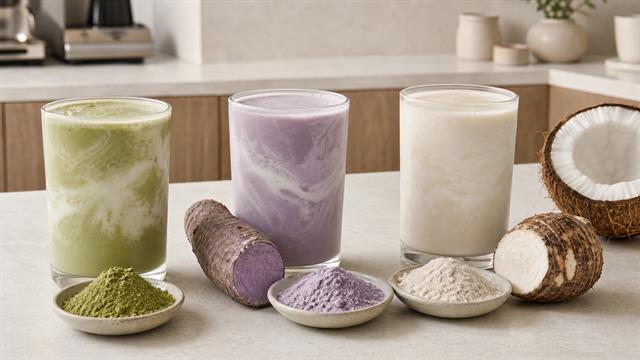
Because coconut milk powder provides a clean, neutral plant lipid matrix enriched with natural sweet notes, it acts as an ideal flavor carrier, bitterness suppressor, and texture anchor across modern beverage menus. Pairing pure botanical powders with a clean-label coconut base unlocks three major beverage categories:
1. Coconut Ube Latte (The Violet Velvet Paradigm)
Pure purple yam powder (authentic ube powder derived from Dioscorea alata) delivers visual drama through acylated anthocyanins but contains under 1% lipid. Introducing 60% fat coconut milk powder supplies the missing lipid phase: lauric fat globules coat the tongue, softening the starch profile and prolonging the roasted vanilla-nut aroma while creating an opaque milky-lavender canvas without synthetic dyes.
2. Barista-Grade Coconut Matcha (The Polyphenol-Lipid Balance)
Green tea powders (pure ceremonial matcha powder) are prized for chlorophyll and L-theanine, but tea catechins (EGCG) bring astringency. Whisked into a coconut milk base, lipid micelles physically interact with tea polyphenols, mitigating astringent receptor binding on the tongue while preserving aroma. Coconut's natural sweetness eliminates added sugar syrups for a true clean-label green latte.
3. Pure Taro & Coconut Comfort Tea (The Authentic Asian Profile)
Traditional Asian café menus rely heavily on the pairing of taro and coconut. Formulating with 100% pure taro powder (Colocasia esculenta) delivers earthy-biscuit depth and smooth starch viscosity, while bulk coconut milk powder supplies essential fat creaminess. This combination recreates the classic Southeast Asian dessert profile with a strictly declared two-ingredient plant base.
4. Cold-Brew & RTD Emulsion Stability
For packaged ready-to-drink formulations stored under refrigeration (2°C to 8°C), pairing 60% fat coconut milk powder with low-inclusion gellan gum or native citrus fiber builds a weak colloidal network. This prevents gravitational creaming of lipid globules and holds suspended botanical starches in place for extended commercial shelf stability.
5. What Quality Parameters Must Appear on a Serious Coconut Milk Powder COA?
Because coconut milk powder carries a substantial lipid load, quality assurance protocols must evaluate both microbiological safety and oxidative stability. High moisture levels combined with elevated ambient temperatures can trigger enzymatic hydrolysis and free radical auto-oxidation, generating foul-smelling ketones and soapy aldehydes.
COA parameters issued with Haoze Bio commercial shipments:
| COA Parameter | Specification | Notes & Regulatory Relevance |
|---|---|---|
| Botanical Source | 100% Cocos nucifera Endosperm | Extracted from fresh, mature coconut meat |
| Total Fat Content (Dry Basis) | 60.0% – 65.0% | Solvent extraction / Soxhlet determination |
| Carrier System | Tapioca Starch / Non-GMO Dextrin | 100% Plant-derived wall material |
| Dairy Allergens (Sodium Caseinate) | Not Detected (Negative) | Validated by ELISA / PCR testing per export lot |
| Moisture Content | ≤ 2.5% | Karl Fischer titration; limits fat hydrolysis & caking |
| Free Fatty Acids (as Lauric Acid) | ≤ 0.20% | Marker of fresh kernel processing; limits rancidity |
| Peroxide Value (POV) | ≤ 2.0 meq/kg | Primary lipid oxidation index; guarantees freshness |
| Particle Mesh Size | 80–120 Mesh (≥ 98% pass) | Optimized for rapid rehydration without grittiness |
| Heavy Metals | Pb ≤ 0.5 · As ≤ 0.2 · Cd ≤ 0.1 · Hg ≤ 0.05 mg/kg | Strict compliance with EU No 2023/915 and US FDA limits |
| Total Plate Count (TPC) | ≤ 5,000 CFU/g | Low bio-burden spray-drying sanitary control |
| Yeast & Mold | ≤ 50 CFU/g | Critical for dry blend and RTD shelf life |
| Pathogens (E. coli, Salmonella) | Negative in 25 g | Standard international food safety clearance |
| Shelf Life & Storage | 18–24 Months | Sealed in multi-layer barrier foil liners |
6. How Growth-Stage Beverage Brands Can Scale from Pilot Trials to Drum-Level Sourcing
For emerging beverage brands, regional café chains, and contract packaging formulators, raw material procurement often presents an operational bottleneck. Traditional agricultural commodity exporters enforce rigid container-load minimum order quantities (MOQs) and provide minimal technical documentation, while local retail distributors impose steep markups on unstandardized, repackaged powders.
Haoze Bio bridges this divide through an agile, technical manufacturing and supply architecture:
- Benchtop Formulation Sampling: We support R&D and culinary labs with verified sample lots (100g to 500g) accompanied by complete technical dossiers, enabling accurate cost-in-use modeling, shelf-life testing, and cold-dispersion trials before commercial commitments are made.
- Pilot-Scale Validation (10 kg to 25 kg): Transition smoothly into commercial test-market runs or regional store rollouts without tying up operational working capital in pallet-scale inventory.
- Tailored Packaging & Barrier Protection: Because high-fat coconut powder is sensitive to oxygen, ambient humidity, and thermal spikes during ocean freight, all commercial goods are packaged in food-grade, multi-layer aluminum barrier foil liners, with optional vacuum or nitrogen purging to ensure pristine arrival across challenging freight lanes.
- Comprehensive Export Documentation: Every consignment leaves our facility with lot-specific Certificate of Analysis (COA), Certificate of Origin (COO), and internationally accredited Halal and Kosher certifications as standard compliance documentation for rapid customs clearance across North American, European, and Middle Eastern entry ports.
Start With a Documented Pilot Batch
Send your target drink format, serving temperature, and required certificates to our technical team. We will return sample options, incoming-screening protocols, and a route-quoted landed-cost estimate for your review-no container commitments required to start.
Technical Formulation Support: info@haoze-bio.com
References
- Tangsuphoom, N., & Coupland, J. N. (2005). Effect of heating and homogenization on the stability of coconut milk emulsions. Journal of Food Science, 70(8), e466–e470. doi.org/10.1111/j.1365-2621.2005.tb11516.x
- Tangsuphoom, N., & Coupland, J. N. (2008). Effect of surface-active stabilizers on the microstructure and stability of coconut milk emulsions. Food Hydrocolloids, 22(7), 1233–1242. doi.org/10.1016/j.foodhyd.2007.08.005
- Patil, U., & Benjakul, S. (2018). Coconut milk and coconut oil: their manufacture, properties and food applications. Journal of Food Science and Technology, 55(4), 1207–1218. doi.org/10.1007/s13197-018-3069-4
- Simuang, J., Chiewchan, N., & Tansakul, A. (2004). Effects of fat content and temperature on the apparent viscosity of coconut milk. Journal of Food Engineering, 64(2), 193–197. doi.org/10.1016/j.jfoodeng.2003.09.032
- Peamprasart, T., & Chiewchan, N. (2006). Effect of fat content and preheating on the thermal behavior and stability of spray-dried coconut milk emulsion. Food and Bioproducts Processing, 84(C4), 312–318. doi.org/10.1205/fbp06018
- Bhandari, B. R., Senoussi, A., Dumoulin, E. D., & Lebert, A. (1993). Spray drying of concentrated fruit juices. Drying Technology, 11(5), 1081–1092. doi.org/10.1080/07373939308916884
- Kaushal, P., Kumar, V., & Sharma, H. K. (2015). Utilization of taro (Colocasia esculenta): a review. Journal of Food Science and Technology, 52(1), 27–40. doi.org/10.1007/s13197-013-0933-y
- Tamaroh, S., & Purwani, T. (2023). Chemical and functional properties of preparation before drying purple yam flour (Dioscorea alata L.). AIP Conference Proceedings, 2596, 040027. doi.org/10.1063/5.0119218
- Food and Drug Administration (FDA). (2023). Food Allergen Labeling and Consumer Protection Act of 2004 (FALCPA). Compliance Policy Guide Sec. 555.250 Major Food Allergens. U.S. Department of Health and Human Services.
- Codex Alimentarius Commission. (2019). Standard for Aqueous Coconut Products - Coconut Milk and Coconut Cream (CXS 240-2003, Amended 2019). Joint FAO/WHO Food Standards Programme.