


Formulator's Direct-Answer Takeaway: To formulate a stable, dairy-like plant beverage base without artificial emulsifiers or dairy allergens, specify a spray-dried coconut milk powder standardized to 60%–65% fat encapsulated in non-GMO tapioca starch or native acacia fiber. Avoid commodity coffee whiteners stabilized with sodium caseinate (milk derivative). In cold-beverage service, eliminate clumping and free-oil ringing by employing a two-step warm rehydration master slurry (45°C–55°C at 1:3 ratio with mechanical shear) or pairing with 0.10%–0.20% cold-swelling guar gum for stable ambient suspension.
1. The Dairy Allergen Trap: Why Commercial Coconut Milk Powder Often Fails Vegan Audits
In the rapidly expanding plant-based beverage and specialty café sector, coconut milk powder is widely treated as the foundational non-dairy creaming ingredient. However, R&D formulators and commercial procurement teams reviewing supplier technical data sheets frequently encounter an unexpected barrier: powders marketed as "coconut powder" carrying declared allergen warnings for milk derivatives.
Raw coconut milk pressed from mature coconut endosperm (Cocos nucifera) is a natural oil-in-water emulsion consisting of roughly 50% water, 35%–40% fat, 9%–11% non-fat solids, and approximately 3% native protein. During industrial spray drying, atomizing and dehydrating high-fat droplets presents an immediate thermal hurdle: coconut fat possesses a low melting threshold (approximately 24°C to 26°C). Without an effective encapsulating wall material, atomized lipid droplets adhere to drying tower walls as a sticky, unrecoverable molten residue.
To overcome chamber sticking at minimum processing cost, commodity ingredient manufacturers routinely add sodium caseinate (a milk-derived protein fraction) at 1% to 3% inclusion levels alongside glucose syrup or maltodextrin. Sodium caseinate migrates rapidly to the oil-water droplet interface, forming a steric viscoelastic film that prevents droplet coalescence during spray atomization.
While effective for mass-market coffee creamers, this practice disqualifies the ingredient from vegan, dairy-free, and kosher pareve product formulations. For brands distributing in North America and Europe, importing powders with undeclared milk proteins risks severe regulatory consequences under the Food Allergen Labeling and Consumer Protection Act (FALCPA) and EU Regulation 1169/2011, including product recalls and lost commercial certifications. A true clean-label specification replaces dairy proteins with hypoallergenic plant polysaccharides-such as non-GMO tapioca starch, pea protein isolates, or native acacia fiber-ensuring 100% dairy-free integrity.
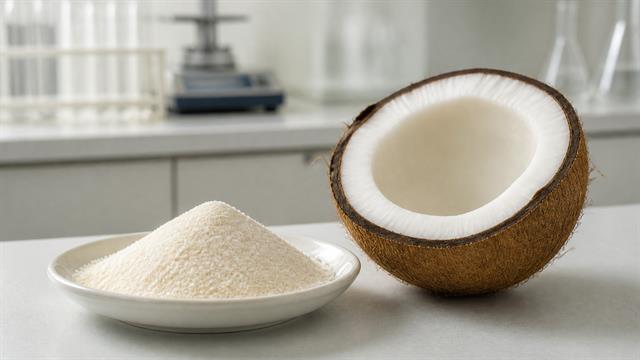
Microencapsulation & Wall Material Architecture
During industrial spray atomization, low-melting coconut fat droplets must be microencapsulated within a protective polysaccharide matrix to prevent chamber adhesion and ambient oxidation.
Specifying non-GMO tapioca dextrin or native acacia fiber delivers complete dairy-free compliance while maintaining free-flowing powder granularity without milk-derived sodium caseinate.
2. Fat Content Architecture: Comparing 60%–65% Full-Fat Creamer vs. Low-Fat Formats
Selecting the appropriate coconut milk powder grade requires balancing lipid mouthfeel with reconstitution physics and finished beverage nutritional profiles. Commercial food manufacturers categorize spray-dried coconut powders into two principal grades:
- Full-Fat Barista Grade (60%–65% Fat): Recreates the unctuous body and rich mouth-coating of fresh culinary coconut cream. The lipid fraction is naturally rich in medium-chain triglycerides (MCTs), predominantly lauric acid (C12:0, representing 48% to 52% of total fatty acids), accompanied by myristic (C14:0) and caprylic/capric acids. Lauric acid provides a clean, fast-melting sensation on the tongue without the waxy or greasy aftertaste typical of hydrogenated vegetable fats. Best suited for ready-to-drink (RTD) latte bases, premium coconut milk tea, dairy-free ice cream mixes, and keto functional creamers.
- Low-Fat Dispersible Grade (25%–35% Fat): Produced by blending cold-pressed coconut milk with higher ratios of soluble plant carriers prior to dehydration. This format provides mild coconut aroma with a lighter, water-thin beverage viscosity. Ideal for instant powdered drink mixes, protein shakes, and vending formulations where excessive dietary fat could impair shelf flowability or exceed macronutrient calorie targets.
| Technical Parameter | Full-Fat Barista Grade (60%–65%) | Low-Fat Dispersible (25%–35%) | Commodity Dairy-Blended Creamer |
|---|---|---|---|
| Total Fat (Dry Basis) | 60.0% – 65.0% | 25.0% – 35.0% | 45.0% – 52.0% |
| Carrier & Wall System | Non-GMO Tapioca Dextrin / Acacia | Soluble Corn/Tapioca Maltodextrin | Sodium Caseinate (1%–3%) + Glucose Syrup |
| Dairy Allergen Status | 100% Dairy-Free / Vegan | 100% Dairy-Free / Vegan | Contains Milk Derivatives |
| Reconstitution Behavior | Emulsified, opaque milk state | Fast dissolving, translucent cloud | Instant solubility in hot liquids |
| Recommended Usage | Raw coconut latte, vegan creamers, desserts | Vending, instant iced teas, protein premixes | Standard commercial coffee whitener |
3. Physical Chemistry of Clumping and Oiling-Off: The Commercial Reconstitution Solution
A common technical complaint from commercial café managers and beverage development labs is that adding high-fat coconut milk powder directly into cold liquid (e.g., iced water, cold brew, or chilled plant milk) causes immediate lumping and a floating oily film. This phenomenon is governed by the physical crystallization behavior of coconut triglycerides:
- Thermal Phase Inversion: Coconut fat crystallizes sharply between 20°C and 24°C. When dry powder is dropped into chilled water (4°C to 10°C), surface triglycerides solidify instantaneously into a hydrophobic, wax-like boundary layer. This barrier repels water penetration and traps unhydrated core powder into resilient "fish-eye" agglomerates.
- Stokes' Creaming and Oil Bloom: Unencapsulated surface free fat droplets rapidly coalesce when shear is insufficient. Because coconut oil has a lower density (ρ ≈ 0.92 g/cm³) than the surrounding water phase, oil droplets rapidly rise to the surface, creating an unappealing oily sheen ("oiling-off") and greasy mouthfeel.
Commercial beverage facilities and high-volume specialty beverage bars overcome this physical barrier without synthetic additives through a standardized Two-Step Thermal Slurry Protocol:
Standard Operating Procedure: Café Master-Batch Preparation
Step 1: Thermal Pre-Hydration (1:3 Ratio)
Disperse 250 g of 60% fat coconut milk powder into 750 g of warm filtered water heated to 45°C–55°C. At this temperature, crystalline lauric triglycerides melt fully into a fluid state, allowing the plant polysaccharide wall to hydrate uniformly and re-establish a stable protective hydration mantle around each oil droplet.
Step 2: Mechanical High-Shear Blending
Mix the warm slurry for 60 to 90 seconds using an immersion commercial blender or high-speed bar blender. This mechanical shear breaks oil droplets down to sub-3-micron diameter, maximizing emulsion stability.
Step 3: Chilling & Cold Storage
Once homogenized, chill the concentrated base to 2°C–6°C. The prepared slurry remains completely homogeneous and pourable for up to 48 hours under refrigeration, incorporating instantly into cold-shaken teas, iced lattes, and frappes with zero clumping and zero oil separation.
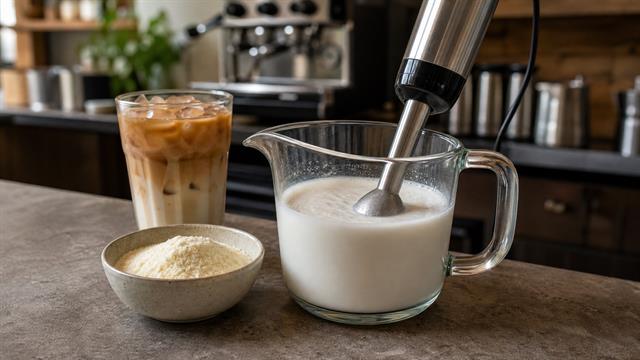
Two-Step Thermal Hydration for Barista Service
High-fat coconut milk powder requires thermal pre-hydration at 45°C–55°C to liquefy crystalline lauric triglycerides before introducing mechanical shear.
Once homogenized with an immersion wand or high-speed blender, the refrigerated master slurry remains completely pourable and cold-water miscible, eliminating in-glass clumping and surface oil ringing.
4. Botanical Synergy Matrix: Pairing Coconut Bases with Ube, Matcha, and Clean Stabilizers
Because coconut milk powder contributes a clean, mildly sweet plant-lipid base without overpowering nutty or grassy notes, it functions as an exceptional flavor carrier, astringency mask, and visual whitener across modern specialty drinks. Pairing spray-dried coconut bases with targeted botanicals creates distinct commercial product lines:
1. Raw Coconut Ube Latte (Velvet Botanical Purple)
Natural purple yam powder (pure organic ube powder from Dioscorea alata) provides vibrant acylated anthocyanin hues and earthy vanilla undertones. However, single-ingredient ube powder is lean (<1% fat), which can feel thin on the mid-palate in iced water bases.
Formulation Synergy: Incorporating 60% fat coconut milk powder introduces creamy opacity. Coconut lipid micelles soften starchy mouthfeel and extend aromatic finish, creating an opaque milky-lavender canvas that eliminates any need for artificial colorants (FD&C Red 40 or Blue 1).
2. Barista Coconut Matcha (Polyphenol Smoothing)
High-grade green tea (bulk ceremonial matcha powder) contributes rich chlorophyll color and L-theanine umami, but tea catechins (EGCG) can present sharp astringency in cold water preparation.
Formulation Synergy: Coconut fat globules complex naturally with tea catechins, buffering harsh bitterness receptors on the palate while preserving delicate fresh grass aromas. The natural sweetness of coconut fat allows cafés to market a "Zero Added Sugar" clean-label green latte.
3. Southeast Asian Style Coconut Taro Blend
Commercial beverage chains frequently rely on artificial purple syrups with chemical coconut aromas. Formulating with authentic 100% pure taro powder (Colocasia esculenta) delivers earthy biscuit body and gentle starch viscosity.
Formulation Synergy: Adding spray-dried coconut milk powder supplies essential dairy-free richness, recreating the classic coconut-taro dessert profile with clean-label transparency.
4. Hydrocolloid Stabilization: Guar Gum Anti-Settling
When botanical powders with insoluble root fiber or tea solids are blended into coconut bases, gravity-induced sediment can settle over 15–30 minutes of standing in clear take-out cups.
Formulation Synergy: Co-formulating with 0.10% to 0.20% cold-swelling guar gum powder builds a pseudoplastic fluid network that holds botanical particles in suspension without altering fresh flavor release.

Figure: Layered commercial plant-based iced lattes pairing coconut milk base with natural purple yam (ube) and ceremonial matcha green tea.
5. Commercial Quality Benchmarks: What Must Appear on a Serious Coconut Milk Powder COA
Because spray-dried coconut milk powder carries a substantial lipid concentration, quality assurance protocols must verify both microbiological hygiene and oxidative rancidity thresholds. High moisture combined with ambient storage triggers enzymatic fat hydrolysis, releasing free fatty acids that impart soapy off-flavors.
The parameters below represent standard export specification baselines provided on official batch Certificates of Analysis (COA) from Haoze Bio:
| COA Testing Parameter | Standard Specification | Technical & Quality Significance |
|---|---|---|
| Botanical Source | 100% Cocos nucifera Endosperm | Sourced exclusively from fresh, mature coconut kernel meat |
| Total Fat Content (Dry Basis) | 60.0% – 65.0% | Soxhlet extraction validation; guarantees creamy mouthfeel |
| Carrier Matrix | Non-GMO Tapioca Dextrin / Plant Starch | 100% plant-origin wall material for clean-label compliance |
| Dairy Allergen (Sodium Caseinate) | Not Detected (Negative) | Verified via ELISA testing per batch; safe for vegan labels |
| Moisture Content | ≤ 2.5% | Prevents caking, microbial growth, and lipid hydrolysis |
| Free Fatty Acids (FFA as Lauric) | ≤ 0.20% | Freshness indicator; prevents soapy off-flavors |
| Peroxide Value (POV) | ≤ 2.0 meq/kg | Direct metric of primary lipid auto-oxidation control |
| Particle Mesh Size | 80–120 Mesh (≥ 98% pass) | Fine micronization for rapid rehydration without grittiness |
| Heavy Metals | Pb ≤ 0.5 · As ≤ 0.2 · Cd ≤ 0.1 mg/kg | Strict compliance with US FDA and EU 2023/915 standards |
| Total Plate Count (TPC) | ≤ 5,000 CFU/g | Low bio-burden hygiene control throughout spray processing |
| Yeast & Mold | ≤ 50 CFU/g | Critical metric for shelf-stable powder blends |
| Pathogens (Salmonella, E. coli) | Negative in 25 g | Mandatory food safety clearance per lot |
*Note: Detailed batch-specific Certificate of Analysis is issued with every commercial consignment based on pre-shipment sampling.
6. Scaling from Pilot Formulation to Commercial Bulk Sourcing: Agile B2B Supply
For emerging beverage chains, contract manufacturing co-packers, and growing plant-based brands, scaling powder procurement often creates logistical stress. Traditional raw ingredient exporters enforce full-container minimums and provide little formulation guidance, while local retail distributors mark up repackaged powders without batch COA traceability.
Haoze Bio supports growth-stage beverage developers with an agile manufacturing and supply framework:
- R&D Benchtop Sample Validation: 100 g to 500 g verified pilot sample lots provided with complete technical dossiers, enabling precise solubility, oiling-off, and sensory evaluations before commercial scaling.
- Flexible Commercial Pilot Batches: Scalable batch volumes (25 kg trial cartons to multi-pallet shipments) designed to accommodate product launches without locking operational working capital into excess inventory.
- High-Barrier Protective Packaging: Standard commercial packing in multi-layer aluminum foil barrier bags (25 kg fiber drums or carton outers) with nitrogen flushing, preventing lipid oxidation, moisture uptake, and flavor loss across maritime freight corridors.
- Turnkey OEM & Custom Blending: Complete capability to pre-blend commercial coconut latte bases with matcha, ube, natural sweeteners, or hydrocolloids, packaged in commercial 1 kg food-service pouches or retail single-serve stick packs.
7. Frequently Asked Commercial & Technical Questions (Buyer FAQ)
Q: Why do commercial coconut milk powders often contain sodium caseinate, and can I get a 100% dairy-free certificate?
A: Coconut fat has a low melting point (24°C–26°C), making atomized droplets sticky and challenging to spray-dry. Commodity manufacturers often add 1% to 3% sodium caseinate (a milk protein) as a low-cost emulsifier. For true vegan and dairy-free formulations, Haoze Bio provides 100% plant-based coconut milk powder using non-GMO tapioca starch or acacia fiber as wall material, certified with lot-specific ELISA allergen-negative test reports.
Q: What is the primary functional difference between 60%–65% fat and low-fat coconut milk powder in drinks?
A: Full-fat grades (60%–65% fat) deliver heavy, dairy-like creaminess, natural lauric acid mouth-coating, and rich opacity, making them ideal for barista lattes, vegan creamers, and dessert premixes. Low-fat grades (25%–35% fat) offer lighter body, rapid cold solubility, and lower calorie density, best suited for instant tea mixes, protein blends, and automated beverage dispensers.
Q: How do café operators prevent clumping and oil separation in cold-shaken drinks?
A: Because coconut fat crystallizes below 24°C, direct addition of raw powder into chilled liquids causes hydrophobic agglomeration and surface oil bloom. The industry standard solution is a two-step master-batch slurry: dissolve the powder in warm water (45°C–55°C) at a 1:3 ratio with high-speed blending for 60 seconds, then chill and refrigerate for up to 48 hours for immediate iced drink service.
Q: What is the typical shelf life, packaging, and minimum trial order quantity?
A: Standard shelf life is 18 to 24 months when stored sealed in cool, dry conditions (<20°C). Products are packaged in food-grade multi-layer aluminum foil bags within 25 kg fiber drums or cartons. We support R&D sampling with 100 g to 500 g sample packs and flexible trial shipments starting at 25 kg.
Scientific References & Analytical Benchmarks
- Tangsuphoom, N., & Coupland, J. N. (2008). Effect of thermal treatments on properties of coconut milk emulsions prepared with surface-active stabilizers. Food Hydrocolloids, 22(8), 1592-1600.
- Raghavendra, S. N., & Raghavarao, K. S. M. S. (2010). Effect of different drying methods on the quality of coconut milk powder. Journal of Food Engineering, 97(2), 211-218.
- Seow, C. C., & Gwee, C. N. (1997). Coconut milk: chemistry and technology. International Journal of Food Science & Technology, 32(3), 189-201.
- Patil, U., & Benjakul, S. (2018). Coconut milk and coconut oil: their manufacture, physical properties and functional properties. Journal of Food Science and Technology, 55(3), 947-955.
Troubleshooting Plant-Based Beverage Emulsions or Sourcing Dairy-Free Coconut Powder?
Connect with Haoze Bio's technical ingredient specialists for batch COAs, sample dispatch (100g–500g), custom fat ratio blending, and private-label stick pack solutions.
Contact Haoze Bio Technical Team
Technical Formulation Email: info@haoze-bio.com