


Direct Formulation Takeaways: Commercial Feasibility at a Glance
Formulation Bottom Line: Whole organic spirulina (Arthrospira platensis) powder is not a water-soluble extract; it is an intact cellular biomass containing 60% to 70% functional protein alongside chlorophyll, phycobiliproteins, and cell wall polysaccharides. In aqueous commercial formulations, insoluble particulates naturally settle within 2 to 4 minutes following Stokes' Law.
The Commercial Solution: Stabilizing bulk spirulina in commercial ready-to-mix (RTM) dry beverage sachets or high-viscosity cold smoothies requires three concerted steps: specifying an 80 to 120 mesh particle gradient, establishing a cold-setting hydrocolloid suspension network (0.12%–0.18% Guar Gum Powder), and neutralizing volatile geosmin/hexanal off-flavors through spray-dried microencapsulated medium-chain fat carriers (Bulk Coconut Milk Powder).
Understanding Whole Algal Biomass: Why Spirulina Defies Standard Beverage Solubility
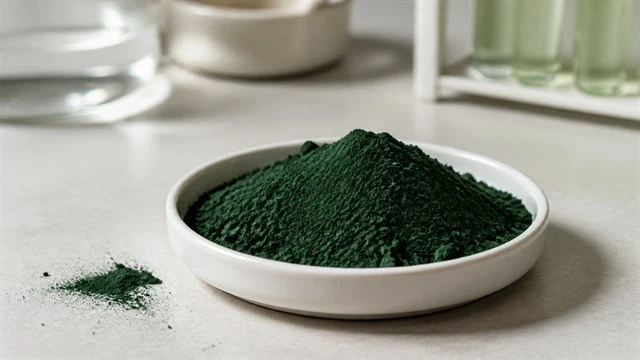
Microalgal Structure & Rehydration Behavior: Dehydrated cyanobacteria cells form dense, micro-clustered particulates ranging from 20 to 150 microns. Unlike water-soluble botanical extracts, spirulina creates an opaque colloidal dispersion. Controlled 80–120 mesh air classification ensures uniform wettability across high-speed packaging hoppers without generating friction-induced lipid oxidation.
Commercial beverage formulators transitioning from fruit juice powders or hydrolyzed botanical extracts frequently encounter unexpected rheological hurdles when piloting bulk spirulina powder. Unlike purified botanical extracts that dissolve into clear liquids, whole Organic Spirulina Powder represents dehydrated filamentous cyanobacterium. The algal cells possess a complex peptidoglycan and polysaccharide envelope encasing high-molecular-weight structural protein complexes.
When stirred into pure water, spirulina forms a colloidal suspension rather than a thermodynamic solution. Individual particles range from 20 to 150 microns depending on post-harvest milling. Without mechanical suspension aids or rheology modifiers, gravitational settlement causes rapid phase separation, leaving an unappealing dark green sediment at the bottom of customer shaker bottles or retail bottles.
At Haoze Bio, our commercial processing focuses on tight mechanical micronization and multi-stage air classification. By narrowing the particle distribution span to a consistent 80 to 120 mesh threshold without inducing localized frictional heat, we prevent premature protein denaturation and thermal agglomeration. This fine, uniform particulate sizing ensures rapid rehydration and smooth oral mouthfeel, preventing the gritty throat burn common with coarse commodity algae.
Overcoming Volatile Off-Flavors: The Biochemistry of Marine Notes and Practical Masking
The primary barrier to consumer reorder rates in commercial greens blends is sensory fatigue caused by spirulina's pungent earthy, pond-like, or sulfurous aroma. Sensory gas chromatography studies confirm that these off-notes originate from specific volatile organic compounds: geosmin (imparting earthy/damp soil notes), 2-methylisoborneol (MIB), and lipid peroxidation derivatives such as hexanal, (E,Z)-2,6-nonadienal, and dimethyl sulfide derived from degraded polyunsaturated fatty acids.
Standard citric acid flavoring often fails because acidifying whole spirulina below pH 4.5 reaches the isoelectric point of phycobiliproteins, causing severe flocculation and curdy sediment. Instead, commercial beverage developers achieve clean flavor profiles through structured lipid encapsulation and targeted botanical aromatic synergy:
1. Lipophilic Volatile Trapping
Volatile aldehydes like hexanal and geosmin exhibit strong affinity for medium-chain triglycerides. Incorporating 10% to 15% Bulk Coconut Milk Powder creates a microencapsulating lipid emulsion upon hydration. The fat globules coat tongue papillae, physically buffering olfactory receptors against volatile release while imparting rich, creamy body.
2. Polyphenol & Aromatic Balancing
Co-formulating spirulina with high-tannin and high-theanine botanical bases such as High Quality Bulk Matcha Powder neutralizes marine sulfur notes. The natural catechins bind free amine compounds, transforming aggressive swampy overtones into a balanced, premium vegetal umami profile favored in commercial café menus.
Haoze Bio tackles flavor stability at the cultivation origin. Our certified organic spirulina is cultivated in closed, automated raceway cascade ponds utilizing deep mineral aquifer water rather than open surface run-off. Combined with rapid post-wash vacuum flash drying, this eliminates wild cyanobacterial contamination and thermal lipid auto-oxidation, delivering baseline powder with a remarkably mild, fresh aroma.
Engineering Stable Suspension: Rheology and Stokes' Law in RTM Greens Formulations
Hydrocolloid Network Rheology: Cold-setting galactomannans from natural guar gum establish a pseudoplastic shear-thinning fluid matrix. Under rest conditions in customer shaker cups, the 3D polymer mesh counteracts gravitational sedimentation for over 30 minutes, yet thins instantly under oral shear for a light, refreshing mouthfeel.
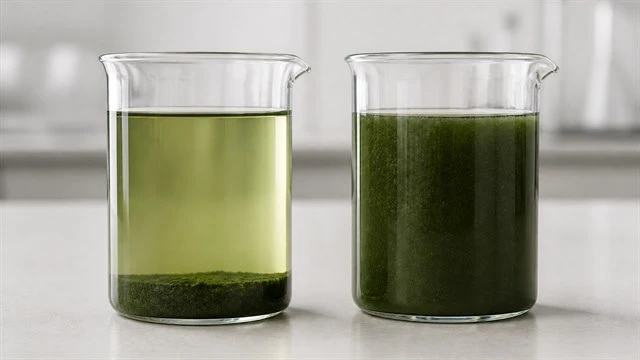
To prevent particulate settling in shaker bottles without turning the beverage into an undrinkable gel, formulators rely on Stokes' Law: V = [2r²(ρ_p - ρ_f)g] / 9η. Particle settling velocity (V) decreases exponentially with smaller particle radius (r) and inversely with continuous phase dynamic viscosity (η).
Because commodity spirulina has a higher specific gravity than water, relying solely on fine milling is insufficient; formulators must engineer pseudoplastic shear-thinning fluid properties:
| Hydrocolloid / Stabilizer System | Usage Level (%) | Hydration Kinetics | Commercial RTM & RTD Performance |
|---|---|---|---|
| Cold-Soluble Guar Gum Powder | 0.12% – 0.20% | Rapid in cold water (<30s) | Establishes an immediate 3D polymer mesh that suspends 80–120 mesh spirulina particles during consumer drinking windows without slimy mouthfeel. |
| Xanthan Gum + Acacia Fiber Complex | 0.08% + 1.50% | Moderate, requires shaking | High yield stress under rest prevents phase separation; high shear-thinning allows clean, watery drinkability during swallowing. |
| Propylene Glycol Alginate (PGA) | 0.10% – 0.25% | Acid-stable, cold or warm | Ideal for mildly acidic functional fruit blends (pH 4.8–5.5); prevents calcium bridging and protein coprecipitation. |
Can Spirulina Support True Ready-to-Drink (RTD) Bottling? Thermal Limits & Single-Serve Alternatives

Figure 3: High-speed automated stick pack co-packing and ready-to-mix single-serve greens blend contract manufacturing.
A recurring inquiry from beverage brand managers is whether whole organic spirulina can be formulated into shelf-stable, clear, or pasteurized bottled RTD beverages. The short technical answer is: not in conventional thermal hot-fill or UHT retort systems without significant physical alteration.
Differential scanning calorimetry (DSC) demonstrates that spirulina protein isolates exhibit two thermal denaturation peaks at approximately 67.0°C and 109.0°C. Exposing whole spirulina suspensions to standard beverage pasteurization (85°C–95°C for 30 seconds) triggers hydrophobic protein unfolding, leading to irreversible gelation, grainy curd formation, and dramatic chlorophyll browning (pheophytinization).
For brands seeking commercial retail viability, two viable paths exist:
- The Purified Colorant Route (Blue Phycocyanin Powder): When visual brilliance and clear RTD solubility are desired without heavy protein or marine off-flavors, formulators extract the phycobiliprotein isolate. Phycocyanin dissolves instantly into a vivid sapphire blue, making it suitable for cold-chain functional waters, beauty wellness shots, and clean-label natural coloring.
- The Single-Serve Dry Premix Route (Stick Pack / Sachet OEM): Rather than fighting thermal denaturation in wet bottles, over 85% of successful commercial greens brands utilize dry single-serve stick packs. Haoze Bio provides agile blending, granulation, and co-packing support for 5g to 15g single-serve sachets, allowing consumers to reconstitute active, unheated live enzymes and native protein on demand.
Regulatory Compliance, Heavy Metal Thresholds, and Verification Standards
Because cyanobacteria are bioaccumulators, harvesting spirulina from open municipal or agricultural waterways exposes brands to severe regulatory liabilities, including California Proposition 65 warnings and EU import rejections. Critical compliance thresholds focus on four heavy metals and cyanobacterial hepatotoxins:
- Lead (Pb) & Cadmium (Cd): Fully compliant with EU Regulation 2023/915 and strict North American dietary supplement monographs (Pb < 1.0 ppm, Cd < 0.5 ppm, As < 1.0 ppm, Hg < 0.1 ppm).
- Microcystins & BMAA Screen: Every commercial production batch is tested via competitive ELISA to guarantee total microcystins remain below detection limits (<0.5 ppm), eliminating cross-contamination from toxic cyanobacteria.
- Organic Integrity: Certified 100% USDA Organic and EU Organic by accredited certifiers, confirming zero synthetic nitrogen fertilizers, ionizing irradiation, or chemical defoamers during pond cultivation.
Commercial Specification & Typical Certificate of Analysis (COA) Benchmark
The following parameters represent standard commercial production baselines for Haoze Bio Bulk Organic Spirulina Powder. Individual lot-specific release testing is validated via attached COA with every shipment:
| Analytical Parameter | Commercial Standard | Test Methodology |
|---|---|---|
| Botanical Identity | Arthrospira platensis (Cyanobacteria) | TLC / Microscopic Morphology |
| Protein Content (Dry Basis) | ≥ 60.0% (Typical 62.0% – 68.0%) | Kjeldahl Method (AOAC 984.13) |
| Total Carotenoids / Phycocyanin | ≥ 400 mg/100g / ≥ 12.0% Phycocyanin | UV-Vis Spectrophotometry |
| Particle Sizing / Mesh | 100% through 80 Mesh (≥95% through 100 Mesh) | USP <786> Particle Sieve |
| Moisture & Total Ash | Moisture ≤ 7.0% | Ash ≤ 8.0% | USP <731> / USP <561> |
| Heavy Metals (Pb, As, Cd, Hg) | Pb ≤ 1.0 ppm, As ≤ 1.0 ppm, Cd ≤ 0.5 ppm, Hg ≤ 0.1 ppm | ICP-MS |
| Microbiological Profile | Total Plate Count < 50,000 CFU/g | Yeast/Mold < 100 CFU/g | USP <2021> |
| Pathogens (Salmonella, E. coli) | Negative in 25g / Negative in 10g | USP <2022> |
Frequently Asked Questions: B2B Beverage & Greens Formulation
Q1: Why does spirulina curdle or drop out of solution when mixed with fruit juices?
A: Most citrus and berry juices operate at pH 3.2 to 3.8. Phycobiliproteins in spirulina have an isoelectric point near pH 4.2 to 4.5. When beverage pH drops into this zone, net electrostatic surface charge falls to zero, causing rapid protein agglomeration and precipitation. To preserve colloidal stability, maintain beverage pH at or above 5.2, or add protective hydrocolloids like Propylene Glycol Alginate (PGA) to shield protein charges.
Q2: What is the optimal mesh size for high-speed single-serve stick pack packaging?
A: Ultra-fine powders (>200 mesh) often suffer from severe electrostatic charge and poor powder flowability, leading to bridging and seal contamination in automated vertical form-fill-seal (VFFS) machinery. An 80 to 120 mesh particle distribution represents the commercial sweet spot-offering fast water dispersion in shaker cups while maintaining smooth, reliable hopper flow rates.
Q3: How does bulk whole spirulina powder differ commercially from Blue Phycocyanin?
A: Whole organic spirulina powder is a complete nutrient-dense biomass (containing intact proteins, lipids, chlorophyll, and fiber) that forms an opaque green suspension. Blue Phycocyanin is an isolated, purified water-soluble pigment-protein complex that produces transparent sapphire blue solutions with zero algal odor, ideal for premium beverages, confectionery, and cosmetic liquid formulas.
Q4: What packaging standards are used to prevent lipid oxidation during transit?
A: Spirulina is sensitive to oxygen, light, and moisture. Haoze Bio packages wholesale material in standard 25 kg fiber drums lined with double-layer heavy-duty polyethylene food-grade bags, vacuum-nitrogen sealed to protect polyunsaturated fatty acids from oxidative degradation, ensuring a reliable 24-month shelf life under cool, dry storage.
Scientific References & Analytical Benchmarks
- Chronakis, I. S., et al. (2001). Gelation of edible blue-green algae protein isolate (Spirulina platensis strain Pacifica). Journal of Agricultural and Food Chemistry, 49(5), 2415-2422.
- Lafarga, T., et al. (2020). Bioactive compounds and health benefits of Spirulina platensis. Food Reviews International, 37(4), 412-432.
- Spolaore, P., et al. (2006). Commercial applications of microalgae. Journal of Bioscience and Bioengineering, 101(2), 87-96.
- European Commission. (2023). Commission Regulation (EU) 2023/915 on maximum levels for certain contaminants in food. Official Journal of the European Union.
Partner with Haoze Bio: Wholesale Sourcing & Formulation Support
Ready to Scale Your Commercial Greens Beverage or RTM Premix Line?
Whether you require calibrated 80–120 mesh Organic Spirulina Powder in standard 25 kg export drums, synergistic hydrocolloid pre-blends, or contract packaging into branded stick packs, Haoze Bio delivers verified batch documentation, complimentary pilot bench samples, and responsive technical engineering support.
Request Samples & Technical Specifications
Official Direct Inquiry Email: info@haoze-bio.com