

Executive Procurement Summary
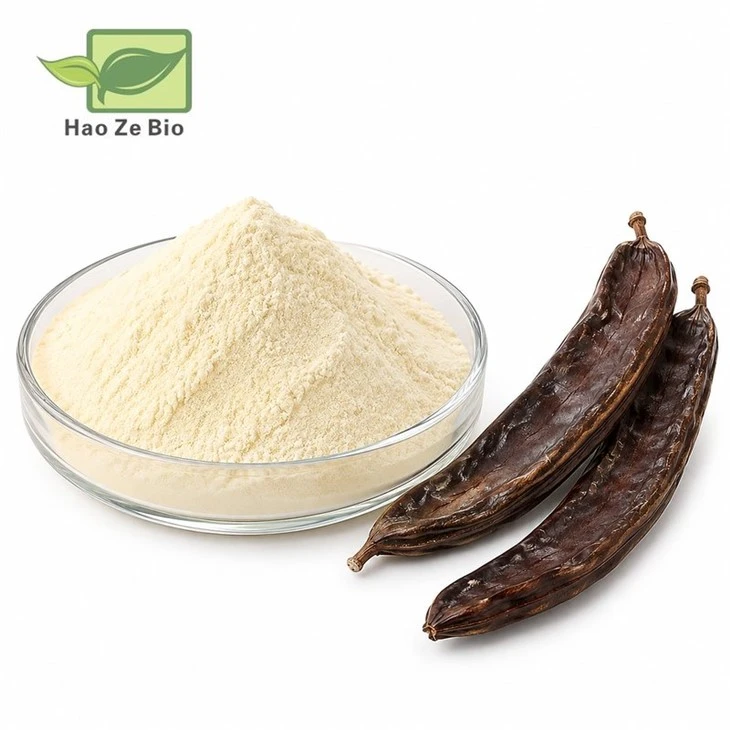
Locust Bean Gum Powder (Carob Bean Gum, E410 / INS 410, CAS 9000-40-2) is the milled endosperm polysaccharide of the carob tree Ceratonia siliqua (L.) Taub. - a non-ionic galactomannan with a mannose-to-galactose ratio near 4:1. That sparse branching is the whole story. The powder disperses quietly in cold water, fully activates only with heat (practical band 80 to 85 °C), and - unlike guar - forms true mixed gels with kappa-carrageenan and xanthan. Haoze Bio supplies two heat-hydrated viscosity tiers (2,400-3,000 and 3,000-3,800 mPa·s, 1% solution, 25 °C), 200 mesh low-speck powder, ethylene oxide non-detect batch reports (LOQ 0.1 ppm) and a lot-specific COA with every consignment. Standard packing: 25 kg moisture-barrier bags or fiber drums; 100 g to 500 g evaluation samples supported. All figures below are release specifications - your batch values are the shipped COA.
Material Identity: Why a 4:1 Sugar Ratio Changes Everything
Under 21 CFR 184.1343, locust (carob) bean gum is defined as the macerated endosperm of the seed of Ceratonia siliqua, a leguminous evergreen tree, carrying lesser quantities of seed coat and germ. Regulation (EC) 1333/2008 registers the same material as E410, with purity criteria under Commission Regulation (EU) No 231/2012. Codex lists it as INS 410; JECFA allocated its ADI as "not specified" in 1981.
Structurally, locust bean gum is a beta-1,4-linked mannopyranose backbone with alpha-1,6 galactose side branches - and the branches are sparse. Guar places a galactose unit roughly at every second mannose (about 2:1); locust bean gum about every fourth (4:1). Those long unbranched smooth zones will not stay dissolved at room temperature. In cold water the powder disperses, partially swells, and otherwise waits. Heat past the activation band and the chains open, entangle, and build a smooth non-gelling viscosity between 2,400 and 3,800 mPa·s (1% solution, 25 °C, Brookfield RVT after hot hydration and cooling).
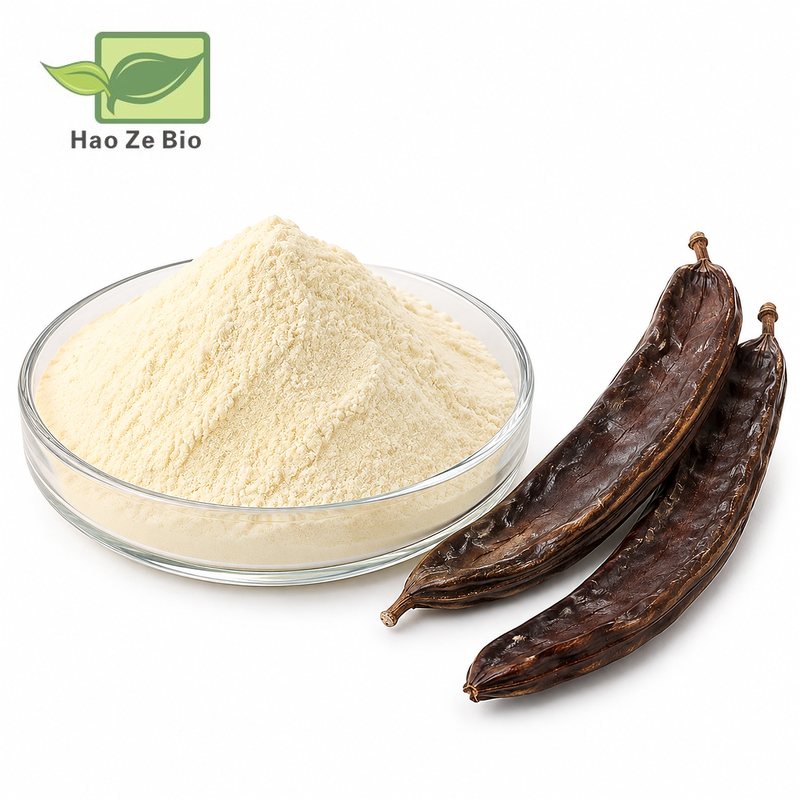
The same smooth zones that block cold solubility are exactly what let LBG zip between the helical domains of kappa-carrageenan or xanthan and knit a mixed gel - a behavior guar, with its crowded branching, cannot deliver. One structural variable, two commercial consequences. We mill from de-hulled, de-germed carob endosperm splits by dry grinding and air classification alone; no solvent extraction step exists in this process, and none is used in ours. Dark seed-coat specks are held to a minimum by density sorting - a quality dimension that matters the moment the gum meets a white dairy base.
Botanical and Batch Traceability
Every export lot travels with its identity dossier: Ceratonia siliqua endosperm origin, CAS 9000-40-2, the E410 / INS 410 compliance file, and a lot-specific COA from our own lab - Brookfield viscosity, sieve analysis, ICP-MS heavy metals, headspace GC-MS for ethylene oxide and 2-chloroethanol.
Haoze Bio (Xi'an Haoze Biotechnology Co., Ltd., established 2014) operates GMP-standard milling and blending lines with enclosed sieving and magnetic separation, serving frozen-dairy plants, confection houses, co-packers and private-label brands across North America and Europe. The mannose-to-galactose ratio of any lot can be verified by HPLC on request - a direct answer to the adulteration questions QA teams actually ask.
Why Your Locust Bean Gum Refuses to Thicken Cold - and Why That Is a Feature
The most common field complaint about LBG is silence: a plant doses 0.2% into a cold or warm batch, stirs for an hour, and measures almost nothing. That is not degraded material. That is the galactomannan behaving exactly as its structure dictates. Manufacturer guidance spans 165 °F (74 °C) to roughly 190 °F (88 °C) for full hydration; artisan dairy practice typically holds the mix at 82 to 85 °C for two to three minutes alongside starch gelatinization; cold water only disperses the powder with partial swelling. Our recommendation for production trials: cold-disperse under high shear (rotor-stator 3,000 to 8,000 rpm or a powder-induction hopper) at or below 60 °C, ramp to 80 to 85 °C, hold, then cool - and judge viscosity at service temperature, not at the hot state. Treat that band as a validation target in your own matrix: free water, sugar load and mineral content all shift it.
Read correctly, cold-insolubility is a processing advantage. A gum that hydrates the instant it meets water gives you fish-eyes and blinding strainers. LBG hands you a deliberate two-stage window: disperse cold, activate hot. Some lines exploit the cold-state thinness precisely for pumping, coating and filling work, letting viscosity appear only after the thermal step. Where powder meets hot surfaces or heavy syrup directly, standard dispersion discipline applies: pre-blend 10 to 20 parts sugar or starch per part gum, or pre-disperse into the oil phase before water contact.
Three honest limitations belong in the same paragraph. A process that never sees a thermal step - cold-filled RTD, cold-blend drink lines - will not activate LBG at all, and that job belongs to other gums. Systems with little free water need the upper end of the thermal band. Strong acid plus prolonged heat hydrolyzes any galactomannan, so low-pH recipes earn an accelerated shelf-life validation before sign-off. Within that shared family weakness, LBG is the more acid-tolerant of the two seed galactomannans - one reason cultured-dairy and cheese buyers specify it over guar.
Heat-Activation Workflow on the Production Floor
For dairy and dessert bases: hydrate the other dry ingredients first, cold-disperse the LBG under high shear, ramp to 80 to 85 °C with steady agitation, hold two to three minutes, then cool. Viscosity develops on cooling, not on heating - verify your target mPa·s band at 25 °C after the run.
Our technical team will run your formula profile with you: target texture, thermal equipment, pH, sugar load, and the cold-chain your retail channel actually imposes. Send the application brief to info@haoze-bio.com and we come back with a dosing starting point and a verification plan, not a datasheet dump.
Commercial Viscosity Tiers and Specification Selection Matrix
Both tiers are milled to 200 mesh fine grade with low dark-speck content and tested as 1% (w/w) solutions: hot-hydrated with agitation, cooled to 25 °C, read on a Brookfield RVT viscometer at 20 rpm. The values below are release bands; every commercial shipment carries its measured lot figures on the COA.
| Grade | Viscosity (1% sol, 25 °C, heat-hydrated) | Mesh | Sensory and Process Behavior | Best-Fit Systems |
|---|---|---|---|---|
| LBG-2800 Standard Fluidity | 2,400 – 3,000 mPa·s | 200 (95% pass minimum) | Smooth cold dispersion, clean activation on heat, neutral aroma with no beany note | Ice cream and gelato mixes, yogurt and quark, cream cheese, bakery fillings |
| LBG-3500 High Viscosity | 3,000 – 3,800 mPa·s | 200 (95% pass minimum) | Maximum water binding per kilogram, firmer mixed-gel response at equal dosage | Carrageenan and xanthan gel systems, wet pet food jelly, processed meat water retention, lean-dosage frozen bases |
| Custom Blend Development | To agreed target | 100 / 200 on request | Worked examples: LBG dusted 1:10 onto sucrose or dextrose for one-dump cold dispersion; 1:1 xanthan carrier premix for hot-set gel systems; starch blends for instant pudding dry mixes | OEM dry-blend programs, private-label stabilizer packs, co-packer ready mixes |
What Happens When Locust Bean Gum Meets Carrageenan or Xanthan?
On its own, locust bean gum thickens but never gels - no concentration of pure LBG sets a water system into a true gel. Its premium value lives in mixed gelation. The smooth mannose zones of the LBG chain adsorb onto the double-helical junction zones that kappa-carrageenan and xanthan form on cooling, co-building a network neither polymer achieves alone. Guar, the cheaper cousin, mostly cannot do this: its dense galactose branching sterically blocks the zippered binding, so guar partners in viscosity but not in gel architecture. That single asymmetry is why gel-system formulators pay a multiple of the guar price.
With kappa-carrageenan, small LBG additions convert a short, brittle, weeping gel into an elastic, sliceable gel with markedly reduced syneresis - classic literature synergy peaks sit near an LBG-to-kappa ratio around 1:5.5 by weight at typical total gum loads. This is the backbone of refrigeration-free dessert gels and of sliced cheese-analogue texture work. With xanthan, hot-blended and cooled, LBG gives soft, flexible, heat-reversible gels; the strongest synergy reports cluster near 1:1 xanthan to LBG at around 1% total gum, with meaningful interaction across a wide band. Treat every ratio here as a starting point for a designed verification series on your own product, not as a finished recipe.
| Blend System | Starting Ratio (by weight) | Gel Character | Typical Products | Verify Before Sign-off |
|---|---|---|---|---|
| Kappa-carrageenan + LBG | LBG at ~15-20% of total gum (peak near 1:5.5) | Elastic, sliceable, low weeping, ambient-stable set | Dessert gels, milk puddings, gelatin-free confection, cheese systems | Gel strength and syneresis after 7-day storage at target temperature |
| Xanthan + LBG | Near 1:1 at ~1% total gum (band 2:1 to 1:4 usable) | Soft, flexible, heat-reversible gel; clean melt on reheating | Baked fillings that re-melt, frozen dessert bodies, saucy systems needing thermal reversibility | Melt-reset cycle behavior and freeze-thaw texture panel |
| LBG solo (thickening) | 0.10-0.30% of formulation | Smooth non-gelling body after heat activation | Ice cream mix, cream cheese, yogurt, quark | Viscosity at service temperature; overrun and scoop in frozen trials |
Application Engineering: Where LBG Earns Its Price
Ice Cream and Gelato: The Freeze-Thaw Barrier in Your Mix
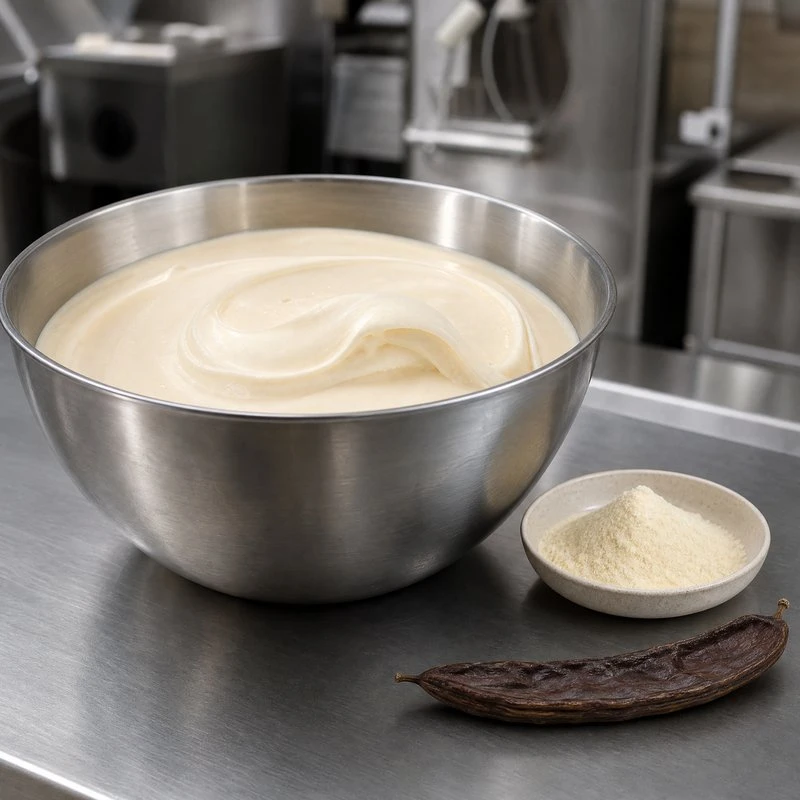
Cold-chain cycling drives ice-crystal recrystallization, and every fat reduction or sugar replacement on your label rewrite weakens body further. Dose LBG at 0.10% to 0.30% of the mix, hot-hydrated through your standard pasteurization step: the hydrogen-bond network locks mobile water and slows diffusion toward growing ice nuclei across every temperature swing. Artisan gelato practice pairs roughly 0.8 g LBG with 0.4 g guar per kilogram of mix (about 0.08% plus 0.04%) to split cost-in-use and tune melt-down - run that matrix before you lock either gum solo.
Sign-off protocol: accelerated freeze-thaw cycling (for example alternating -18 °C storage with a -7 °C abuse window) read by crystal-size microscopy, plus a scoop-and-melt sensory panel before specification lock.
Cream Cheese and Quark: Kill the Whey on the Lid
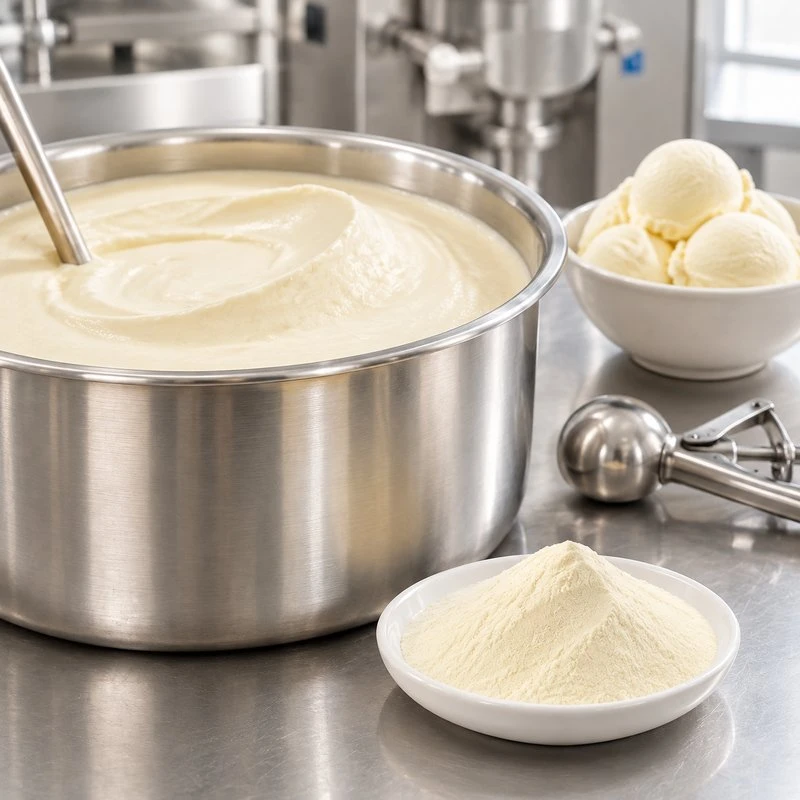
Fresh and processed cheese systems fail on texture drift: serum pooling under the lid, a chalky cut, body that thins across shelf life. 0.1% to 0.3% LBG, hydrated during the heat step of the mix, binds the serum phase and delivers measurable syneresis reduction with a smooth, spreadable cut. In processed and spreadable work, pairing LBG with kappa-carrageenan at the ratios above converts a brittle cut into a sliceable, low-weep body that survives distribution warmth.
Regulatory headroom: US cheese systems run to 0.8% as served under 21 CFR 184.1343 - set your dose by flavor-neutrality testing at target level, not by the legal ceiling.
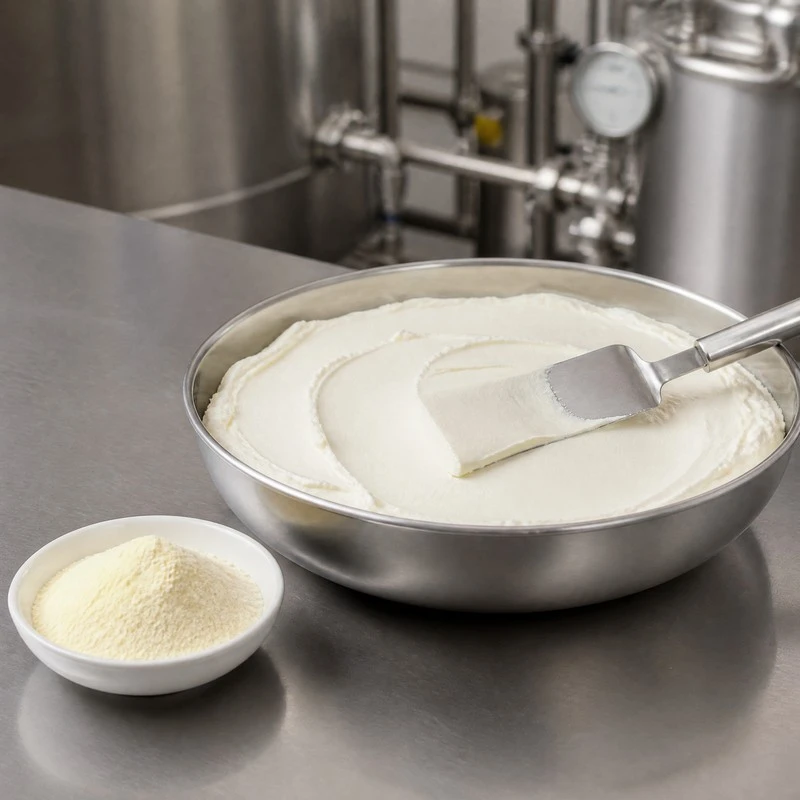
Gelatin-Free Dessert Gels: Halal and Kosher Friendly Bite
Replacing bovine or porcine gelatin without losing bite usually means accepting a soft melt in ambient distribution - unless the system is built on kappa-carrageenan plus LBG. At 15% to 20% LBG of total gum the pair sets elastic, sliceable and remarkably low-weep: long-standing practice in refrigeration-free dessert gels engineered for warm markets. Raise the LBG share for elasticity and a softer melt; hold it low for a firmer, cleaner snap.
Documentation: Halal and Kosher certification files and animal-origin-free statements ship with your lot and support the gum system on your label - the carrageenan partner stays in your own specification.
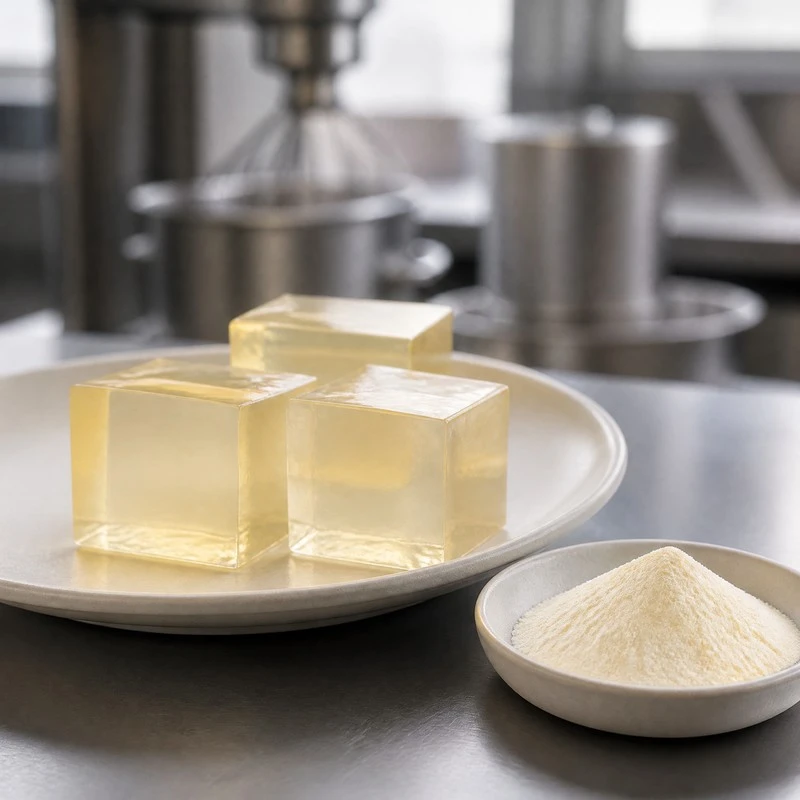
Wet Pet Food and Processed Meat: Water Binding That Survives Retort
Canned pet food must flow correctly on opening after sterilization; comminuted and emulsified meat systems lose cooking yield the moment the protein matrix relaxes. Hot-dispersed LBG binds process water and steadies the fat-water-protein network - E410 is an established gelling and stabilizing partner in canned pet-food jelly, assessed as such in EFSA's feed-additive evaluation of locust bean gum.
Non-ionic advantage: salt load and protein will not crash LBG viscosity the way they can hit anionic gums - run drip-loss and post-retort jelly-flow trials inside your dosage band.
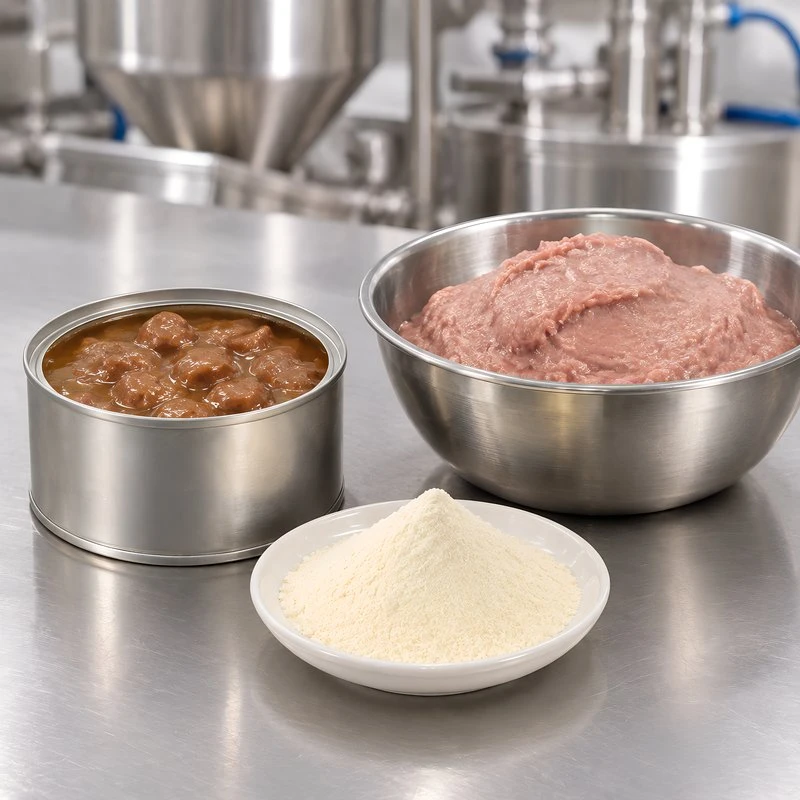
US Maximum Use Levels at a Glance (21 CFR 184.1343)
GRAS use of locust (carob) bean gum in the United States is tied to defined maximum levels in the food as served. Regulatory teams get this table for free here; in the EU, permitted levels are set per food category under Regulation (EC) 1333/2008 with purity criteria in Commission Regulation (EU) No 231/2012.
| Food Category (as served) | Maximum Level | Typical Products That Fall Here | Why LBG Earns Its Slot on That BOM |
|---|---|---|---|
| Baked goods and baking mixes | 0.15% | Gluten-free breads and tortillas, dry cake and bread premixes, doughnuts | Dough water management and softer slicing crumb; slows staling drift in high-rice-flour systems |
| Nonalcoholic beverages and beverage bases | 0.25% | Protein shake and meal-replacement powders, hot-dispersed RTD coffee and cocoa drinks | Body and particle suspension in systems that actually see a thermal step - cold-fill juice is not an LBG job |
| Cheeses | 0.8% | Cream cheese, quark and fromage frais, processed cheese spread, sliced cheese analogue | Bind the serum phase: syneresis control, spreadable cut; with carrageenan, a sliceable low-weep body |
| Gelatins, puddings and fillings | 0.75% | Instant and cook-up pudding mixes, bakery cream and fruit fillings, dessert gels | Smooth set without gelatin; xanthan pairing keeps baked fillings heat-reversible on re-plate |
| Commercial jams and jellies | 0.75% | Reduced-sugar fruit spreads, fruit preparations for stirred yogurt | Replaces the body lost when sugar comes down, without masking fruit |
| All other food categories | 0.5% | Salad dressings, soups and sauces, canned pet food gravy and jelly | Non-ionic water binding that salt load and protein will not crash |
*The rule assigns this additive a single permitted function - stabilizer and thickener - in every listing, so a Function column would repeat six times; the right-hand columns translate each legal category into where locust bean gum actually sits on a real bill of materials. Match your own category before formulation sign-off.
Ethylene Oxide Discipline and Authenticity Control
We state the uncomfortable history plainly because it is the trust test for this category. In June 2021 the EU rapid alert RASFF 2021.2966 flagged locust bean gum (E410) contaminated with ethylene oxide above the limit of quantification, and the European Commission convened member-state crisis coordinators three times before ordering withdrawal and recall of every finished product carrying the contaminated additive lot. Regulation (EC) 396/2005 keeps the residue definition for ethylene oxide (summed with 2-chloroethanol) at the limit of quantification - effectively zero - and Regulation (EU) No 231/2012 prohibits ethylene oxide sterilization of food additives outright. A gum imported into the EU therefore needs documented innocence on every lot, not a reassuring paragraph.
Haoze Bio's control set: the gum is never ethylene-oxide treated at any stage; incoming lots travel on heat-treated (ISPM 15) pallets under supplier declarations; and every commercial lot ships with a headspace GC-MS report showing ethylene oxide and 2-chloroethanol below a 0.1 mg/kg limit of quantification. Ask any supplier for the actual report - hesitation is its own answer.
The second trust vector is authenticity. LBG trades at a multiple of guar gum - commonly four to six times, higher in short Mediterranean crop years - which makes guar adulteration the known economic shortcut in this market. Our COA reports the mannose-to-galactose ratio (specification band 3.5:1 to 4.5:1, typical measured value 4.1:1 by HPLC), and the quick in-house check needs no laboratory: disperse 1% in cold water at about 20 °C - genuine LBG stays nearly thin until heated, while guar-adulterated material jumps to viscosity immediately. Full HPLC verification on request supports your incoming-goods QA program.
Batch Quality Assurance - Reference COA Technical Parameters
Release parameters below are standing specification benchmarks consistent with FCC monograph logic, EU 231/2012 purity criteria and the EFSA 2017 re-evaluation guidance, which recommends explicit microbial criteria in gum specifications. A lot-specific Certificate of Analysis accompanies every export consignment; the shipped batch document governs.
| Analytical Parameter | Specification Benchmark | Typical Batch Result | Analytical Method |
|---|---|---|---|
| Appearance and color | Off-white to pale yellowish-white fine powder, low dark specks | Conforms | Visual inspection |
| Odor and taste | Neutral, characteristic, free of beany off-notes | Conforms | Organoleptic panel |
| Identity (hydrolysis chromatography) | Matches galactose and mannose pattern of E410 | Conforms | FCC / EU 231/2012 identity tests |
| Mannose-to-galactose ratio | 3.5:1 to 4.5:1 | 4.1:1 | HPLC sugar analysis after hydrolysis |
| Viscosity - LBG-2800 tier | 2,400 – 3,000 mPa·s (1% sol, 25 °C, heat-hydrated) | 2,720 mPa·s | Brookfield RVT, spindle 4, 20 rpm |
| Viscosity - LBG-3500 tier | 3,000 – 3,800 mPa·s (1% sol, 25 °C, heat-hydrated) | 3,350 mPa·s | Brookfield RVT, spindle 4, 20 rpm |
| Particle size (200 mesh) | 95% pass minimum | 97.4% pass | Air-jet sieve analysis |
| Loss on drying | 8.0% maximum | 6.9% | 105 °C to constant weight |
| Total ash | 5.0% maximum | 3.6% | Muffle incineration |
| Acid-insoluble ash | 2.0% maximum | 0.7% | FCC reference method |
| Protein (N × 6.25) | 6.0% maximum | 5.1% | Kjeldahl |
| Starch | Absent (iodine test) | Passes | Iodine color reaction |
| Lead (Pb) | 2.0 ppm maximum (0.5 ppm for infant-formula-suitable lots) | < 0.2 ppm | ICP-MS |
| Arsenic (As) | 1.0 ppm maximum | < 0.1 ppm | ICP-MS |
| Cadmium (Cd) | 1.0 ppm maximum | < 0.05 ppm | ICP-MS |
| Mercury (Hg) | 0.1 ppm maximum | < 0.01 ppm | ICP-MS |
| Total aerobic count | 5,000 cfu/g maximum | < 600 cfu/g | Plate count |
| Yeast and mold | 500 cfu/g maximum | < 50 cfu/g | Plate count |
| Escherichia coli | Absent in 10 g | Absent | Plate method |
| Salmonella spp. | Absent in 25 g | Absent | Enrichment culture |
| Ethylene oxide plus 2-chloroethanol | Not detected (LOQ 0.1 mg/kg) | Not detected | Headspace GC-MS |
| Shelf life (sealed, dry, cool) | 24 months | 24 months | Accelerated stability program |
Manufacturing Infrastructure Behind a Batch-Consistent Seed Gum
Locust bean gum starts as hard endosperm splits - the ground seed kernel of the carob tree - and stays a physical milling product all the way to the drum. That makes particle engineering, speck control and microbiological hygiene the real quality levers. Our clean hydrocolloid milling lines run enclosed pneumatic conveying, vibrating sieving under dust control, continuous rare-earth magnetic separation and density sorting for seed-coat residue, keeping food-grade hygiene and foreign-matter risk out of the equation for your incoming-goods inspection.

Every commercial batch passes a three-stage check - incoming splits, in-process milled lot, finished packed lot - on calibrated Brookfield RVT viscometers (hot-hydration protocol, 25 °C read), air-jet sieve verification, loss-on-drying balance, and ICP-MS heavy-metal quantitation. Ethylene oxide and 2-chloroethanol are screened per lot by headspace GC-MS. Retain samples for every exported lot are archived under controlled temperature for the full shelf life, so a spec question twelve months from now still has a physical answer.

Custom Dry Blending and Pilot-to-Scale Support
Single-gum buying is increasingly being replaced by functional premix buying, and the shift favors LBG users: dose-and-dump sugar or starch carries, designed LBG-xanthan carrier blends for instant hot-disperse behavior, and private-label stabilizer packs that hide your texture system from contract-kitchen copyists. We develop these dry blends with your team - pilot validation starts from a single 25 kg drum and scales to palletized 300 to 1,000 kg runs with agreed batch-to-batch viscosity windows and custom-printed packing under your brand.

Certification Portfolio and Export Compliance File
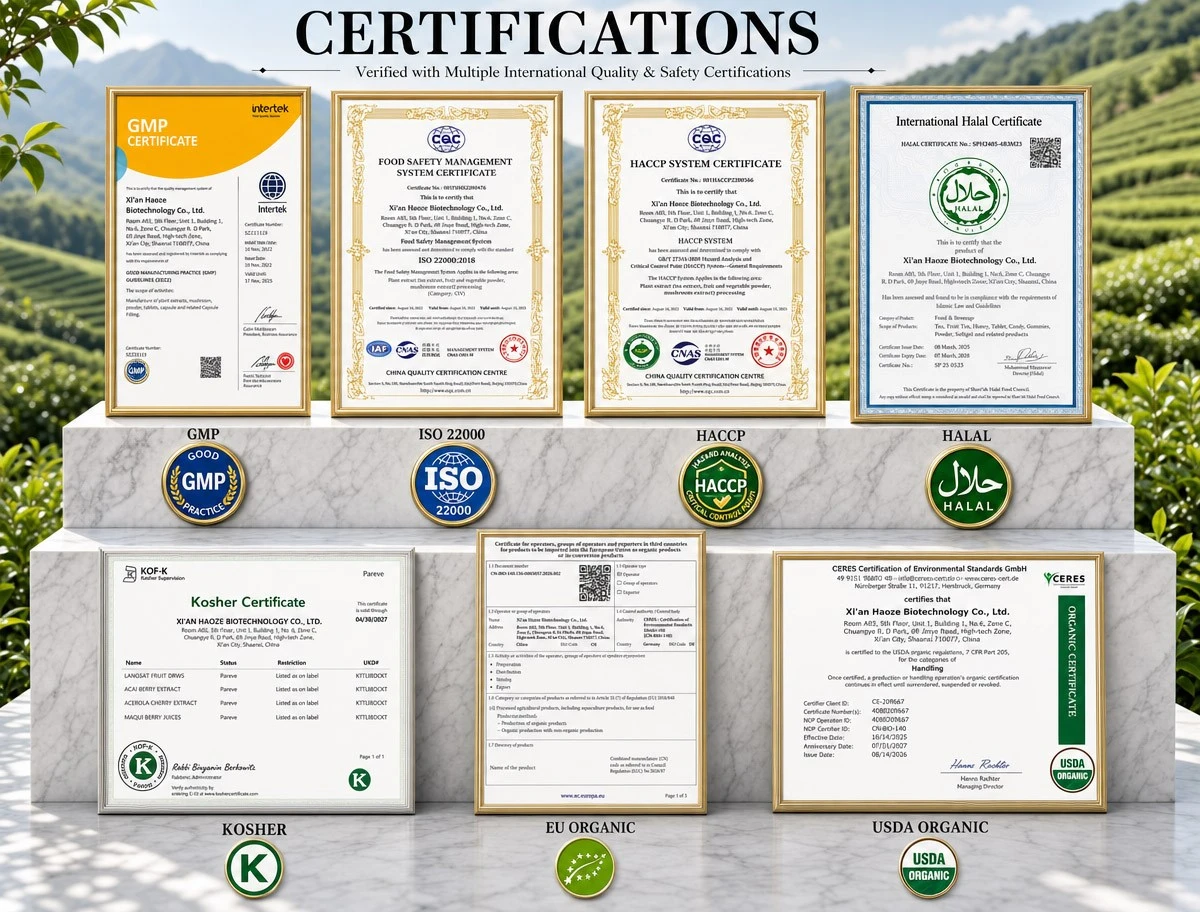
Haoze Bio operates under ISO 9001, ISO 22000, HACCP, FSSC 22000 and GMP management systems, holds Halal and Kosher certification for this product line, maintains US FDA facility registration, and has passed TUV Rheinland on-site audit. Export consignments ship with the complete document set your QA and customs teams expect: commercial invoice and packing list, bill of lading, certificate of origin, phytosanitary certificate, lot COA with ethylene-oxide report, and allergen statement on request (the gum is legume-derived - most markets require no declaration, and we document the position per destination).
Moisture-Barrier Packaging and Global Shipping
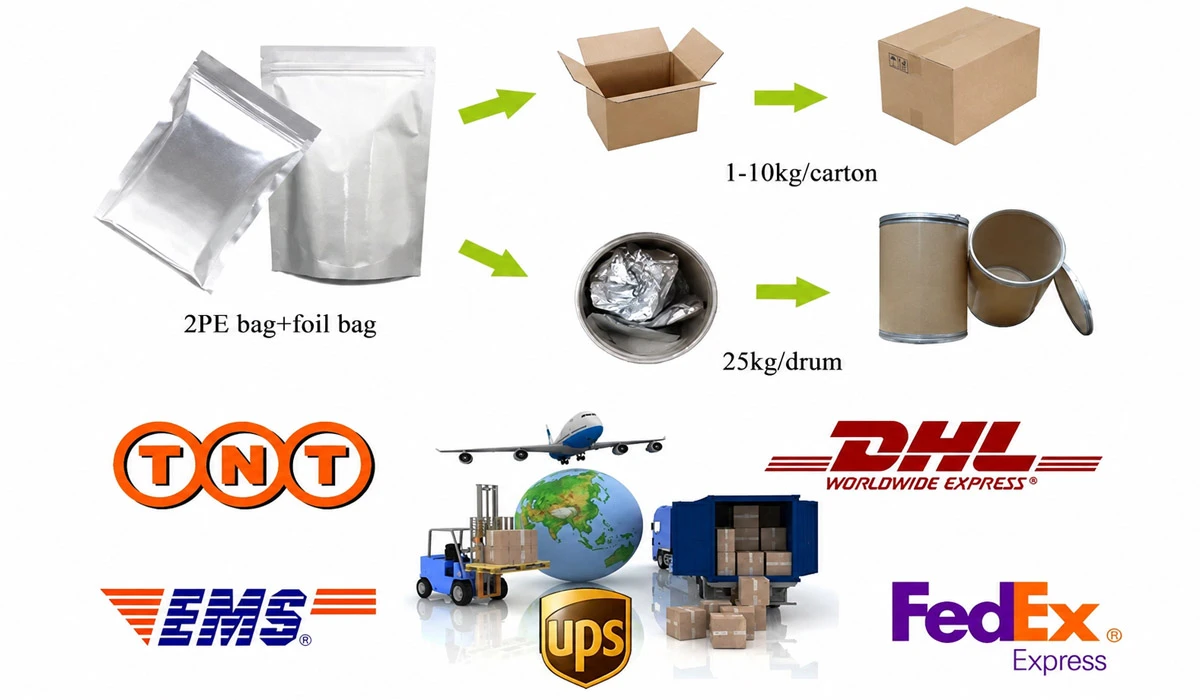
Fine seed gums are hygroscopic: an under-barrier bag in a humid port warehouse turns surface-caked and flow-poor before your production line ever sees it. We pack in food-grade polyethylene inner liners heat-sealed inside multi-wall kraft-laminated bags or fiber drums (25 kg net), palletized with stretch wrap and corner protection for FCL and LCL ocean movement, with expedited air freight for laboratory and trial-run quantities. Storage guidance we test to: sealed original packing, cool and dry conditions, 24-month shelf life.
Buyer FAQ - Procurement and Formulation
Q: I dosed locust bean gum and my batch never thickened. What went wrong?
A: In almost every reported case the batch never reached full hydration temperature. LBG only disperses and partially swells in cold or warm water; complete hydration requires heating the dispersion to roughly 80 to 85 °C with agitation, holding a few minutes, then cooling - viscosity develops on cooling, so judge at service temperature, not hot state. If your process has no thermal step (cold blending, cold filling), LBG is the wrong tool for that line: choose a cold-hydrating gum instead, or re-engineer a hot-disperse and cool step into the process.
Q: What temperature and hold time fully hydrates locust bean gum?
A: Published manufacturer guidance spans 74 to about 88 °C for full hydration, and artisan dairy practice commonly holds 82 to 85 °C for two to three minutes together with starch gelatinization. Our working recommendation for trials: disperse cold or at or below 60 °C under high shear, ramp to 80 to 85 °C, hold 2 to 3 minutes, cool, and verify viscosity at 25 °C against your target band. Low-free-water systems (heavy syrup, high sugar) need the upper end of the band.
Q: Which blend ratios work for carrageenan and xanthan gel systems?
A: For kappa-carrageenan, start with LBG at 15 to 20% of total gum - the elasticity and anti-syneresis synergy peaks near an LBG-to-kappa ratio of about 1:5.5 - and you get an elastic, sliceable, ambient-stable gel suited to dessert gels and cheese systems. For xanthan, hot-blend near 1:1 xanthan to LBG at around 1% total gum for a soft, flexible, heat-reversible gel; meaningful interaction persists across a wide 2:1-to-1:4 band. Both numbers are starting points for a verification series on your product, not finished recipes.
Q: LBG costs several times guar. When is the premium actually justified?
A: Pay it when your product needs something guar structurally cannot provide: mixed gels with kappa-carrageenan or xanthan (guar gives viscosity synergy but no gel architecture), freeze-thaw crystal control in dairy desserts, better acid tolerance than guar in cultured systems, and a cleaner sensory background in delicate dairy bases. Do not pay it for cold-process thickening or bulk viscosity alone - those jobs are solved with cheaper gums, and we will tell you that in the quotation conversation instead of upselling.
Q: How do you control ethylene oxide risk on this product?
A: The gum is never ethylene-oxide treated; EU rules make the position unforgiving - Regulation (EC) 396/2005 sets the ethylene oxide residue limit at the limit of quantification (with 2-chloroethanol), Regulation (EU) No 231/2012 bans EO sterilization of food additives, and RASFF alert 2021.2966 on contaminated E410 triggered EU-wide recalls of finished goods including frozen desserts. Every Haoze lot ships with a headspace GC-MS report showing ethylene oxide and 2-chloroethanol non-detect at a 0.1 mg/kg limit of quantification. Request the actual batch report from any supplier before first shipment - including from us; that is how it should work.
Q: How can I verify I am receiving genuine LBG and not guar-blended material?
A: Two levels of check. Bench-fast: disperse 1% of the powder in cold water near 20 °C - genuine LBG stays nearly thin until heated, while guar-blended material builds viscosity immediately (guar hydrates cold; that is the structural difference). Laboratory-grade: acid hydrolysis followed by HPLC sugar analysis - genuine locust bean gum returns a mannose-to-galactose ratio near 4:1 (our specification band 3.5:1 to 4.5:1), whereas guar pulls the ratio toward 2:1. Our COA carries the measured ratio, and we support your incoming-QA verification with samples of documentation either way.
Q: What samples, minimum order quantities and packing options do you support?
A: Complimentary 100 g to 500 g laboratory evaluation samples with matching lot COA for benchtop trials; pilot validation from a single 25 kg drum; palletized production orders from 300 kg, with FCL programs for committed users. Standard packing is a PE inner liner heat-sealed inside multi-wall kraft-laminated bags or fiber drums; store sealed, cool and dry for a 24-month shelf life. Air freight dispatch for trial quantities typically within 3 to 7 business days; ocean LCL and FCL with corner-boarded, stretch-wrapped pallets for bulk.
Request Locust Bean Gum Evaluation Samples, Batch COA and Bulk Quotation
Tell us the system you are building - frozen dairy, gel confection, cheese, meat or pet food - and the texture problem behind it. We will return a grade recommendation (LBG-2800 or LBG-3500), a dosing starting point, a verification checklist for your equipment, and commercial terms: complimentary 100 g to 500 g evaluation samples with matching lot COA and ethylene-oxide report, pilot 25 kg drums, and bulk programs with fixed viscosity windows. Technical replies within 24 business hours.
Contact Haoze Bio Technical Team →
Direct inquiry email: info@haoze-bio.com | Xi'an Haoze Biotechnology Co., Ltd.