


Executive Procurement Summary
Xanthan gum powder thickens and stabilizes cold-water systems without a heating step. It retains viscosity in acidic beverages such as citrus drinks and coffee, where guar gum hydrolyzes and loses thickness over shelf life, and it lets a filled bottle pour easily while holding suspended particles in place during storage. Two grades are supplied, standard and high viscosity, quoted by the official US test method so your own lab can reproduce the same figure. Typical use levels run from 0.05% to 0.8% depending on the system; grade specifications, application notes and the identity checks written into 21 CFR 172.695 are listed further down this page. Each drum ships with a batch certificate of analysis covering identity, solvent residue and microbiology; evaluation samples and substrate statements are available on request.
Material Identity: The Only Gum Grown in a Fermenter
Xanthan is not a ground seed gum. It is a polysaccharide produced by the bacterium Xanthomonas campestris in a pure-culture fermentation, then recovered, dried and milled, and it is the only bacterially produced food gum made at industrial scale. The US rule for it (21 CFR 172.695) is unusually specific: which organism, what must be absent from the finished powder, and which laboratory reactions prove a white powder is genuinely xanthan rather than something cheaper. Every one of those conditions is listed line-by-line further down this page, with our matching batch results beside them - you never have to take our word for any of it.
Three practical properties follow from the production route, and they matter more to a buyer than structure does. Xanthan hydrates in cold water at room temperature within minutes - no cook step. Its viscosity holds in acid conditions that would thin a guar-based drink body over shelf life. And its solutions are thin while poured or pumped and return to full thickness once at rest; that is why a xanthan dressing coats the salad leaf and stays there, while a plain syrup of the same apparent thickness slides off into the bottom of the box.

The bowl shows the powder as your QC will receive it: white to cream, fine, free-flowing, low dust. The beaker shows the same material fully hydrated at 1% in cold water - a clear, glossy film that holds its shape as it slides off the glass, without any heating step anywhere in the process. The two properties visible here: xanthan dissolves cold, and its solution stays clear enough for beverage clarity specs where starch-based thickeners would cloud the product. Batch appearance and clarity are graded against retained samples on every drum shipped.
Why a First Beaker Test of Xanthan Can Look Like Failure
Sprinkle xanthan straight into still water and you will get lumps with dry white hearts - the outside of each particle hydrates on contact, seals into a waterproof shell, and the powder inside never sees the water. These are the "fish eyes" that make a pilot batch look ruined. Nothing is wrong with the gum; it hydrates extremely quickly. The fix is a single dispersion rule: keep every particle away from free water until it is already spread out. Pre-blend the gum one part to five–ten parts dry sugar (or slurry it in a cold oil from the formula) and feed that into a vigorous vortex; two to five minutes of high shear gives full viscosity, then a short degas rest clears the entrained air. Fine-mesh 200 grades build viscosity faster than 80 mesh - better for cold instant systems, and the same pre-blend rule applies.
The second beaker below shows what xanthan is actually specified for: not thickness alone, but holding particles in place. Xanthan solutions carry a yield value - below a small force threshold, suspended particles stay where they are, nothing creeps and nothing compacts; once the threshold is exceeded, in the pump or on the pour, the liquid flows almost like water again. One bottle got 0.15% xanthan; the other got nothing. After a day on a lab bench the difference is not viscosity - it is whether a label claim of "with real aloe pieces" survives shipping, or ends as a brown sediment layer the customer shakes once and gives up on.
Read the right-hand bottle like your QA reads a stability rack: seeds evenly distributed top to bottom after 24 hours of dead stillness, the liquid body itself clear because the gum is doing suspension work rather than clouding. The left bottle is the control - serum separation above, compacted sediment below, exactly what a "shake well" instruction is trying to paper over. Run this paired-bottle test in your own plant before you approve any supplier: 0.05, 0.10, 0.15 and 0.20% at your real pH, your real particle load, one warm week and one cold week. The ladder gives you the minimum dose that stands still - the dose worth standardizing on, since everything above it adds texture risk without adding stability.

Viscosity Grades and Specification Selection Matrix
Both grades are quoted by the official US test method - the same recipe, potassium chloride adjustment, instrument and spindle speed your QC lab would use - so the number on this page and the number on your bench are the same physical quantity. In sourcing, compare suppliers by method before comparing them by number: a "1% solution viscosity" quoted in plain water at a different spindle speed is a different physical quantity, not a price argument. Typical batch results ride with every shipment on the lot certificate.
| Grade | Viscosity Band (mPa·s) | Particle Size | How It Behaves on the Floor | Best-Fit Systems |
|---|---|---|---|---|
| XG-1000 Standard Fluidity | 800 – 1,300 | 80 or 200 mesh | Fast cold build with a wider working window before the mix turns ropey; forgiving in high-shear homogenization | Dressings, pourable sauces, gluten-free bakery blends, dairy and cultured systems |
| XG-1500 High Viscosity | 1,300 – 2,000 | 80 or 200 mesh | Maximum suspension force per gram; dose carefully - the slide into "gummy" starts earlier | Particulate and pulpy RTD beverages, shot-format suspensions, light-body drinks needing stillness at low total gum |
| Custom Blend Development | To agreed target | 100 / 200 on request | Worked examples: xanthan dusted 1:10 onto dextrose for one-dump cold dispersion; xanthan plus locust bean gum co-carrier premix for hot-set heat-reversible gels; starch carries for instant dry mixes | OEM dry-blend programs, private-label stabilizer packs, co-packer ready mixes |
Why Does Xanthan Suddenly Form a Gel Next to Certain Gums?
On its own, xanthan thickens - it never sets a true gel no matter how high you dose. But mix it with a galactomannan that carries long smooth mannose stretches, above all locust bean gum, and the pair forms a firm, rubbery, heat-reversible gel that neither half can make alone. This behavior is so reliable that the US pharmacopeial identity test for xanthan is literally a gel test with locust bean gum: blend equal weights, hydrate together hot, cool - a firm rubbery gel means genuine xanthan, no gel means it is something else. We sell both sides of that beaker, which is why our starter ratios below are written from our own reference blends, not a datasheet paraphrase.
Konjac extends the same synergy further: a small share of konjac glucomannan allows a lower xanthan dose at equal texture - a cost reduction worth testing in your own systems. Guar and xanthan is the everyday viscosity partnership - thickening synergy rather than gel synergy. And kappa carrageenan plus xanthan in milk systems leans on protein interactions worth checking against your isoelectric point before scaling.
| Partner System | What You Get | Working Start (total gum basis) | Verify Before Sign-off |
|---|---|---|---|
| Xanthan + locust bean gum | Firm elastic heat-reversible gel; the pair that defines the FDA identity test | 1:1 near 1% total gum; useful window from 8:2 to 2:8 | Small-tube hot-set and re-melt cycle; texture at your cold-chain temperature after 7 days |
| Xanthan + konjac-style glucomannan | Same texture at lower total gum; alkaline systems set strongest | 1:1 to 1:2 xanthan to partner at 0.5-1% total | pH window check, then dose-reduction ladder against your current single-gum cost |
| Xanthan + guar | Viscosity synergy for body and freeze-thaw water control - no true gel | 2:1 to 1:1 at 0.2-0.5% total | Acid work first: if your pH sits below about 4, guar share should stay small |
| Xanthan in dairy systems | Body with serum control; casein interaction shifts set point | 0.05-0.25% alone or carry against your carrageenan spec | Set and syneresis at your fill pH, not at lab neutral |
Application Engineering: Where Xanthan Earns Its Place on the BOM
RTD Beverages and Particulate Drinks: Suspension Through Storage and Transport
In citrus and coffee RTDs the stabilizer choice comes down to pH: below about pH 4 the seed gums hydrolyze and lose thickness across shelf life, while xanthan keeps its viscosity in that range. Dose 0.05% to 0.30% against your particle load and hydrate cold - no cook step is needed, and the built body is generally retained through pasteurization; confirm with a bench heat test on your own matrix. The mechanism is the same stand-still threshold as the beaker test above: seeds and pulp hold position for months in the bottle, flow easily through the filler, and return to full thickness afterward.
Sign-off protocol: paired-bottle test at 0.05 / 0.10 / 0.15 / 0.20% at your real pH - one week ambient, one warm cycle, then a shake-and-settle sensory pass.
Dressings, Sauces and Condiments: Coating Control at Low Dose
Pourable dressings run 0.10% to 0.30%, thick sauces and ketchup-type systems 0.30% to 0.80%. That pour-thin, cling-thick behavior is the whole product story: steady through vinegar, brine and salt loads that break protein emulsions. Oil-in-water dressings gain serum control and spice suspension in one ingredient. One process note: viscosity drops while hot and recovers fully on cooling - pumps and nozzles should be sized for the cold body, not the hot one.
Watch for: overdosing turns "cling" into "coat-the-throat"; ladder from the low end and stop where the pour test passes.
Gluten-Free Bakery: Replacing the Binder Function of Gluten
Without gluten there is nothing to hold gas or structure, so crumb and volume collapse on the first cool-down. Xanthan at 0.15% to 0.70% of flour weight (breads and pizza toward the top, cakes and cookies at the bottom) restores dough elasticity, evens the crumb, and buys shelf softness industrial GF accounts are judged on. Overdose is the classic pilot mistake - gummy, sticky crumb; published cake work sits near 0.8% as the ceiling, not the target.
Ask us for: the 0.15 / 0.3 / 0.5 / 0.7% evaluation ladder pack, pre-blended into your flour carrier so the bakery line sees one ingredient.
Plant-Based and Hot-Fill Dairy Systems
Oat and almond bases settle a chalk layer within days without a suspension backbone; 0.05% to 0.25% keeps the solids moving and supplies much of the creamy mouthfeel that fat provides in full-dairy products. In yogurt and quark it suppresses whey separation. For hot-fill and retort lines the same property matters twice: heating thins it temporarily, cooling restores it - gelatin systems lose their set under the same treatment.
Combine: with our locust bean gum for heat-reversible body, or with carrageenan specs your plant already runs - ask for the two-gum starter kit.
US Identity and Purity Rules at a Glance (21 CFR 172.695)
Xanthan is one of the few food gums whose identity test is written directly into the US Code of Federal Regulations - including the locust bean gum gel reaction. Every line below is a condition our lots are released against; the same numbers appear on the batch COA so your regulatory file cites one source.
| Regulatory Requirement (as written) | Our Batch Position | Method on COA |
|---|---|---|
| Produced by pure-culture fermentation of a nonpathogenic Xanthomonas campestris strain; finished product free of viable cells | Partner strain documentation held; process verified per batch release | Supplier qualification file; retained-sample audit |
| Residual isopropyl alcohol not above 750 ppm | Typical result below 200 ppm | Headspace GC, each lot |
| Minimum viscosity 600 cP - 1% gum plus 1% potassium chloride, stirred 2 h, read at 75 °F, LV spindle 3 at 60 rpm | XG-1000: 800-1,300 · XG-1500: 1,300-2,000 mPa·s | Brookfield, statutory method, each lot |
| Viscosity ratio 75 °F to 150 °F between 1.02 and 1.45 | Reported on every COA (V1:V2) | Dual-temperature reading |
| Pyruvic acid test positive - at least 1.5% pyruvate | Typical 2.5-3.0% | Hydrolysis and assay, each lot |
| Locust bean gum gel test: firm rubbery gel with LBG, no gel without it | Positive as required; also the reason our two gums make a documented pairing story | Official beaker procedure |
| Container labeling: name of additive plus "food grade"; adequate directions for use | Applied on every drum | Label proof retained |
| Use under GMP as stabilizer, emulsifier, thickener, suspending agent, bodying agent or foam enhancer | All six declared functions are our application program | Technical data sheet |
EU note: use levels are set per food category under Regulation (EC) 1333/2008 with purity criteria in Commission Regulation (EU) No 231/2012 - confirm your own category before formulation sign-off; our technical team supplies the EU-facing document set with each quotation.
Solvent Routes, Fermentation Substrate and the Questions Buyers Actually Get Asked
Which alcohol recovered your polymer? Industrial xanthan is precipitated with either isopropyl alcohol or ethanol - the US regulator approved the ethanol route in 2004, and both may be declared simply as "xanthan gum." The recovery route and the measured residue are stated on every lot certificate: isopropyl plus ethanol residue, headspace GC, against the 750 ppm ceiling.
What did the bacteria eat? Fermentation media are sugar feedstocks - commonly corn-derived glucose, occasionally wheat- or soy-based media depending on line. The harvested polymer is purified away from the medium, and residual protein is trace, yet gluten-sensitive accounts deserve measurements rather than reassurance: each lot ships with a substrate statement and, on request for contract accounts, a gluten ELISA result under the 20 ppm US claim threshold - the same bar FDA set for fermented and hydrolyzed foods in its 2021 rule.
The digestion-research questions. EFSA's 2017 re-evaluation of E415 found no need for a numerical ADI and no safety concern for the general population; JECFA has carried an ADI of 0-15 mg per kg bodyweight for decades. Dose experiments in people place laxative-type effects in the range of roughly 10-15 g per day - while a heavy xanthan diet of dressings, sauces and GF bread adds up to well under 1 g per day. Meanwhile a 2022 mechanistic study showed gut bacteria can ferment the gum itself, which is the honest version of both facts: it is not absorbed, it is not inert in the colon, and at real formulation levels nobody is anywhere near the effect thresholds. The literature is stated here rather than ignored: some consumers do report sensitivity, and the decision belongs with your regulatory team with the numbers in hand.
Batch Quality Assurance - Reference COA Framework
Specification values below are our release criteria; the value that governs is your shipped lot COA. Methods follow the US pharmacopeial and 21 CFR 172.695 framework, and retained samples are kept for the full shelf life.
| Parameter | Release Criteria | Typical Batch Result | Method Basis |
|---|---|---|---|
| Appearance and color | White to cream, fine free-flowing powder | Conforms | Visual vs retained standard |
| Odor | Neutral, characteristic, no solvent note | Conforms | Sensory |
| Identity - locust bean gum gel test | Firm rubbery gel with LBG; no gel without | Positive | 21 CFR 172.695(d)(3) |
| Pyruvic acid content | At least 1.5% | 2.5-3.0% | 21 CFR 172.695(d)(4) |
| Viscosity XG-1000 | 800-1,300 mPa·s | ~1,050 | 1% plus 1% KCl, 24 °C, LV3 60 rpm |
| Viscosity XG-1500 | 1,300-2,000 mPa·s | ~1,600 | Same method |
| V1 to V2 ratio (75 °F to 150 °F) | 1.02-1.45 | Reported per lot | Dual reading, Brookfield |
| Ethanol plus isopropyl alcohol residue | ≤750 ppm | <200 | Headspace GC |
| Assay (as carbon dioxide, dried basis) | 4.2-5.4% | ~4.9% | FCC framework |
| Loss on drying | ≤13.0% (tighter than the 15% compendial ceiling) | 9-11% | 105 °C |
| Total ash | ≤14% | ~9% | Muffle |
| Nitrogen content | ≤1.6% | Reported | Kjeldahl |
| pH, 1% solution | 6-8 | ~7 | pH meter |
| Lead / Arsenic / Cadmium / Mercury | ≤2.0 / ≤1.0 / ≤0.5 / ≤0.1 mg/kg | <0.2 / <0.1 / <0.05 / <0.01 | ICP-MS |
| Total plate count | ≤5,000 cfu/g | <500 | Plate count |
| Yeast and mold | ≤500 cfu/g | <100 | Plate count |
| Coli forms / Salmonella | Negative per 10 g / negative per 25 g | Negative | Plate and PCR family methods |
| Ethylene oxide and 2-chloroethanol | Not detected (LOQ 0.1 mg/kg) | Not detected | Headspace GC-MS, each lot |
| Particle size | 80 or 200 mesh, at least 95% pass | Reported per lot | Test sieve |
| Substrate and allergen statement | Issued with each lot; gluten ELISA on request for contract accounts | With shipment | Documentation set |
| Shelf life and storage | 24 months sealed, cool and dry | - | Retained-sample program |
Where the Gum Is Made and Where It Becomes Yours
Xanthan's fermentation step happens at audited partner lines running the food-grade strains documented in our qualification file; from drying, milling and sieving through blending, lot QC and packing, the gum lives inside our own GMP infrastructure in Shaanxi - the same 20,000-square-meter production base, 2,000-square-meter GMP section and in-house laboratory stack that stands behind our guar and locust bean gum programs. That split is stated plainly because it is the honest one: we do not claim a fermenter we do not own, and we do not hide behind a trading shell for the steps we do.

Particle engineering is where a fermentation product becomes a usable ingredient. Our air-classified 200-mesh cut trades a slightly harder dispersion start for a cleaner cold build; the 80-mesh standard flows off scoops and vacuum-conveyor guns with less dust entrainment. Both cuts come from the same drying-front milling line, metal-detected and sieved to a single retained-size standard per lot.
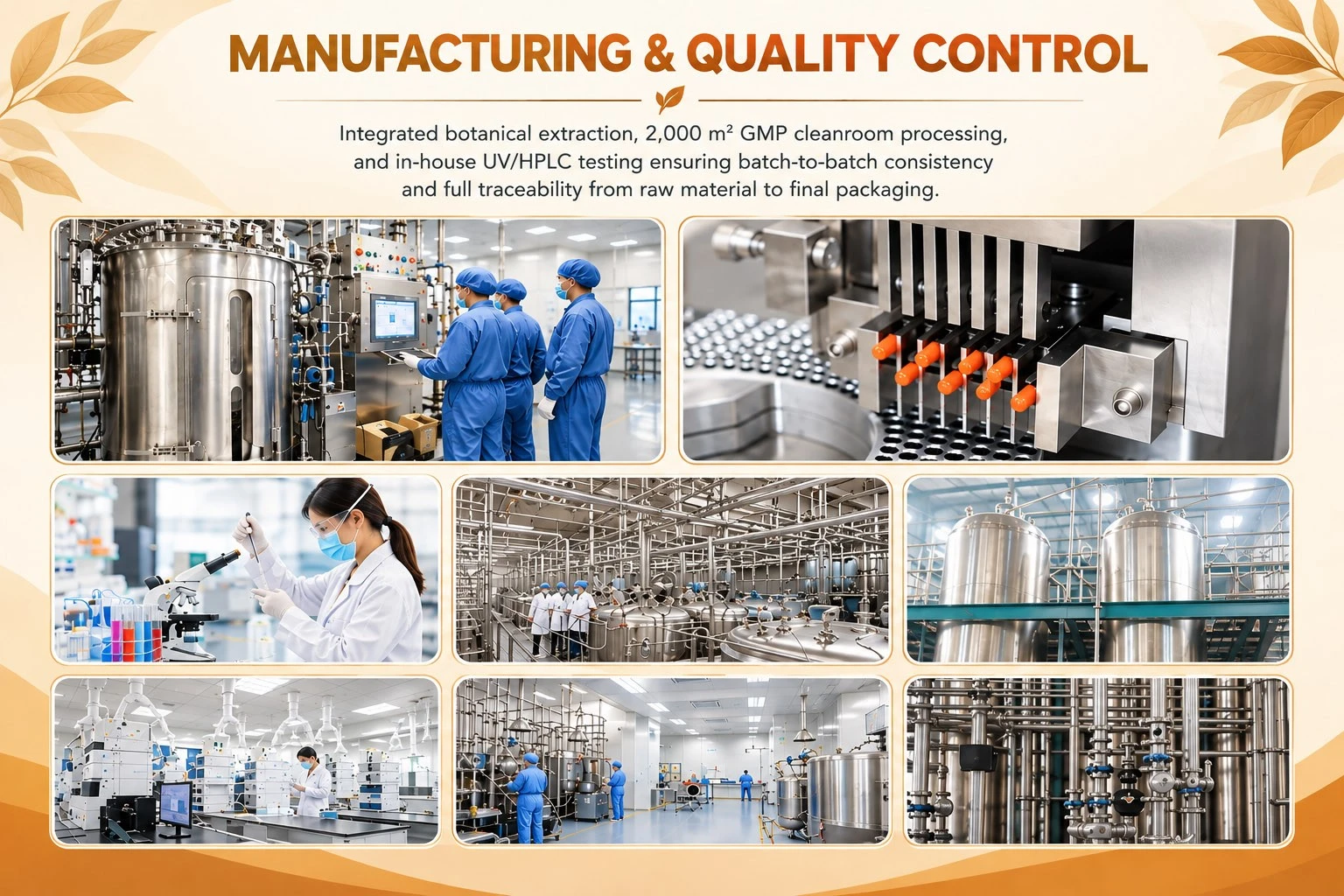
The release lab runs the Brookfield viscosity train (including the statutory 75-to-150 °F ratio reading), headspace GC for solvent residue and ethylene-oxide screening, ICP-MS for four heavy metals, and the full micro battery - with retained samples from every drum held for the complete 24-month shelf claim. COA queries are answered by the analyst who ran the plate, not by a forwarded PDF.
Custom Stabilizer Blends Built on a Gum You Already Spec
Because the xanthan, locust bean gum and guar sides of the synergy table all ship from the same warehouse, custom dry blends are a production reality rather than a sourcing exercise: one-dump dusted premixes on dextrose, hot-set xanthan-LBG pairs proportioned to your tube-test winner, or instant-mix carries for pudding and beverage powders. We blend to your target viscosity band, run your application back on our bench, and pack under your label. Pilot scale starts at one 25 kg drum.

Certifications and the Regulatory File Behind Every Drum
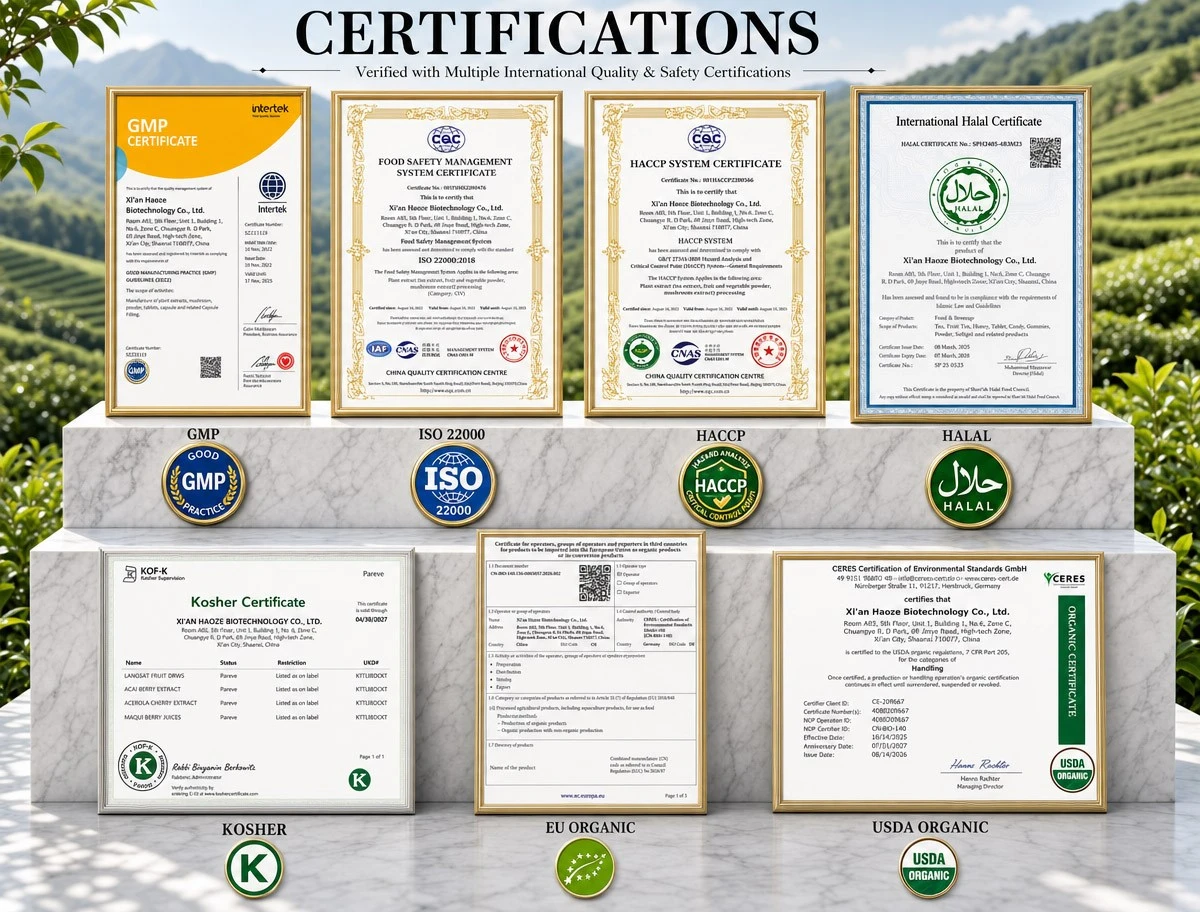
ISO 9001 and ISO 22000 managed quality and food-safety systems, HACCP and FSSC 22000 plans, GMP manufacturing, Halal and Kosher certification for the gum system, FDA facility registration, and a TUV audited site record - the same file your qualification team reviewed if you already buy our seed gums, now extended to the fermentation product. Xanthan-specific documents (strain qualification, solvent-route declaration, substrate statement, ethylene-oxide non-detect report) join the lot package by default; organic positioning is deliberately absent and never claimed for fermented gums.
Packaging and Global Logistics
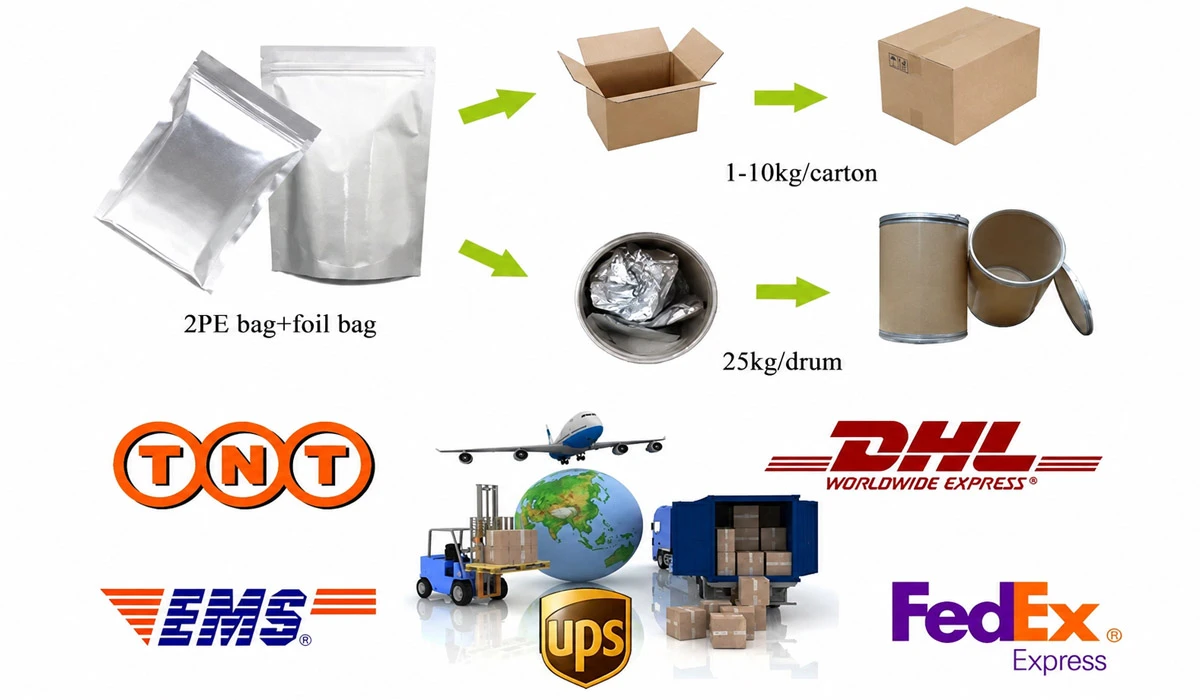
Xanthan is the most hygroscopic of our three gums - it will pull humidity out of a warehouse and turn it into a brick. Standard packing is 25 kg net in PE-bag-in-board drum, palletized on heat-treated ISPM-15 stock with corner boards and stretch wrap; kraft-bag packing is available for full-container programs. Dispatch runs 3-7 working days from order confirmation for stock grades, with expedited air for lab and pilot quantities, and the standard document set (commercial invoice, packing list, COA, certificate of origin, phytosanitary) issues with every shipment.
Buyer FAQ - Dispersion, Dosing and Declarations
Q1: My xanthan keeps lumping with dry white centers in cold water. Is the gum bad?
A: No - it hydrates extremely quickly, which is the intended behavior of the product. Xanthan fully hydrates cold, so any particle that meets still water seals into a shell before the inside wets. Pre-blend it one to ten with dry sugar from your formula (or slurry in cold oil), feed into a vigorous vortex, shear 2-5 minutes. Same gum, zero fish eyes.
Q2: What dose do I actually start at?
A: Build from the bottom: 0.05-0.30% for beverage suspension (against particle load), 0.10-0.30% pourable dressings, 0.30-0.80% thick sauces, 0.15-0.70% of flour weight in gluten-free bakery. The right starting point is the lowest dose that passes a pour test and a shelf-stillness test; higher doses add texture risk without improving stability.
Q3: Xanthan versus guar versus locust bean gum - three sentences?
A: Guar: the most economical cold hydrator, works well at neutral pH, gradually loses thickness over shelf life below about pH 4. Xanthan: hydrates cold, stable in acid and through heat, with the shear-thinning suspension curve. LBG: an economical body that does not hydrate until heated past roughly 80 °C, then acts as the gel partner that turns xanthan from a thickener into a set dessert system. For processes without a heat step and with a pH under about 4, xanthan is the standard choice.
Q4: Can we carry gluten-free or soy-free claims on a fermented product?
A: This depends on the labeling rules of the destination market. The polymer is purified away from the medium, but media can be corn, wheat or soy derived. We issue a substrate statement with every lot and, for contract accounts, a gluten ELISA result below the 20 ppm US claim threshold - the bar FDA set for fermented and hydrolyzed foods in its 2021 rule. The claim decision rests with your regulatory team, based on the lot documents.
Q5: Our citrus RTD drops viscosity after four weeks - is that the gum?
A: Usually the wrong gum was chosen, or the water activity was. Xanthan holds viscosity across the full beverage pH range and through pasteurization; guar at pH 3 slowly hydrolyzes and thins - that thinning profile points to guar rather than to a xanthan defect. Check enzymes too: pectinase carryover in juice can attack companion gums, not xanthan itself. Send us the drop curve; we will rebuild the stabilizer spec against it.
Q6: How do I verify I am receiving real food-grade xanthan rather than an industrial substitute?
A: Run the three checks the CFR itself prescribes - 1% plus 1% KCl viscosity at least 600 cP, V1:V2 ratio between 1.02 and 1.45, and the locust bean gum gel reaction - then ask for pyruvate above 1.5% and the residual-solvent GC number. Our COA reports all five, which is what separates food-grade material from industrial substitutes. Third-party retest of any retained sample is available on request.
Q7: What do samples, MOQ and lead time look like?
A: Free 100-500 g evaluation samples (air courier, 3-5 days) with the lot COA attached; pilots from one 25 kg drum; stock grades dispatch in 3-7 working days, containers weekly. Send the application, target pH and target viscosity; the technical team replies with a suggested dose ladder and the matching grade.
Request Xanthan Gum Evaluation Samples, Batch COA and Bulk Pricing
Send the system you are stabilizing (beverage, dressing, bakery mix or blend program) and the technical team will reply with a dosing ladder, the matching viscosity grade, identity-check results from a recent lot, and pricing for 25 kg drums or container volume. Email info@haoze-bio.com, or use the contact page.