


Executive Procurement Summary
Sakura latte premix is a dry blended base for cherry-blossom flavored milk drinks, built for two serving formats: a ready-to-drink (RTD) bottle or carton filled at a co-packing line, and a café dose dissolved into hot or cold milk. The blend carries three separate jobs - aroma from sakura, sweetness and body from the dairy or plant base, and a pale pink that survives refrigerated shelf life - and each one fails differently, so each one needs its own acceptance number before a first order is placed.
Private-label runs start at 100 bags (MOQ), which is a market-test quantity rather than a production commitment. Inclusion of sakura is set between 0.5 and 3.0 percent by weight of the dry blend and is bounded by the coumarin measured in the lot rather than by habit: coumarin carries a tolerable daily intake of 0.1 mg per kg of body weight per day, and the arithmetic behind that figure belongs in the specification pack, so a label claim can be sized before a formula is locked. Color, sediment and dispersion are specified against measured methods. Blending, sieving, metal detection, packing and lot release are handled here; each shipment ships with its own certificate of analysis.
Flavor, Color and Body Are Three Separate Jobs in One Spoon
A floral milk drink is built from three powders that are routinely confused with each other, and the confusion is where most first formulations fail. Sakura supplies aroma and a seasonal cue. Matcha supplies body, bitterness, caffeine and a green base tone. Ube, true purple yam, supplies color and a starchy thickness. None of the three substitutes for another: sakura carries very little pigment load for the volume it is dosed at, matcha carries no floral top note, and ube thickens whether the recipe wants it to or not.
Because the three behave differently in the same cup, the blend is specified by job rather than by ingredient list. Specify each powder by the job it is bought for, and read the failure mode as what shows up on a filling line rather than in a kitchen trial.
| Powder in the Build | What It Is Bought For | What It Does Poorly | Failure Mode on the Line |
|---|---|---|---|
| Sakura (cherry blossom, Prunus spp.) | Aroma and the seasonal signal. The characteristic sweet, vanilla-like note comes from coumarin formed when the leaf or salt-cured flower ferments. | Color at the doses a formula can legally and sensibly carry; and it contributes almost no body. | Aroma lost to the heat step, and whatever pink survives dosing is washed out by the pH of milk. |
| Matcha (stone-ground green tea) | Body, bitterness, caffeine and green tone; it is what stops a latte from tasting like sweetened milk. | It is a suspended leaf solids, not a soluble extract, so it always wants to settle. | A sediment ring in the bottle and an olive-brown shift once the fill temperature and pH are wrong. |
| Ube / purple yam (Dioscorea alata) | Deep purple and starch-driven thickness, useful when the drink is meant to read as a dessert. | Color stability across a pH swing, and it can be counterfeited in the market by dyed taro or purple sweet potato. | Gray-blue cast over milk, and a pasty or thread-like mouthfeel once the starch load exceeds what the recipe can carry. |
All three are in the program and all three can sit in one blend, which is how a sakura-matcha or sakura-ube build is assembled. Where only the aroma is wanted, sakura goes in alone and the body comes from the dairy or creamer base instead.

The dish holds the blended premix as it leaves packing: a pale, faintly pink free-flowing powder, fine enough that no individual grain reads at normal viewing distance, scraped level with a sampling scoop resting in it. The dried blossom at the left is the aroma source. Judge the color against the working dose in milk rather than against the powder in the dish: at the inclusion rate this blend carries, the drink reads as a soft blush rather than the saturated pink of a syrup-based café drink, because the pigment travels in the aroma ingredient and that ingredient is dosed by flavor, not by color.
How Much Sakura Can a Formula Carry?
The answer is a calculation, not a habit, and the variable that decides it is coumarin. Cherry leaves and, to a lesser extent, the flowers contain coumarin; the salt-curing step that Japanese producers use generates more of it, which is precisely why cured leaf smells of vanilla. In the United States, 21 CFR 189.130 prohibits food containing added coumarin - coumarin as such, or brought in through tonka beans or tonka extract. That language matters: it addresses coumarin put in as a flavoring compound, not a botanical ingredient that carries coumarin as a natural constituent, and the difference is why sakura-flavored products reach the US market with an exposure file behind them rather than with an additive approval.
The reference point for that exposure file is the European tolerable daily intake. EFSA set the coumarin TDI at 0.1 mg per kg of body weight per day, which is about 6 mg per day for a 60 kg adult. A 2024 US GRAS notice covering a sakura leaf distillate used exactly this frame: the estimated intake from the proposed use was calculated at 0.009 mg per kg body weight per day, roughly eleven times below the TDI, and the ingredient was concluded safe at the measured levels. That document is the closest published analogue to what a sakura latte does, and it is worth reading before a first order rather than after a complaint.
The same arithmetic scales down to a spoon of premix. Take a 20 g single-serve dose, a sakura inclusion rate, and the coumarin measured in the delivered lot - 300 mg per kg is used as the worked example in this calculation, not as a specification, because the figure belongs to the lot and we report it on the certificate:
| Sakura in the Dry Blend | Blossom per 20 g Serving | Coumarin per Serving at 300 mg/kg | Share of a 6 mg Daily TDI |
|---|---|---|---|
| 0.5% - aroma hint, dairy-forward | 0.1 g | 0.03 mg | 0.5% |
| 1.5% - the usual working point | 0.3 g | 0.09 mg | 1.5% |
| 3.0% - assertive floral, Japanese-style | 0.6 g | 0.18 mg | 3.0% |
Two things fall out of that table. First, the dose a latte actually needs sits two orders of magnitude below the tolerable intake, so the working ceiling for sakura is set by flavor and by cost, not by coumarin. Second, the arithmetic only holds once the measured figure is in hand: published work on cherry leaves reports coumarin spanning from effectively nothing to well over a gram per kilogram depending on species, leaf versus flower, harvest week and curing method. A blend built on an assumed number and delivered against a measured one is the failure mode, which is why coumarin appears as a reported line on the certificate rather than as a paragraph of reassurance.
Where a build carries matcha as well, caffeine moves onto the same worksheet. It is declared per serving at the finished dose, measured on the lot, and it decides whether the product is sold as a beverage or positioned where a Supplement Facts panel applies. If the destination is a new dietary ingredient notification, 21 CFR 190.6 sets the clock at 75 days before introduction and expects the Latin binomial name of the botanical on the paperwork - which is the same reason the species question under sourcing is not pedantry.
Why Does Sakura Pink Turn Gray in Milk?
Because the pigment class involved is pH-indicating by nature. Anthocyanins read red where the solution is acid, and as pH climbs they lose the flavylium structure that carries the red, shifting through colorless toward blue-gray in alkaline conditions; peonidin-type pigments, the family behind many purple roots and blossoms, are documented turning deep blue at pH 8. Milk sits at roughly pH 6.6 to 6.8, and a neutral latte base with milk powder is not far below that. At that pH a blossom-derived pink is being asked to hold a color it was never stable in, which is why the honest options are to move the drink or to move the expectation.
A second, smaller effect runs the same way. Blossom pigment load per gram is low relative to the dose an aroma-driven formula can carry, so the pink in the cup is thin to begin with; and a salt-cured input brings sodium alongside aroma. Both push the practical answer toward specifying a measured color target and a photograph taken under fixed conditions, rather than toward a higher inclusion rate.
| Design Decision | Neutral Build, pH 6.6 to 6.8 | Acidified Build, pH 4.2 to 4.6 |
|---|---|---|
| Color outcome | Soft blush drifting to gray-pink across refrigerated shelf life; accept and specify it on a color card. | Pink holds, because the anthocyanins keep the red form; this is the route if the shelf-facing color is the product. |
| Protein risk | None from acidity; casein is comfortable here. Heat stability of the milk protein is the only live question. | pH 4.6 is the casein isoelectric point, so without a stabilizer the drink flocculates and rings. |
| Stabilizer needed | Generally no. A low dose of a seed gum is used only when insoluble matcha or blossom fines must be held. | Yes. Pectin is the conventional choice; propylene glycol alginate is the acid-tolerant alternative and stays soluble and active through the pH 3 to 5 band where a plain alginate drops out. |
| Flavor interaction | Milk sweetness dominates; sakura reads as a top note. | The acid lifts the floral note and makes the drink read as a yogurt-style beverage rather than a latte. |
| Category on the label | Milk beverage or coffee-style drink, depending on the base. | Acidified milk beverage, which is a different food category in both the European and Codex schedules - check the additive allowances there, not in the neutral column. |
Choose the route before the flavor intensity is discussed. It decides the stabilizer list, the label category and how the color will be judged, and switching routes after a formula is signed is a re-formulation rather than an adjustment.

Both glasses hold the same premix at the same dose; only the finished pH differs. The left glass sits at milk pH, around 6.7, where the pigment has left the red form and the drink reads cool and ashy. The right glass is acidified into the pH 4.2 to 4.6 band, where the pink returns and holds across refrigerated shelf life, at the cost of a stabilizer the neutral build does not need. Photograph the two under one light source before committing to a route: it settles the color conversation with a brand owner faster than any specification line can.
How Are Sediment and Fading Measured Instead of Argued?
Milk-based ready-to-drink products fail physically before they fail chemically, and the published work says so directly: sediment in ready-to-drink coffee is dominated by carbohydrate material, while latte-type products are governed by protein-mediated interactions, and the standard way to rank milk-protein beverages on heat stability is thermal treatment followed by centrifugal separation, gravimetric measurement of the sediment and a particle-size read.
That is the framework we hand over with the samples, because it is the framework a co-packer will use to judge whether the blend belongs in their line. Four measurements, at day 0 and then at the intervals the shelf claim requires:
| What Is Measured | How | What the Number Protects | Our Release Figure |
|---|---|---|---|
| Color drift | Instrument ΔE against the day-zero reference, in the primary package, refrigerated and light-exposed in parallel. | The shelf-facing promise; a pink that fades is a returns problem before it is a taste problem. | ΔE at or below 2.0 by day 90, at or below 3.5 at the end of the shelf claim. |
| Serum separation | Settled volume read on a still bottle at 25 °C, no shaking before the read. | The ring on the shoulder that a consumer photographs. | At or below 1.0% by volume at 90 days. |
| Particle size after homogenization | Laser diffraction, volume-weighted mean diameter, reported with the method and medium. | Dose uniformity top to bottom, and how fast the insoluble fraction will settle. | D[4,3] at or below 45 µm at a two-stage 150 / 50 bar setting. |
| Cold dispersion | Stirred into water or milk at 20 °C for 30 seconds, then inspected against a black-and-white card. | Whether the line needs high shear, a pre-blend, or a warm step it did not budget for. | No visible aggregates or film; no dry core. |
Run the panel at three doses rather than one, and hold one bottle at 40 °C alongside the 25 °C reference. The accelerated bottle is what tells you at day 14 whether a spring launch will still look right at the far end of a refrigerated code date.
Getting It Into Water at 20 °C Without a Gel Core
A sakura latte premix is a hygroscopic mixture: sugar or a polyol on the outside of each particle, milk solids that wet slowly, and a fine botanical fraction that floats. Dropped straight into cold water the blend does exactly what sweetened drink mixes always do - the outer layer hydrates first, forms a skin, and shields a dry white core that no amount of further stirring will reach cleanly.
The protocol that avoids it is the same one that governs every flavored drink mix we pack. Pre-blend the premix with five to ten times its weight of the dry sugar or creamer fraction from the recipe, so each particle arrives at the liquid already separated. Add the pre-blend slowly to a moving vortex rather than dumping it into a still surface. High shear for two to five minutes, then a short rest to let entrained air clear before anything is filled. Where the formula carries an acidified dairy base, the stabilizer goes into the same dry pre-blend rather than being dosed as a slurry, because a gum added to liquid after the protein has already begun to flocculate cannot redisperse it.
Two product-specific points follow from the blossom content. Sakura fines are light and partly hydrophobic, so they prefer to sit on the surface rather than suspend; a low dose of a cold-hydrating gum is the normal way to hold them, and it is the same reason anise and chia-style suspensions are specified with xanthan rather than with a seed gum. And because aroma is volatile, whatever is dosed for scent at 20 °C is not the same quantity that survives a hot fill, which is why the aroma level is built around the destination process.
Species, Salt, Sulfite and the Pesticide Screen
Four sourcing questions decide whether a sakura input behaves the way the specification says it should, and all four are settled at order rather than at inspection.
Which sakura. "Sakura", the Japanese word for cherry blossom, is not one plant. The commercial food materials are Oshima-type (Prunus speciosa, the species behind the 2024 US GRAS filing, valued because its leaves carry the strongest coumarin aroma), Somei-Yoshino and Yedoensis, and salt-cured flower and cured leaf are different inputs with different aroma, salt and pigment profiles. A specification that names only the common name cannot be verified against a certificate, which is why the certificate names the species and the part used.
How much salt came with it. Traditional preservation is brine-curing, and cured material carries surface salt that shows up in the sodium line of a nutrition panel long before it shows up on the palate. Rinsing and controlled re-drying reduce it; the trade is a loss of the volatile aroma that was the reason for buying cured material in the first place. Specify the sodium contribution you are willing to declare, and the input is built to it.
Sulfur treatment. Blossom material is in some supply chains treated to hold color. This is a labeling trigger rather than a quality preference: in the United States a sulfiting agent present at 10 ppm or more in the finished food must be declared on the label under 21 CFR 101.100(a)(4), while 21 CFR 130.9 restricts sulfiting agents in specified raw produce and food-service uses, and undeclared sulfiting agents are a standing basis for import detention; the European threshold for mandatory declaration is the same figure expressed as 10 mg/kg of SO₂. Because the trigger is calculated on the finished drink, a treated input can put a declaration on a label nobody intended to carry one.
Pesticide screening. Flowers are not a commodity with a tidy residue table, and an unlisted substance falls to a default limit of 0.01 mg/kg in the European schedule. The published sakura processing file screens incoming leaf against 473 analytes under Japan's positive-list system, which is the practical benchmark to ask any supplier for; a certificate that lists heavy metals and micro but is silent on residues has not answered the question.
Where the Aroma Goes In, and What the Heat Step Takes Away
Coumarin and the accompanying volatiles are carried by steam, so a blend designed for a hot-fill or retort line loses aroma in the same step that sterilizes the drink. Two responses are used in practice and they are not interchangeable. Either the blossom fraction is kept out of the pre-mix and dosed post-process as a separate aroma addition, which preserves the note but splits the ingredient into two additions on the label and two dosing steps on the line; or the blend is dosed high enough before heat that an acceptable note survives, which costs more and shifts the flavor toward a cooked, caramelized register that some brands want and most spring launches do not.
For refrigerated, pasteurized bottles the pressure is lower: a short high-temperature hold followed by rapid cooling leaves most of the aroma intact, and the color becomes the binding constraint instead. For a powder that a café or a consumer dissolves at 60 to 80 °C, neither problem exists, which is why the same blend can behave well in one channel and badly in another. State the thermal profile of the destination process at sampling, and the aroma level in the formula is built around it rather than adjusted afterwards.
Formats, Quantities and What Private Label Covers
Whether the order is an OEM formula or an ODM starting point, Haoze Bio owns the batch end to end: formulation, dry blending, sieving, granulation where an instantizing step is specified, filling into the chosen retail format, metal detection, packing and lot release. The format is chosen against how the drink is sold rather than against what is easy to pack: single-serve sticks of 3 to 25 g suit vending, café counters and sampling programs; 100 to 500 g stand-up pouches suit a direct-to-consumer SKU and the small-brand shelf; 1 to 5 kg foodservice pouches suit an independent café making the drink by the jug; and 25 kg drums suit a co-packer dosing from a hopper.
Private-label runs start at 100 bags. That MOQ exists deliberately. A brand testing a spring flavor should be able to order a shelf's worth, watch what the retail data says, and come back for a pallet, rather than committing to a minimum that only a distributor can absorb. Sample packs of 100 to 500 g go out free of charge for bench work, courier on the recipient's account, and stock formats dispatch in 3 to 7 working days while blended and filled lots are scheduled at purchase-order confirmation.

On the label side the support is structural rather than advisory: ingredient sequence from the actual formula, nutrition panel built from the declared composition, net-quantity statement against the target market's rules, and the declaration triggers that a floral input can trip - sulfiting agents at the 10 ppm threshold, milk as a declared allergen, and soya lecithin if a creamer carrying it is selected. Where a product is positioned as a dietary supplement rather than a beverage, the panel format changes and the 75-day pre-market notification for a new dietary ingredient applies; that determination stays with the brand's own regulatory reviewer, and the documents are prepared to whichever answer is chosen.
Specification and Typical Results
These are the release criteria for the standard sakura latte premix build; a custom formula changes the compositional lines and keeps the safety lines. Typical results come from recent production lots, and the consignment delivered ships with its own certificate of analysis (COA).
| Parameter | Release Criteria | Typical Result | Basis / Method |
|---|---|---|---|
| Appearance | Pale blush free-flowing powder, no caking | Conforms | Visual against retained standard |
| Aroma and taste | Characteristic sakura, sweet-floral, no cooked or musty note | Conforms | Panel against retained standard |
| Moisture | NMT 5.0% | 3.4% | Gravimetric |
| Particle size | At least 95% passes 80 mesh (180 µm) | 98% passes | Test sieve |
| Bulk density | 0.35 to 0.55 g/mL | 0.44 g/mL | Untapped |
| Cold dispersion at 20 °C | No visible aggregates after 30 seconds stirring | Pass | Black-and-white card inspection |
| Sakura inclusion | 0.5 to 3.0% of the dry blend, per agreed build | 1.5% | Formulation record |
| Coumarin | Reported per lot | Reported | LC-MS |
| Caffeine | Reported per lot where the build carries tea | Reported | HPLC |
| Sulfur dioxide | Below the 10 mg/kg declaration threshold | Not detected | Distillation / ion chromatography |
| Ethylene oxide and 2-chloroethanol | Not detected at 0.1 mg/kg | Not detected | GC-MS headspace |
| Lead / Arsenic / Cadmium / Mercury | <2.0 / <1.0 / <0.5 / <0.1 mg/kg | <2.0 / <1.0 / <0.5 / <0.1 | ICP-MS |
| Total aerobic plate count | NMT 5,000 CFU/g | 190 CFU/g | Plate count |
| Yeast and mold | NMT 500 CFU/g | <100 CFU/g | Plate count |
| Coliforms / Salmonella | Absent | Absent | Defined substrate |
| Allergen statement | Milk declared; soya declared if a lecithin-bearing creamer is in the build | Statement issued | Recipe and line review |
| Shelf life and storage | 24 months sealed, cool, dry, out of direct light | 24 months | Retained-sample protocol |
When This Is the Wrong Blend to Specify
Four situations call for a different product, and it is cheaper to say so at sampling than at the second production run. A clear or translucent beverage cannot be made with this blend: blossom and tea fractions are suspended solids, not extracts, and they will haze and settle a clear pack. A carbonated format is a poor fit for the same reason, since nucleation on fine particles turns the head into a filling-line problem. A product that must be bright, saturated pink on shelf is better served by a color-forward build around purple yam or a permitted color, because a blossom dosed for flavor will not deliver that hue at any inclusion rate a formula can carry.
The fourth case is regulatory rather than physical. A ready-to-drink can and a capsule or stick sachet sell into different rulebooks, and a botanical input that behaves as a flavoring in a milk beverage may be treated as a dietary ingredient somewhere else. Where that distinction matters to the launch, settle it with the destination market's own reviewer before the format is chosen, and bring the measured coumarin and caffeine figures to that conversation rather than a marketing sheet.
Who Owns the Batch, and What the Batch File Contains
Botanicals and dairy do not arrive from a single source, and the composition of a latte premix is worth little if nobody is accountable for how the parts were qualified. Blossom and leaf material, stone-ground tea and yam powder come in through qualified supplying lines; from receipt onward the work is ours and sits in one infrastructure - incoming lot sampling, identity and residue review, sieve classification, dry blending to the agreed formula, granulation where instantizing is specified, metal detection, packing and documented release.

The batch file that travels with a release carries the certificate of analysis for the finished blend, the incoming material identity records, the sieve and moisture results from the blending lot, the metal-detection verification record, and retained-sample documentation held for the full 24-month shelf claim. Specification questions on a delivered lot are answered by the analyst who ran the tests, which is the difference between a supplier who holds a file and a supplier who forwards one.

Certifications and the Document Set Behind Each Pallet
The quality systems behind the blend are those of the group operation: ISO 9001 and ISO 22000, HACCP, FSSC 22000 and GMP, with the site subject to on-site third-party audit. Halal and Kosher documents are part of the standard consignment paperwork, and the facility holds FDA food-facility registration for exports into the United States. Organic certification is not offered for a blended dairy format of this kind, and the blossom input is outside the organic scope that covers several of our single-ingredient botanical powders.
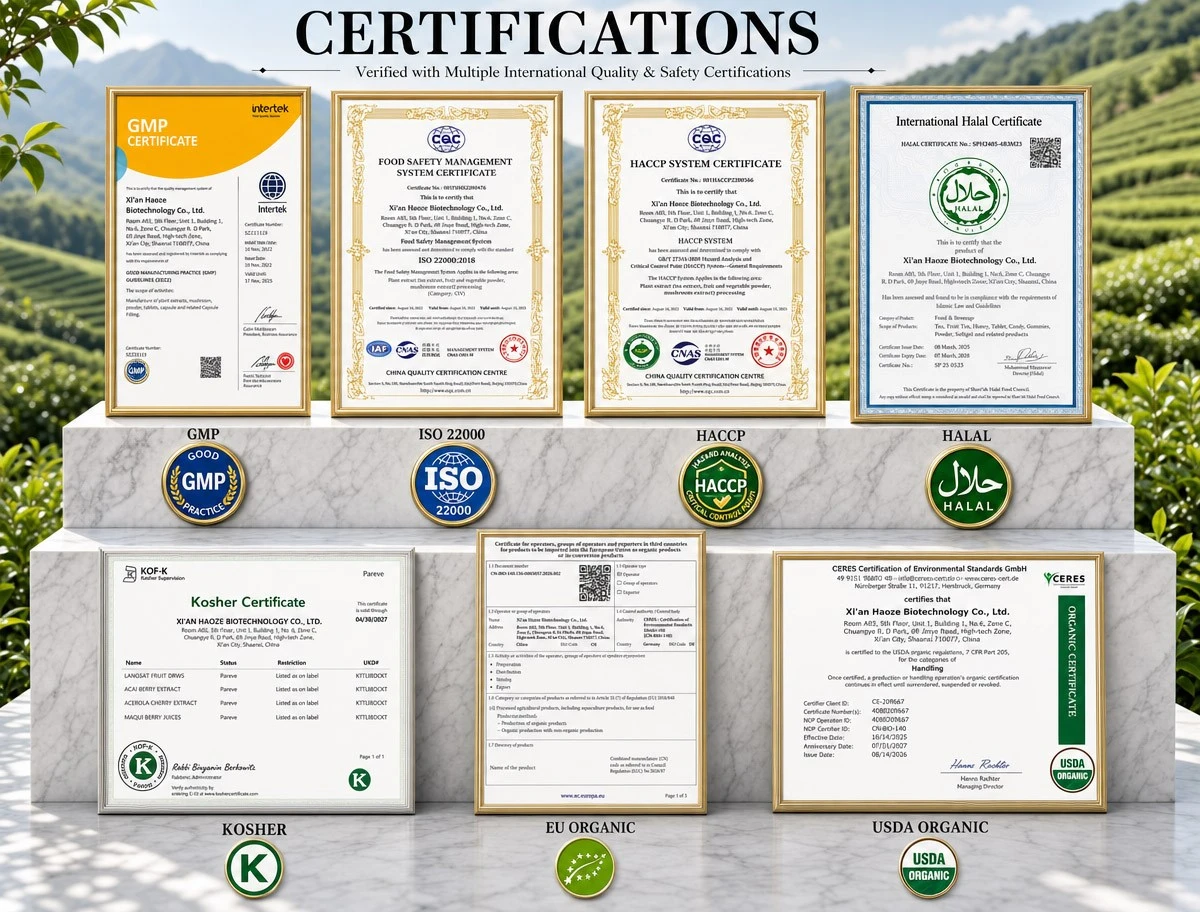
What sits on top of the certificates is the part a beverage buyer actually needs: specification and allergen statements, the residue and sulfite position for the delivered lot, a non-irradiation and ethylene-oxide statement, country-of-origin documentation, and the composition data needed to draft the nutrition panel before artwork is locked.
Packaging, Barrier Choice and Shipping
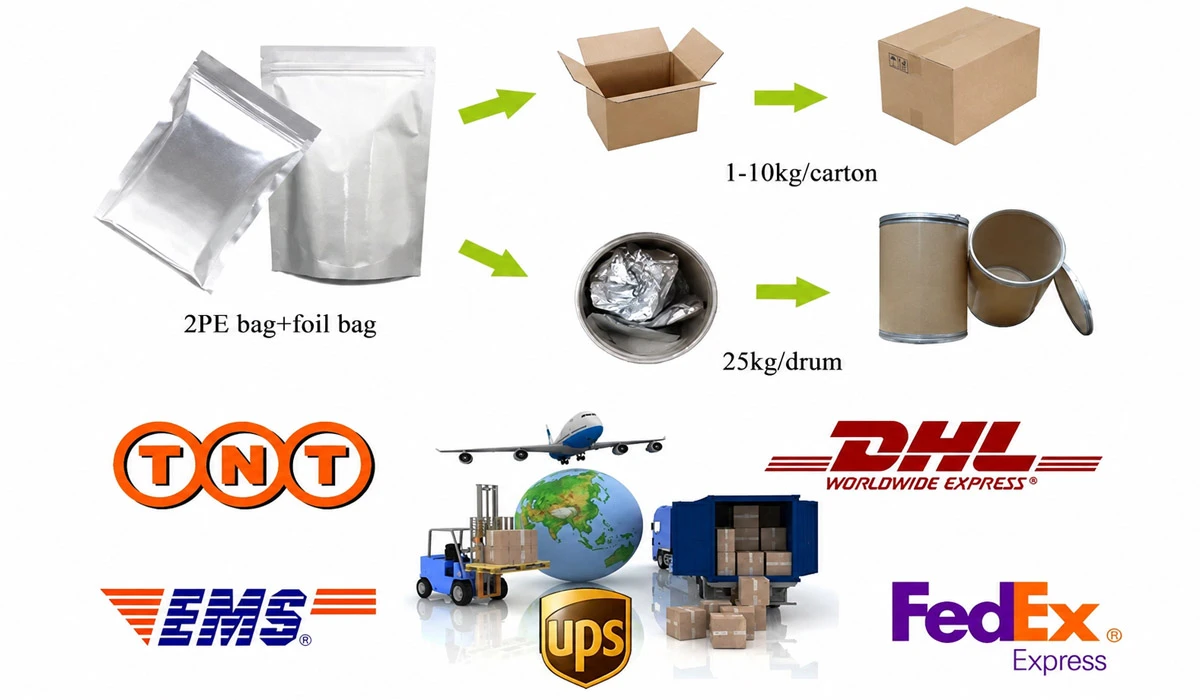
Sugar-based premixes are hygroscopic and blossom aromas are volatile, so the barrier is a functional decision rather than a cosmetic one. Metallized or high-barrier laminate structures hold both aroma and free-flow; a clear single-web pouch lets moisture in and lets the floral note out, and the failure arrives as a cake at the bottom of the bag with a flat cup. Retail stand-up pouches, single-serve sticks, foodservice foils and 25 kg liner drums are all packed on the same program, with nitrogen flushing available on formats where the account requires it.
Sample packs of 100 to 500 g move by courier within 3 to 5 days; stock formats dispatch in 3 to 7 working days; blended and private-label lots are scheduled at purchase-order confirmation and ship air or sea with the export documentation prepared for the destination. Palletization follows ISPM-15 and the packing list is issued with the lot certificate so a receiving QA team can reconcile a delivery without opening drums to find out what is in them.
Buyer Questions on Sakura, Milk pH and Bottle Life
Q1: Is sakura permitted in a US beverage, given the coumarin position?
A: The US rule at 21 CFR 189.130 addresses added coumarin, whether dosed directly or carried in through tonka beans or tonka extract; it is not an approval route for the botanical itself, and it is not the same question as a blossom ingredient that contains coumarin naturally. What a US launch needs is an exposure case: the measured coumarin in the delivered lot, the inclusion rate, the serving size and the resulting intake against the 0.1 mg per kg body weight per day tolerable intake. A 2024 GRAS notice for a sakura leaf distillate was built on exactly that reasoning and came out roughly eleven-fold below the TDI. Whether a specific product may be marketed is a determination for the brand's own regulatory reviewer; the lot data and the calculation are supplied so that determination can be made.
Q2: My sakura latte pours gray instead of pink. Is the lot wrong?
A: In most cases the lot is fine and the pH is doing what pH does. Anthocyanin-type pigments read red in acid and drift through colorless toward blue-gray as pH rises, and milk sits at about pH 6.6 to 6.8, so a neutral latte is asking a blossom pigment to hold a color outside its stable range. Either move the drink to an acidified build at pH 4.2 to 4.6, accepting that the protein then needs a stabilizer, or keep the neutral build and set the color expectation on an agreed card with a measured ΔE limit instead of a photograph of a competitor's syrup-based drink.
Q3: How much sakura goes into the blend, and how much ends up in the cup?
A: Between 0.5 and 3.0 percent of the dry blend, and the working point is usually 1.5 percent. At a 20 g single-serve dose that is 0.1 g at the low end and 0.6 g at the top, with the flavor rather than the color deciding where in that band a brand lands. The same figure sets the coumarin load, so the inclusion rate and the exposure calculation are the same conversation.
Q4: Does the blend need a stabilizer for a bottled drink?
A: For a neutral build, usually not: the question at pH 6.7 is heat stability of the milk protein rather than electrostatic protection. For an acidified build, yes. At pH 4.2 to 4.6 the casein is sitting on its isoelectric point at 4.6 and will flocculate and ring without a stabilizer. Pectin is the conventional answer; propylene glycol alginate is the acid-tolerant alternative, staying soluble and surface-active through pH 3 to 5 where a plain alginate precipitates, and it carries no gel-setting behavior with calcium. Where the build includes matcha, a small dose of a cold-hydrating gum is added on top of that to hold the leaf solids.
Q5: What do I have to declare because the blossom was cured or treated?
A: Two triggers are common. Sulfuring agents used to hold color become a declaration item once the finished food reaches 10 ppm in the United States or 10 mg/kg as SO₂ in the European Union, and because the threshold is calculated on the finished drink a treated input can put a label statement on a product nobody intended to carry one. Salt carried over from brine-curing is the second: it lands on the sodium line before it lands on the palate. Both are specified at order, and both are reported on the certificate for the delivered lot.
Q6: Which sakura is actually in the drum?
A: It has to be stated, because sakura is a category rather than a species. Oshima-type Prunus speciosa is the food material behind the published US GRAS work and carries the strongest aroma in its leaves; Somei-Yoshino and Yedoensis are flower materials with a lighter profile, and cured leaf and cured flower are separate inputs with different salt and aroma loads. The certificate names the species and the part used, which is also what the labeling and any new-dietary-ingredient paperwork will ask for.
Q7: Samples, quantity, packing and lead time?
A: Evaluation samples of 100 to 500 g are provided free of charge with courier on the recipient's account, and formulation samples are built to the target pH and thermal profile rather than to a generic recipe. Wholesale private-label runs start at an MOQ of 100 bags. Retail stand-up pouches of 100 to 500 g, sticks of 3 to 25 g, foodservice pouches of 1 to 5 kg and 25 kg liner drums are all available, with nitrogen flushing on the formats that need it. Stock formats dispatch in 3 to 7 working days and blended private-label lots are scheduled at purchase-order confirmation. Shelf life is 24 months sealed, cool, dry and out of direct light.
Send the format you are launching - bottled ready-to-drink, café stick dose or retail pouch - together with the target pH, the thermal step and the destination market. The technical team replies with the inclusion rate and aroma level that survive that process, the measured coumarin and sulfite position for the lot, a color card with the ΔE limit, and quantities from 100 bags. Email info@haoze-bio.com, WhatsApp +86 153 3912 2816, or use the contact page.