


Direct Answer: Before anyone can blend a drink mix for you, six things have to exist on paper: the cup you are aiming at, the powder weight that fills it, how the powder must behave in water, what it has to taste like next to a named product, what it will be packed into and weighed at, and what shelf life you intend to claim. Order size is not on that list, and that is the problem. North American packing quotations commonly start at 20,000 to 50,000 units, and a brand planning 1,000 to 5,000 pouches never gets as far as the machine. At that size the work has to be organised upstream: a dry blend made to a written specification, shipped as a base mix, and packed either locally or on a line that also does the blending. The six inputs, the physics that decides whether a mix survives its pouch, and the ownership of each number on the label are worked through below.
1. Three Order Sizes, Three Different Ways to Fail
A drink mix is not one product with three order quantities. Each quantity is a different supply chain, and each fails in a different place. Sorting out which one you are in prevents most of the expense, because the decisions that matter at one stage are invisible at the next.
The quantities below are typical ranges drawn from public buyer discussions and normal dry-blend practice, not commitments from any single factory. They are useful because they describe where the ceiling sits, and a ceiling tells you which route is closed before a month is spent on email.
| Where you are | How the work is normally organised | What breaks first | What must be fixed before anything is ordered |
|---|---|---|---|
| Trial: a few hundred packs, one market, one shelf | Buy an off-the-shelf base mix and have it packed in small runs, or blend at a pilot scale counted in tens of kilograms rather than tonnes | The cup cannot be repeated. Two people make the drink from the same scoop and get two different products, and neither is what the label describes | Powder weight per serving, and the water volume and temperature that goes with it. Everything else can wait; this cannot |
| Repeating orders: roughly 1,000 to 5,000 packs | A custom dry blend produced against a written specification, then either imported as a base mix and packed locally, or run through a supplier that also fills stick packs and pouches | Physical behaviour rather than taste: the mix sets hard inside the pack, or it separates between the first pack and the tenth, and flavour or colour drifts across a case | Three numbers on the same sheet: the water activity the blend leaves at, the particle size or granulation decision, and the water-vapour transmission rate of the pack intended for it |
| Volume: pallets and containers, several stock-keeping units | Standing specifications, retained samples, scheduled production slots, and a document set that can be handed to a retailer or an auditor without translation | Batch drift and paperwork: every batch is acceptable alone, and no two batches match each other, or the certificate on file does not describe the drum in front of the inspector | A written release specification with limits rather than typical values, a retained-sample and lot-code rule, and the change list that forces a re-test |
The middle row is where both the money and the misunderstanding sit, and it is the one worth reading carefully. A brand at a few hundred packs usually needs an existing specification rather than a new one; a brand at volume has already survived the middle row and is reading different documents.

2. What a Blender Needs in Writing Before Anyone Can Price or Produce
Blenders and packers complain about the same thing, and buyers never expect it: the enquiry that contains a flavour, a colour and a hope. The six items below are the shortest version of a usable brief. They cost an afternoon to write, and they are the difference between a specification that carries through three years of orders and a batch that has to be remade because nobody agreed what good looked like.
| What you hand over | Why it is needed | What the blender does with it | What goes wrong without it |
|---|---|---|---|
| The cup, not the flavour name: water volume, water temperature, and how the drink is made | Shaken, stirred, blended, hot-mixed and simply dropped into cold water are five different formulas | Sets particle size, whether the batch has to be granulated, and how much body the system needs | A mix that dissolves in the laboratory beaker and floats at the shop counter demonstration |
| Powder weight per serving, with the water volume beside it | The two are one number; move either and strength, cost per serving and the panel all move with it | Fixes fill weight on the packing machine and the serving statement the label can carry | Overfill to chase taste, or a pack that reads two-thirds full and looks short on the shelf |
| Three words for the texture, plus one drink you do not want | Sensory language bounds body, coating and chalkiness far faster than pseudo-measurement of them | Chooses between seed gums, xanthan and no gum at all; the comparison of guar, xanthan and locust bean gum on this site sets out where each one stops working | A round of samples that are all nearly right and none reproducible, because the target moved each time |
| Ingredient list with replacement boundaries | Allergens, sourcing limits, clean-label position and the carriers that may or may not be used | Determines supplier, grade, and whether a shared line has to be cleaned and swabbed before the run | A formula that cannot be bought twice, or a declared allergen the brand never intended to carry |
| Pack format, fill weight and the tolerance you will accept | Net content is enforced as an average with a floor on individual packs, so tolerance is a real cost rather than a detail | Sets the forming collar and sealing window, and whether a blend needs free-flow treatment to meter at all | Powder bridging in the hopper, rejects at the checkweigher, or giveaway paid silently on every pack |
| The shelf life you intend to claim, and where the product will be stored on the way to it | Claim and storage decide the testing plan, and the plan is what protects the brand when a complaint arrives | Chooses the barrier, whether a scavenger or desiccant is needed, and what retained samples are tested for and when | Eighteen months printed on a mix that cakes at month four in a warm climate, with no evidence trail either way |
Two of the six decide whether the product survives on a shelf, and both are routinely left out of a purchase order: the state of the water inside the powder, and the pack that has to hold it there. The ready-made latte and fruit mixes in the matcha latte powder and private label strawberry matcha specifications exist for brands that would rather start from a finished sheet than write one, and both carry the same six headings.
3. Can You Copy the Serving Size From the Product You Are Following?
No, and the reason is structural rather than legal caution. In the United States the declared serving size starts from a reference amount customarily consumed for a product category, set out in 21 CFR 101.12 and applied through the labelling rules at 21 CFR 101.9. For a powder consumed after being made into a drink, the category and its reference amount are applied to the beverage as prepared, and the powder quantity is then whatever the preparation directions require. The scoop is not a design choice; it is inherited from a stated direction of use.
Three consequences follow, and they arrive before the first sample is mixed rather than after the label is printed.
The powder weight is derived, not decorative. Write the water volume first, at the temperature and dilution the drink is actually made at. The grams that follow are what carries the sweetener, the acidulant, the dairy or non-dairy solids, the colour and any gum. Move the water and the whole formula rescales; move the grams and strength, cost per serving and the panel have all changed.
Serving count comes out of the pack, not the other way round. A 300 gram pouch that has to deliver ten servings allows 30 grams per serving. If the formula needs 34 grams to taste right, the options are a larger pouch, a different strength, or eight servings on the panel. Each is a commercial decision, and each is cheaper to make before the film is tooled.
Functional dosage is expressed per serving, not per kilogram of mix. A hydrocolloid at a fraction of one percent of the finished drink is a very small absolute weight in a sachet, sometimes below what a low-capacity dosing screw can meter reliably. This is where a formula that is correct on paper becomes unmakeable on a stick-pack machine, so the smallest metering weight the packing line can hold should be known before the formula is frozen.
4. Why Does a Batch That Passed on Monday Cake by Month Three?
Because it was released against moisture, and moisture is the wrong quantity. A powder can leave a plant inside its moisture specification, flow cleanly through a filling machine, and still reach the end customer as a solid mass. Moisture content says how much water is present. Water activity says how available that water is, and availability drives both microbial behaviour and the physical collapse of a powder bed.
Water activity sits between zero and one and corresponds directly to the humidity a product will settle at: the equilibrium relative humidity is the water activity multiplied by one hundred. A powder at 0.30 aw is heading toward equilibrium with air at about 30 percent relative humidity at the same temperature. Put that powder, or one at 0.25 aw, into a warehouse at 70 percent relative humidity and the thermodynamic pull runs into the product. Whether it actually cakes depends on how much water it can take on, for how long, at what temperature and under what stack load, which is why a specification that only says "keep it dry" survives an audit and not a summer.
The mechanism depends on what the powder is made of, and a drink mix usually contains several kinds at once. Spray-dried and other amorphous ingredients - milk and creamer powders, fruit and juice powders, maltodextrin carriers, instant coffee - begin as a rigid glass. Water is an efficient plasticiser, so as those particles take on moisture their glass transition temperature falls; once storage temperature is high enough relative to it, particle surfaces soften, contacts form liquid-like bridges, and the bed consolidates. Crystalline materials behave differently and fail more abruptly: sugar and salt can stay untroubled across a range of humidity, then absorb enough water at the surface to form a saturated solution, and when humidity falls again they recrystallise into solid bridges that bind particles into a cake no amount of shaking will open. Powders carrying meaningful surface fat, cocoa being the usual example in a chocolate mix, can cake through fat bridges at temperatures where water has little to do with it. Compression from stacked cases and electrostatic attraction in very fine fractions account for the rest.
This is why there is no single safe water activity to put on a specification, and why the honest engineering answer is a procedure rather than a number. Establish by measurement the region where this particular blend changes behaviour; then specify an operating band with margin under it, and verify production against that band. One published example is worth understanding precisely: a spray-dried milk powder measured on a dynamic sorption curve showed its inflection at about 0.43 aw, below which water was taken up at the surface and above which uptake became bulk absorption and the curve steepened sharply. That figure belongs to that powder. Carrying it across to a different formula is precisely the mistake that produces a caked pallet.
The same logic explains a complaint usually blamed on a supplier change. In a blend of components starting at different water activities, water moves from the higher-activity ingredient into the lower one until the mixture equilibrates, and the final value cannot be predicted from the starting numbers alone: it depends on how much of each component is present and on how each one holds water. Changing a single ingredient, a different creamer, a different juice powder, a different sweetener carrier, can move the whole blend across its critical region while every incoming certificate still reads in specification.
One boundary should be stated plainly, because dry products are routinely misunderstood here. Low water activity stops microorganisms growing; it does not kill what is already present. Growth of the common spoilage yeasts and moulds becomes impossible below roughly 0.70 and virtually all microbial growth stops under about 0.60, yet the pathogens of concern in dry ingredients can persist for long periods at those levels. A water-activity result is therefore neither a clearance nor a kill step, which is why the microbiological panel on a certificate and the supplier's control programme matter independently of how dry the mix is.
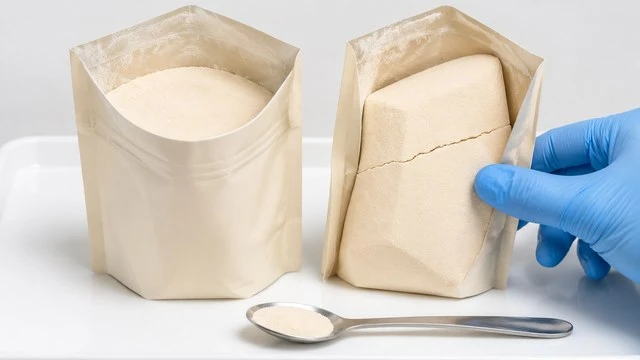
This is the complaint, photographed
Both pouches held the same mix at the same fill weight and sat in the same case. The one on the right took on enough water for its surface to soften, then dried back while carrying the weight of the packs above it. It keeps the seam and the fold of the pouch, and the crack across the middle is where two consolidated layers bonded.
This is why the question at receiving should never be what the moisture is. Ask what the water activity was at release, what the humidity inside a case does across a warehouse and a customer's shelf, and what the pack does about that for that long.
5. The Pouch Is Part of the Formula
A drink mix does not cake in the blending plant. It cakes inside the pack, in whoever's building it stands on, and the pack decides how quickly surrounding air reaches the powder. Water-vapour transmission rate is how that speed is reported, and it is the one packaging figure a brand can specify before a single roll of film is ordered.
Three constructions carry most of this category, and they trade against each other in a predictable way. Aluminium foil laminate offers the strongest resistance to moisture, oxygen and light, costs more per unit of flexibility, cracks when it is creased repeatedly, and complicates finished-pack metal detection. Metallised film, a thin metallic layer deposited on a plastic substrate, gives much of the same barrier at lower cost and survives flexing better, which is why it is common on pouches that travel. High-barrier transparent structures built on ethylene vinyl alcohol keep working after flexing and can be seen through by a metal detector, but lose performance in humid conditions unless the layer is placed and protected properly. For a hygroscopic mix, foil or metallised construction is the default; a transparent front panel is usually a window rather than a barrier.
Three documents settle whether a supplied pouch is the pouch that was bought. Ask the film supplier for all three, whatever the country of origin, and treat the absence of any one of them as the finding:
- A structure bill of materials: every layer, its material, its thickness, and where the adhesive sits. "Metallised laminate" is not a specification; two pouches described identically can differ by an order of magnitude in transmission.
- Transmission data with its test conditions stated. Oxygen and water-vapour rates mean nothing without the temperature and humidity they were measured at, and the pair that matters for a drink mix is a normal-condition reading and a hot-humid one, roughly 23 °C at 50 percent relative humidity and 38 °C at 90 percent. The second figure is what the product actually meets in a warm distribution chain.
- Retention after flexing. Foil cracks. A tumbling test before and after, with oxygen transmission measured both ways, is how a purchaser learns whether the barrier survives being shipped, shelved and squeezed into a shopping bag.
Where metal detection happens is a packaging decision rather than a quality-department habit. Foil and metallised laminates make detection in the finished pack difficult, so on those constructions the control is normally applied to the loose blend before filling, with checks on the filled pack limited to X-ray or destructive sampling. Ask at the quotation stage, in writing: at which station foreign material is detected, to what sensitivity and with which test pieces, and how often the reject mechanism is verified to actually reject. On a transparent or metal-free construction the answer can legitimately be after filling. The wrong answer is that nobody has considered it, because a retailer audit will ask before a customer does.
Buyers comparing suppliers across borders raise packaging provenance more often than any other technical doubt, and it deserves a direct answer rather than reassurance. Origin is not a quality control; documentation is. A pouch that arrives with a structure bill of materials, transmission data at both stated conditions, a flexing retention result, seal-strength and burst data, and a written statement of the food-contact rules its layers comply with for the destination market is usable whichever factory made it. A pouch that arrives with a photograph and a price is not. The same standard applied to the ingredient side is the reason every consignment here travels with a lot-specific certificate rather than a generic one.
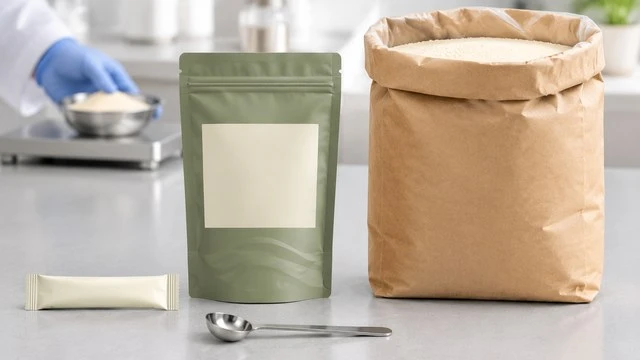
One mix, three fills, three different problems
A stick pack meters by the gram and is sealed seconds after being formed, so it exposes the flow behaviour of the mix directly: bridging in the hopper, dust at the seal, weight drift as the run warms. A resealable pouch is filled in tens or hundreds of grams, often by volume on a smaller line, and its enemy is headspace and settling after the seal. A 25 kilogram sack is a different product entirely: the mix sits there for weeks waiting for someone's line to run.
The pouches and the sack shown here carry no printing by design. A blank matte panel and an embossed pattern are decisions a brand can make before artwork exists; the barrier question above is the one it cannot defer.
6. Mixed Evenly Is Not Packed Evenly
A blend can leave the mixer homogeneous and arrive at the packing machine separated, with nobody having done anything wrong on purpose. Granular material re-arranges whenever it is handled: fine particles fall through coarse ones as a hopper drains, coarser particles rise to the surface of a vibrating bed, and a single drop into a conveyor or a sack is enough to start both processes. It is the same physics that leaves a mixed nut can with the Brazil nuts on top.
In a drink mix the ingredients most at risk are exactly the ones a customer notices: colour, flavour powder, acidulant, sweetener and any low-dose functional addition, all of which are usually the smallest, lightest or most distinctly coloured fraction in the blend. The consequence is not an unsafe product but an inconsistent one, and it is reported in sentences that sound like complaints about quality control: the first sachet was fine and the tenth was pale, one case frothed and the next did not, the bottom of the pouch is darker.
Two controls are worth asking for by name. The first is content uniformity evidence on the first production batch: samples taken from several defined positions in the loaded container, analysed for a marker component, reported against an acceptance limit, with the sampling plan attached rather than merely described. The second is a particle and bulk-density strategy, which returns the conversation to the machine: a coarse, dense, free-flowing granule is far harder to stratify than a fine fluffy fraction, which is one of the main reasons an instant mix is granulated rather than simply blended, alongside dust and wetting behaviour.
If a blend separates, the remedy is rarely more mixing time; a longer run in the same mixer can make segregation worse. The levers are matching particle size and density between components, granulating the fine fraction onto a carrier, reducing drop heights and handling steps before the filling machine, and, where a blend is genuinely heterogeneous, blending at the point of use rather than hoping a pallet survives a container.
7. Net Weight, Allergens and Who Owns Each Number
Net contents are enforced as a distribution rather than a target. In the United States the method used by weights-and-measures officials, set out in NIST Handbook 133, requires the average of a lot to meet or exceed the declared quantity while no individual package falls below the maximum allowable variation, with a separate allowance for moisture. The commercial reading matters more than the mechanism: the average target sits above the declared weight by a margin, every pack carries that margin, and the brand pays for it thousands of times per run. Running light is not an option, so the tolerance conversation belongs in the specification, before the forming collar is chosen.
Allergen responsibility does not transfer with the goods, and the wording is worth understanding precisely. In the United States nine allergens require declaration: milk, egg, fish, crustacean shellfish, tree nuts, wheat, peanut, soya and sesame, the last added with effect from the start of 2023. Advisory statements of the may-contain or made-in-shared-equipment type are voluntary, are not standardised by the regulator in wording or placement, and cannot substitute for the preventive controls behind them. The useful question to a supplier is therefore never whether allergens are present, but which allergens are on this site, which of them are in this room and on this line, what the changeover procedure is, and what evidence is kept when an allergen-containing product runs before or after this one.
Nutrition data divides the same way. A blender or ingredient supplier can hand over composition for each input, the protein, fat, carbohydrate and sugars as declared on each incoming certificate, plus sodium, moisture and the sweetener and colour levels actually dosed, and that table is what makes a panel calculable. The finished panel itself, its rounding, its serving statement and its claims are a labelling decision for the brand and its regulatory reviewer, against the rules of the market the product is sold into. A supplier who simply supplies a finished panel without being asked for the inputs behind it has handed over an opinion, not a dataset.
8. Shelf Life: Who Runs the Test, What Is Measured, What Forces a Rerun
A shelf life is two separate questions that are habitually collapsed into one. The first is safety, and for a dry mix with water activity held in the low band it is rarely the binding constraint. The second is quality, and it is what ends the sellable life: flow, colour, aroma, sweetness balance, dissolve time and the appearance of the drink made from it. A mix that is safe at eighteen months can be unbuyable at four.
A usable plan has four parts, and only one of them is a laboratory. Before anything is stored, write down what failure looks like in the customer's hands: powder that will not break up when the pouch is shaken, a colour more than a stated distance from the approved standard, a dissolve time beyond what the preparation instructions promise, or an off-note above a stated score from a small trained panel. Without that sentence a study reports that nothing changed, and the complaint arrives anyway.
The samples have to come from the real production run in the real packaging, not from a bench trial in a jar. This is the most common way a shelf-life file becomes worthless: the pack tested was not the pack sold. The checks at each interval then cover water activity and moisture, appearance and flow, the drink made to the label directions, the microbiological position at the start and where the product sits on its own certificate, and the pack itself for seal integrity, swelling or leakage. Accelerated storage at elevated temperature and humidity shortens the wait, and it remains a prediction rather than a proof: the usual temperature heuristics assume the degradation mechanism does not change with temperature, which is exactly what a caking or browning problem tends to do.
Does holding an accelerated trial twice as long buy twice the claim?
No. A longer accelerated hold extends the confidence of a model, not the right to print a number, and it can mislead in both directions. A mix that survives heat may still fail in a cold store through condensation on the inside of the pack, and a mix that survives a hot chamber may have avoided a mechanism that only operates at ambient, such as slow fat migration in a chocolate system. Real-time storage in the sold pack runs in parallel and is the record the brand keeps; accelerated data is what allows a launch to happen this year.
Finally, the clause that protects the brand later: a written list of changes that force a re-test. A new supplier for any ingredient, a different carrier or creamer, a change of sweetener system, a new pouch structure or film supplier, a revised sealing window, a change of packing line or country, a move from pouch to stick pack. Any one of them can move a blend across the critical region that governs its own caking behaviour, while every certificate on file still looks correct, and re-running the study is cheaper than defending a claim.
9. Batch Sizes, Loss and the Paperwork That Follows the Sack
Two quantities decide whether a first order is realistic, and both are usually discovered late. The first is the smallest batch a blender can make honestly. Below a certain weight a mixer cannot hold uniformity at all: an ingredient that weighs a few hundred grams in a production batch is a teaspoon in a very small one, and no amount of care distributes a teaspoon through a drum. In practice development and pilot quantities are counted in tens of kilograms, while the first commercially meaningful runs in a horizontal blender start in the hundreds, since a machine of half a cubic metre to three cubic metre capacity working at a typical loose bulk density of 0.4 to 0.7 kilograms per litre produces on the order of 200 to 2,000 kilograms a batch. Ask the figure directly, and ask separately how small a batch can be while still passing content uniformity, because those are two different numbers.
The second is what does not arrive. In dry blending, material left in the mixer, the conveyor and the hopper, oversize removed at the screen, first-off product diverted during set-up, and the samples retained for stability and laboratory use together account for a typical one to four percent of a run. The proportion is small; it matters because the brand pays for it at ingredient prices, and a specification written without a hold-down allowance arrives short against the order every time. A written agreement on how loss is handled, and on who owns the retained samples, removes the only argument that reliably follows a delivery.
On the document side, four items travel with the goods and a fifth decides how much duty and paperwork is involved. A lot-specific certificate of analysis with limits and methods named; an allergen statement covering what is on site and on that line; a declaration on any fumigation or thermal treatment, since heat and gas history are both audited and both change with the source; and the packing and pallet sheet with net and gross weights and the lot numbers per pallet. The fifth is classification. A single-ingredient botanical powder and a compounded mix containing sugar and dairy solids are not the same commodity code, and the code drives the duty rate and part of the documentation. It is decided by what is in the bag, which is why it should be settled with a customs broker from the final formula rather than assumed from a supplier's habit.
The arithmetic a buyer actually needs can be done before asking for a quotation: servings per pack, packs per case, cases per pallet, pallets per consignment, and the stock those pallets represent against the shelf life the label will claim. A program that needs eight pallets a quarter on a twelve-month claim is a different inventory conversation from one that ships two pallets a year, and it is the conversation that decides whether a blend is bought as a base mix by the sack or as a finished pack by the container.
10. The Handover Sheet, and Who Signs Each Line
Five agreements decide whether a first order works, and each of them needs an owner. Most of the cost of that first order sits in the lines where two parties each assumed the other was holding it. A purchase order should name all three owners against every line, and the two right-hand columns are where the argument belongs before anything is signed.
| What has to be agreed | Brand decides | Blending supplier evidences | Packing side confirms |
|---|---|---|---|
| Serving and cup | Water volume, temperature, method of making | Derived powder weight, dissolve behaviour at that temperature, photographs of the made drink at each visit | That the metering screw can hold that weight at the run rate |
| Texture and body | Three sensory words and one product to avoid | The gum or no-gum decision with its limits, and where those limits stop holding | That viscosity causes no foaming or carry-over on the filler |
| Stability | The claim, the storage reality, and what failure means on a shelf | Operating band for water activity with its margin, retained samples, results at each interval | Film structure, transmission data with its conditions, seal parameters and headspace |
| Uniformity | The acceptance limit, expressed in the units a customer will notice | Content uniformity from defined positions on the first production batch, with the sampling plan | Weight variation across the run, not only its average |
| Documents | Which market, and therefore which rules the label follows | Lot certificate with named limits and methods, allergen and treatment statements, change notifications | Net contents against the declared quantity, lot codes legible on every pack |

On the supply side this is where the work sits: ingredient sourcing and incoming inspection, dry blending and granulation where the formula needs it, sieving and foreign-material control, packing into the format the brand has chosen, lot release against a written specification, and the document set that follows the goods. Blending a powder is not difficult. Blending the same powder eleven times a year so that the eleventh behaves like the first is the whole job, and it is done with retained samples, named limits and change control rather than with attention.
11. Questions Worth Settling Before the First Purchase Order
Q1: What do I send before asking anyone to quote a drink mix?
A: Six things, on one page. The finished cup: water volume, water temperature and how the drink is made. The powder weight that fills that cup. The taste and texture target described in three words, plus one product you do not want to resemble. The ingredient list with its boundaries, meaning allergens, carriers and any sourcing limit. The pack format, fill weight and acceptable variation. And the shelf life you intend to claim, together with where the product will actually be stored on the way to the shelf. Order quantity belongs on the same page, but it decides who can say yes rather than what the product is.
Q2: Why does every packing company decline three thousand pouches?
A: Because their lines are built around runs of tens of thousands of units, and setup, cleaning and changeover are charged whether the run is long or short. Public discussion between brands and packers puts typical minimums at twenty to fifty thousand units, with lower figures quoted only for simpler formats on smaller machines. At a few thousand packs the route that works is a dry blend made to a written specification and shipped as a base mix, then packed locally or by a supplier whose equipment also does the filling.
Q3: My mix hardened in the pouch after four months. Who made the mistake?
A: Usually nobody, which is what makes these disputes so expensive to settle. A powder can be released inside its moisture limit and still cake, because caking follows water activity rather than water content. Three inputs decide the outcome: where this particular blend sits on its own sorption curve, the humidity it meets in transit and in the customer's store, and how long the pack keeps that humidity out for the weight of product stacked on top of it. All three can be written down before the first batch. When they are not, the argument happens afterwards with no evidence on either side.
Q4: Can one specification cover both a stick pack and a pouch?
A: The formula can be identical while the specification cannot. A stick pack meters a few grams at speed and is sealed seconds later, so flow, dust and powder caught in the seal determine whether it runs at all. A larger pouch is filled slowly, tolerates a poorer flowing powder, and then suffers from headspace and settling after sealing. Free-flow treatment, particle size and the dosing method are packing decisions that reach back into the blend, which is why the pack should be chosen before a formula is frozen rather than after it.
Q5: Who signs off the nutrition panel and the allergen statement?
A: The brand does, with its own reviewer, under the rules of the market it sells into. The blending supplier supplies the inputs: composition for each incoming ingredient as its certificate declares, what was actually dosed, the allergens present on site and on that line, and the changeover procedure between runs. A blender cannot own the finished panel, and a supplier that offers one without being asked for the data behind it has handed over an opinion rather than a dataset.
Q6: How is batch to batch consistency actually proved?
A: With retained samples and a written release specification rather than with assurances. In practice that means a lot number tying the batch to its certificate, samples kept for the length of the declared shelf life, limits rather than typical values on the few items that decide performance, content uniformity evidence taken from defined positions in the container on the first production batch, and a named list of changes that force a re-test. None of it is exotic, and its absence is what turns one bad pallet into a problem with a whole program.
Start With the Sheet, Not the Sample Request
Send the cup, the powder weight, the sensory target, the ingredient boundaries, the pack format with its fill weight, and the shelf life you intend to claim. The reply states which of those are still open, what batch size and handling loss look like at your quantity, and what the first pilot run should be designed to prove. Base mix samples of one hundred to five hundred grams are provided free of charge for evaluation.
Technical enquiries: info@haoze-bio.com
WhatsApp: +86 153 3912 2816
Talk to the Technical Team Message on WhatsAppReferences and Standards Cited
- Novasina AG, technical paper "Water activity in powders: caking, flowability, shelf life and food safety", including the dynamic sorption example for spray-dried milk powder and the distinction between moisture content and water activity. Open source.
- Meintrup DWS, application note "Water activity in powders and spices", on keeping a glassy powder below its critical region. Open application note (PDF).
- ChromaPack, "Aluminium Foil vs. Metallized PET vs. EVOH High Barrier Pouches", 29 September 2026, including the structure bill of materials, transmission-data conditions and flexing-retention checks recommended to purchasers. Open source.
- USA Factory Network, "Shelf-Life Testing for Food & Beverage Brands: What to Know Before Your First Production Run", 21 September 2026, on failure criteria, production-scale samples in final packaging and re-test triggers. Open source.
- United Food Labs, "What You Need Before Pitching to a Beverage Co-Packer", 25 July 2025. Open source.
- U.S. Food and Drug Administration, food-allergen labelling guidance (revised 5th edition, updated 29 October 2026), covering major allergens and allergen-cross-contact controls. Open FDA guidance.
- U.S. Food and Drug Administration, 21 CFR 101.12, "Reference amounts customarily consumed per eating occasion". Open regulation.
- National Institute of Standards and Technology, Handbook 133, "Checking the Net Contents of Packaged Goods", 2023 edition. Open NIST publication page.
- Buyer-side discussion of pack-format minimum quantities and sachet toll packing, r/BeverageIndustry, October 2026. Open discussion.