


Haoze Bio manufactures water-soluble botanical extracts for Thanksgiving zero-proof mocktails and post-feast digestive tonics, featuring FDA-approved butterfly pea flower extract, roselle extract, and functional reishi mushroom powders. Standardized for clean optical clarity and thermal pasteurization stability, these ingredients help beverage formulators craft dynamic color-shifting drinks and soothing herbal elixirs. Bulk commercial orders dispatch in 25 kg fiber drums, supported by free 10 to 20 g benchtop samples and turnkey single-serve stick pack OEM.
1. The Rise of Zero-Proof Thanksgiving: Why Do Functional Botanicals Rule the Holiday Glass?
Holiday drinking habits are undergoing a major cultural transformation across North America and Europe. Consumers are moving away from traditional high-proof alcoholic cocktails and sugary sodas, seeking sophisticated non-alcoholic alternatives that deliver sensory theater, gentle mood elevation, and digestive comfort. Industry trend reports confirm that zero-proof mocktails and adaptogenic sparkling tonics are capturing substantial holiday retail shelf space, growing over thirty percent year-over-year.
Modern holiday hosts want beverages that feel festive and ceremonial rather than punitive. Beverage formulators are pairing bright botanical colors with clean-label plant actives, replacing artificial food dyes and heavy spirits with natural herbs like butterfly pea, roselle, ginger root, and functional fungi.

A holiday botanical mocktail displaying natural blue-to-purple anthocyanin color shifting upon citrus addition.
2. Front-of-Table Showstoppers: Engineering Acid-Sensitive Color Shifts with Butterfly Pea Flower
Holiday mocktails demand immediate visual engagement. Sourcing authentic Butterfly Pea Powder allows drink developers to engineer natural color transformations directly in the customer's glass. The plant's deep blue color originates from specialized delphinidin-type ternatin anthocyanins, which possess unique acylated chemical rings that react instantly to changes in liquid acidity.
In neutral spring water near pH 6.0 to 7.0, the extract presents a vivid royal blue tone. When a bartender or consumer adds an acidic element like fresh lemon juice, apple cider, or tart cranberry puree, the pH drops beneath 4.0. This chemical shift transforms the beverage into an intense violet or magenta. Formulators who require a non-shifting, opaque purple base for holiday pies or warm lattes can alternatively source Bulk Ube Powder to maintain rich color stability across wide pH ranges.
| Liquid Formulation pH | Visible Color Hue | Anthocyanin Ionic State | Holiday Serving Application |
|---|---|---|---|
| pH 6.5 to 7.5 (Neutral) | Deep Royal Blue | Neutral quinonoidal base | Botanical tonic water and butterfly pea ice cubes |
| pH 4.0 to 5.0 (Mild Acid) | Rich Violet to Indigo | Flavylium-cation equilibrium | Cranberry holiday spritzers and apple cider punch |
| pH 2.5 to 3.5 (Strong Acid) | Vivid Magenta Pink | Fully ionized flavylium cation | Sour holiday lemon drops and sparkling citrus sodas |
Menu Formats for Foodservice and RTD Production
3. Regulatory Reality: US FDA 21 CFR Section 73.69 vs. EU Novel Food Status for Butterfly Pea Flower Extract
Sourcing teams developing international holiday drink concepts must understand key legal distinctions before shipping goods across borders. The regulatory status of butterfly pea flower extract differs substantially between the United States and the European Union.
United States (US FDA Compliant)
Full Beverage Approval Under 21 CFR Section 73.69
The US FDA formally approved water-extracted butterfly pea flower as an exempt color additive in beverages, including ready-to-drink teas, sports drinks, and mocktails. Subsequent 2025 federal amendments expanded approval into confectionery and snacks.
European Union (EU Compliance Alert)
Novel Food Authorization Still Required
The European Food Safety Authority reviewed dried flowers of Clitoria ternatea and raised safety objections regarding cyclotide peptide data. In the EU, butterfly pea flower extract cannot be marketed as a general food coloring or beverage ingredient.
Haoze Bio maintains transparent regulatory compliance across all export territories. For European clients seeking vibrant holiday drink colors, our technical application specialists supply compliant botanical alternatives such as certified organic roselle extract powder for deep berry reds, or spirulina phycocyanin for neutral beverage blues.
4. Post-Feast Reset: Formulating Spiced Digestive Elixirs and Evening Mushroom Lattes
Once the Thanksgiving dinner table is cleared, consumer beverage needs change from cold sparkling refreshments to warm digestive comfort. Heavy holiday meals filled with buttery turkey, stuffing, and gravies often cause sluggishness and gastrointestinal bloating. Traditional botanical hot drinks offer clean digestive support without relying on late-night caffeine.
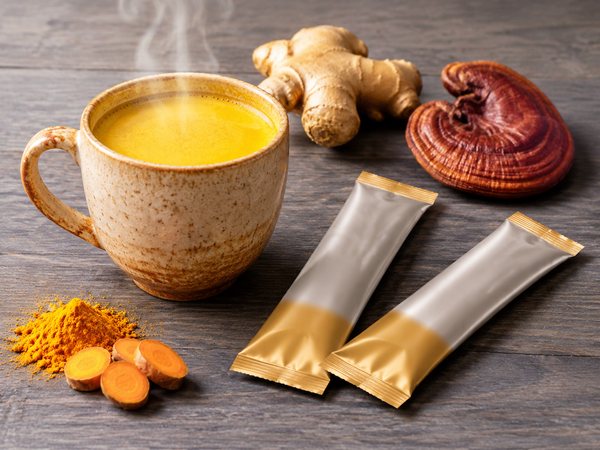
Haoze Bio manufactures water-soluble ginger and turmeric extracts that disperse instantly in warm water or steamed plant milk. In the morning hours, cafe operators blend ceremonial Bulk matcha powder with organic lion's mane mushroom extract to support daytime focus without nervousness. For late evening relaxation, formulators combine standardized reishi mushroom extract with golden turmeric to create soothing bedtime lattes.
| Holiday Serving Moment | Recommended Botanical Formula | Active Marker Potency | Consumer Functional Benefit |
|---|---|---|---|
| Pre-Meal Sparkling Apertif | Butterfly Pea Extract with Fresh Lime | Standardized ternatins | Vibrant natural blue-to-pink color theater |
| Mid-Day Social Tonic | Ceremonial Matcha and Lion's Mane | High L-theanine and beta-glucans | Clear daytime focus without caffeine jitters |
| Post-Dinner Digestif | Ginger Root Extract with Roselle | 5.0% gingerols and organic acids | Warm digestive relief after rich savory meals |
| Late-Night Wind-Down | Turmeric Extract 95% with Reishi | 95.0% curcuminoids and triterpenes | Full-body relaxation and evening calmness |
Solubility and Clarity in Hot Liquid Bases
Beverage bars and instant sachet packaging require botanical powders that dissolve completely within seconds. Raw ground herbs leave fibrous residues that float or collect at the bottom of the cup. Haoze Bio applies multi-stage filtration and spray drying to ensure our extracts leave zero gritty sediment in hot drinks.
5. Beverage Factory Reality: Clarification, Vitamin C Bleaching, and Carbonation Stability
Scaling benchtop holiday drinks into commercial bottling runs introduces chemical challenges that kitchen blenders never encounter. Drink formulators must navigate three common industrial roadblocks when working with natural pigments and botanical extracts.
| Industrial Bottling Roadblock | Chemical Cause on Factory Line | Practical Factory Floor Solution |
|---|---|---|
| Ascorbic Acid Color Bleaching | Vitamin C generates hydrogen peroxide under light, cleaving anthocyanin rings | Replace high-dose ascorbic acid with natural rosemary extract or mixed tocopherols |
| Carbonation pH Drift | Dissolved carbon dioxide forms carbonic acid, lowering liquid pH by 0.5 to 1.2 units | Account for carbonation acidity shifts during syrup blending to protect target blue shades |
| Pasteurization Haze | Thermal heat complexes native plant pectins with dissolved beverage minerals | Specify depectinized, fully clarified botanical extracts passed through 100-mesh filtration |
Formulation Advisory: Preservative Synergy and Benzene Risk
Beverage manufacturers should never combine ascorbic acid (Vitamin C) with sodium benzoate in the presence of trace transition metals, as this reaction can form traces of benzene. When formulating clean-label holiday mocktails, preserve acidity using organic malic acid or citric acid buffers paired with clean physical hot-fill pasteurization.
6. Commercial Execution: Low MOQ Bench Sampling and Turnkey Sachet Packaging
Capturing seasonal holiday sales requires commercial flexibility. Beverage startups, regional cafe chains, and bar operators cannot wait months for custom sample runs, nor can they commit to massive packaging minimums for temporary holiday promotions.
Haoze Bio supports clients with an integrated development pathway designed for commercial speed. R&D teams can evaluate unblended extracts in 25 kg fiber drums, or work directly with our facility for turnkey beverage stick packs and private label OEM.
For retail brands introducing boxed holiday teas or instant drink mixers, turnkey private label packaging begins at accessible thresholds of 500 to 1,000 retail cartons. Standard unblended extracts dispatch from inventory within 3 to 7 business days, providing the agile fulfillment required to execute successful holiday beverage campaigns.
Dedicated Botanical Extraction & Private Label Manufacturing
Haoze Bio operates modern extraction and automated sachet packaging workshops compliant with FSSC 22000, ISO 22000, and GMP standards. In-house analytical laboratories verify active marker concentrations, pesticide residues, and heavy metals by HPLC, UV, and TLC before every batch release.
Every commercial delivery includes a batch-specific Certificate of Analysis, transparent ingredient traceability, and dedicated formulation engineering support.
years in operation
markets exported
tons annual supply capacity
custom OEM projects
7. Frequently Asked Questions (FAQ)
Q1: How much butterfly pea flower extract is needed to achieve a vivid blue beverage?
A: For transparent sparkling waters and syrups, an inclusion rate between 0.05 percent and 0.15 percent by weight delivers an intense royal blue shade. Higher concentrations above 0.2 percent produce a midnight blue to indigo tone. Sourcing standardized liquid or spray-dried extracts ensures consistent color strength across production batches.
Q2: Why does a blue butterfly pea beverage sometimes turn purple during storage?
A: Butterfly pea anthocyanins shift from blue to purple whenever liquid acidity drops below pH 5.0. Carbonated beverages naturally become more acidic as dissolved carbon dioxide forms carbonic acid. Sourcing teams can stabilize the desired blue color by incorporating mild citrate buffers to maintain bottle pH above 5.5.
Q3: Does natural butterfly pea flower extract survive commercial pasteurization?
A: Yes. The ternatin anthocyanins in butterfly pea flowers feature polyacylated structures that demonstrate exceptional heat tolerance compared to berry anthocyanins. The extract withstands standard high-temperature short-time pasteurization at 72 degrees Celsius for 15 seconds, as well as hot-fill bottling operations between 85 and 90 degrees Celsius without noticeable color degradation.
Q4: Can butterfly pea flower extract be legally used in beverages exported to the European Union?
A: Under current European Union food regulations, butterfly pea flower extract is classified as an unauthorized novel food for general beverage use. While fully compliant in the United States under FDA 21 CFR 73.69, European beverage brands should formulate holiday drinks using authorized alternatives such as certified organic roselle hibiscus extract or spirulina blue.
Q5: Can formulators combine butterfly pea flower extract with Vitamin C in holiday drinks?
A: Combining high levels of ascorbic acid with natural anthocyanins can accelerate oxidative pigment bleaching under ambient store lighting. To preserve color vibrancy over an extended shelf life, beverage makers should minimize dissolved oxygen, utilize UV-barrier amber glass bottles, or substitute Vitamin C with natural rosemary extract antioxidants.
Q6: What is the minimum order quantity for custom holiday beverage stick pack OEM?
A: Unblended wholesale botanical extracts ship from stock in 25 kg fiber drums with a 25 kg trial minimum. For private label turnkey packaging, custom production runs for finished retail cartons and stand-up pouches start at accessible thresholds of 500 to 1,000 units, with single-serve stick pack contract filling fully supported, backed by rapid 10 to 20 g benchtop evaluation sampling.
Request Zero-Proof Botanical Samples & Technical Specifications
Contact our beverage application team to evaluate complimentary 10 to 20 g benchtop samples of butterfly pea flower extract, roselle extract, gingerols, or water-soluble mushroom powders. Submit your target beverage concept to receive lot-specific documentation and prompt contract pricing.
Authoritative Regulatory and Industry References
- U.S. Food and Drug Administration (FDA). Code of Federal Regulations Title 21: 21 CFR Section 73.69 - Butterfly pea flower extract. Electronic Code of Federal Regulations (eCFR).
- Symrise Global In-Sight. What's in the Glass: The Drink Trends Reshaping the Beverage Industry in 2026. Beverage Trend Analysis, 2026.
- Beverage Industry Magazine. Beverage-makers turn to botanicals, adaptogens for functional benefits. Functional Formulation Report, 2024-2026.
- University of Florida IFAS Extension. Butterfly Pea (Clitoria ternatea) Flower Extract (BPFE) and Its Use as a Natural Food and Beverage Colorant. EDIS Publication EP573.
- European Food Safety Authority (EFSA). Notification of dried flowers of Clitoria ternatea L. as a traditional food from a third country. EFSA Technical Report EN-7084, 2022.
- U.S. Food and Drug Administration (FDA). FDA Revokes Authorization for the Use of FD&C Red No. 3 in Food and Ingested Drugs. Constituent Updates, 2025.