

Corporate Strategic Announcement | XI'AN, CHINA
In the rapidly maturing global nutraceutical, functional food, and clean-label cosmetic sectors, the fundamental relationship between brand manufacturers and raw material suppliers has reached a critical inflection point. Building upon more than a decade of specialized manufacturing and serving brand partners worldwide since 2014, Xi'an Haoze Biotechnology Co., Ltd. (Haoze Bio) officially unveils its upgraded corporate philosophy: "Bridging Botanical Integrity with Formulation Precision." This strategic doctrine marks a definitive shift from passive material supply to active engineering partnership, designed specifically to eliminate supply chain friction, analytical ambiguity, and industrial processing failures for global health brands.
1. The Modern Sourcing Dilemma: Beyond Commodity Plant Powders
The global functional ingredient landscape is no longer constrained by supply availability; it is challenged by repeatability, authenticity, and industrial performance. Procurement directors and formulation scientists across North America and Europe frequently encounter a frustrating paradox: a botanical extract powder tests compliant on a basic certificate of analysis (COA) for gross assay, yet fails catastrophically during pilot-scale or commercial manufacturing.
Uncovering Hidden Root Causes in Commodity Sourcing
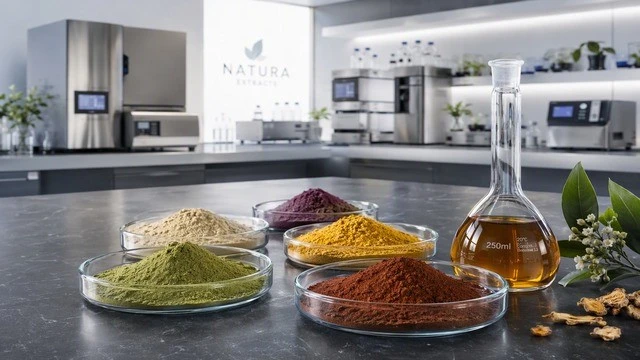
Traditional supply chains treat botanical extracts as inert commodities. When raw powders arrive with mismatched particle size distributions or erratic surface energies, they lead directly to severe caking, cold-water turbidity, and unpredicted thermal degradation during high-speed production.
Haoze Bio addresses this structural gap by embedding analytical chemistry and formulation physics into every stage of the botanical value chain, ensuring every batch behaves predictably inside industrial formulation matrices.
| Observed Industrial Failure Mode | Technical Root Cause in Commodity Supply Chains |
|---|---|
| Severe Caking & Moisture Uptake | Inadequate moisture sorption isotherm profiling and hygroscopic carrier imbalance during spray drying. |
| Incomplete Dispersion & Turbidity | Mismatched particle size distribution (PSD) and surface energy failing to hydrate in cold-water beverage systems. |
| Thermal Degradation & Color Shifting | Unmonitored thermal sensitivity during pasteurization and lack of verified pH buffering data. |
| Import Detentions & Quality Recalls | Trace pesticide residues exceeding USP <561> or undeclared adulterants masked by non-specific UV-Vis testing. |
2. The Haoze Triad: Core Philosophy, Mission, and Vision
To provide clear strategic direction for our global research initiatives, capital investments, and client collaborations, Haoze Bio formalizes its enterprise charter around three interdependent tenets:
Our Core Philosophy
Bridging Botanical Integrity with Formulation Precision
Authentic botanicals should never compromise industrial performance, and technological precision should never compromise clean-label natural purity.
Our Mission
Eliminating Engineering Bottlenecks & Compliance Risks
Empowering global health brands through transparent analytical botanical science, rigorous quality control, and dependable manufacturing.
Our Vision
The Technical Backbone for Next-Gen Nutrition
Serving as the premier international supply chain partner for clean-label, scientifically validated functional wellness products worldwide.
| Strategic Dimension | Traditional Commodity Supplier | Haoze Bio Technical Partnership |
|---|---|---|
| Product Definition | Static powder meeting minimal catalog specifications. | Functionally characterized, matrix-tested bioactive ingredient. |
| Analytical Testing | Basic non-specific UV-Vis assay; standard paper COA. | Orthogonal validation (HPLC assay, HPTLC fingerprints, ICP-MS). |
| Formulation Support | None. Buyer evaluates application performance at own risk. | Pre-mapped thermal, pH, and cold-water solubility performance windows. |
| Supply Chain Control | Brokered spot markets with fragmented, opaque traceability. | Direct cultivation sourcing agreements with full chain-of-custody audits. |
| Regulatory Defense | Reactive; handles border detentions after shipment release. | Proactive multi-jurisdictional dossier pack (FDA FSMA, USP <561>, EU MRLs). |
3. Engineering Empathy: Designing Ingredients for Downstream Processing
At Haoze Bio, "Formulation Precision" represents engineering empathy for the product developer. A high-purity bioactive compound is useless if it precipitates out of solution, clogs industrial spray nozzles, or degrades during shelf-life testing.
Pre-Solving Industrial Manufacturing Bottlenecks
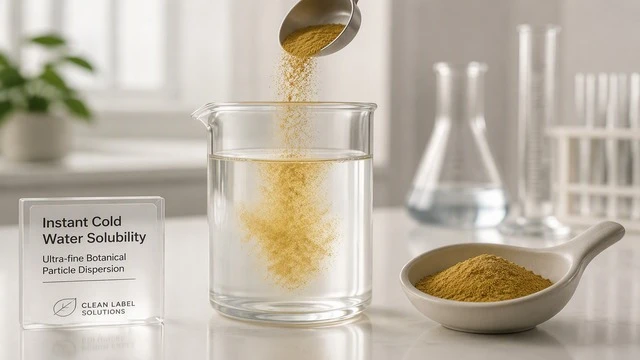
Our R&D center actively screens physical powder rheology to eliminate downtime in our partners' facilities. By pre-testing cold-water dispersion, hydration velocity, and thermal stability windows, we ensure clean dissolution and effortless filling.
From 80-mesh free-flowing granules for high-speed encapsulation to 2000-mesh ultrafine powders for beverages and personal care, our formulations are optimized before scale-up.
Three Pillars of Downstream Engineering
- Particle Morphology & Powder Rheology: Customizing mesh profiles and controlling tapped-to-bulk density ratios to prevent dusting hazards, die-wall friction, and weight variation on high-speed encapsulators and rotary tablet presses.
- Instant Cold-Water Dispersion: Fine-tuning spray drying dynamics and natural carrier structures to eliminate colloidal haze, foaming, and phase separation in Ready-to-Drink (RTD) beverages.
- Thermal & Acid-Base Boundary Mapping: Establishing verified High-Temperature Short-Time (HTST) pasteurization survival curves and pH stability boundaries, allowing chemists to select appropriate organic acids without degradation.
4. Zero-Compromise Quality Control: Data Over Subjective Claims
In an era of intensified regulatory oversight by the US FDA (under 21 CFR 111 and FSMA) and European health authorities (EFSA), regulatory compliance is an existential priority. Haoze Bio operates on an uncompromising principle of analytical transparency: Quality is defined by repeatable analytical data, not subjective claims.
Orthogonal Testing to Eliminate Adulteration
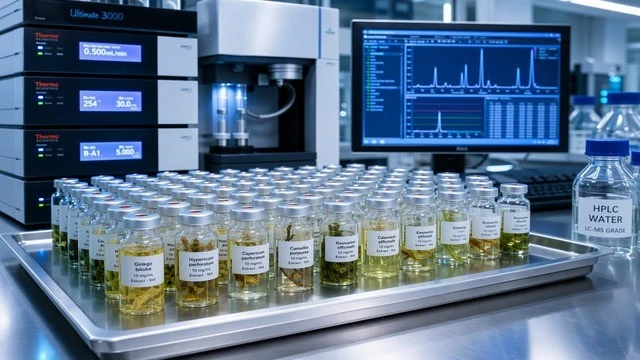
Botanical adulteration remains an industry-wide vulnerability. Haoze Bio rejects non-specific spectrophotometric testing that can be easily masked. Every production batch undergoes multi-method orthogonal verification.
By pairing HPTLC chromatographic fingerprinting with HPLC active marker quantitation and ICP-MS elemental analysis, we provide incontrovertible proof of botanical identity, purity, and safety.
Haoze Bio Global Release Criteria
5. Sustainable Stewardship and Supply Chain Resilience
Long-term brand equity cannot be built on volatile, ecologically irresponsible supply chains. Haoze Bio integrates environmental stewardship and supply continuity directly into our commercial roadmap:
Direct Origin Traceability
Full chain-of-custody documentation from standardized cultivation farms through post-harvest primary processing, ensuring non-irradiated and non-GMO provenance.
Clean Processing Technology
Closed-loop solvent recovery loops, membrane separation, and low-temperature vacuum concentration that dramatically lower environmental carbon footprint.
Strategic Reserve Inventories
Proactive safety stock management in modern temperature-controlled facilities, shielding our international partners from unpredictable geopolitical transport disruptions.
6. Frequently Asked Questions (FAQ)
Q1: How does Haoze Bio verify botanical authenticity and prevent economic adulteration?
Haoze Bio employs orthogonal testing protocols combining High-Performance Thin-Layer Chromatography (HPTLC) fingerprinting with targeted HPLC active quantitation and macroscopic/microscopic physical analysis. We cross-reference every batch against certified primary reference standards to ensure authentic species identity, correct anatomical plant parts, and absolute absence of synthetic spiking agents.
Q2: Can Haoze Bio customize physical parameters like particle size, density, and solubility for specific dosage forms?
Yes. We routinely engineer botanical powders to meet specific dosage parameters, including customizing mesh sizes (from 80-mesh free-flowing granules for encapsulation to 1000+ mesh micro-powders for cosmetics and instant drinks), adjusting bulk density for high-speed tableting, and tailoring water-dispersibility profiles.
Q3: What international compliance documentation is supplied with commercial shipments?
Every shipment is accompanied by a full technical dossier, including a lot-specific Certificate of Analysis (COA), detailed HPLC/HPTLC testing chromatograms, heavy metal and pesticide residue screening reports (USP <561>/EP compliant), allergen statements, non-GMO declarations, and safety data sheets (SDS).
Q4: How does Haoze Bio support global clients during early R&D and pilot evaluation?
We offer comprehensive sample kits complete with technical specification sheets, stability profiles, and formulation guidance notes. Our technical team works directly with client formulators under strict confidentiality to review bench-scale challenges and recommend optimal ingredient grades prior to commercial scale-up.
Partner with a Dedicated Botanical Engineering Specialist
As the functional nutrition and botanical wellness sectors evolve toward heightened scientific validation and clean-label transparency, brand differentiation depends entirely on the stability, purity, and physical reliability of foundational ingredients.
If your technical team is evaluating bulk botanical extracts, developing next-generation formulation matrices, or seeking to eliminate analytical risk in your supply chain, Haoze Bio provides complete technical specifications, full analytical dossiers, and evaluation samples.
Direct Inquiries: haozebio2014@gmail.com
References & Regulatory Standards
- United States Pharmacopeia (USP). USP General Chapter <561>: Articles of Botanical Origin. Rockville, MD: United States Pharmacopeial Convention.
- U.S. Food and Drug Administration (FDA). Current Good Manufacturing Practice in Manufacturing, Packaging, Labeling, or Holding Operations for Dietary Supplements, 21 CFR Part 111.
- European Commission. Regulation (EC) No 396/2005 on Maximum Residue Levels of Pesticides in or on Food and Feed of Plant and Animal Origin. Official Journal of the European Union.
- American Botanical Council (ABC-AHP-NCNPR). Botanical Adulterants Prevention Program (BAPP). Laboratory Guidance Documents on Botanical Identification and Adulteration.
- International Organization for Standardization. ISO 22000:2018: Food safety management systems - Requirements for any organization in the food chain.