


Executive Summary: The Industrial Cost of Grade Misalignment
In modern commercial food and beverage product development, matcha is no longer treated as a monolithic specialty ingredient. Sourcing teams, industrial bakeries, and multinational beverage chains recognize that selecting the incorrect matcha tier results in severe technical and commercial failure modes.
When formulators incorporate delicate, ultra-premium ceremonial matcha into a croissant dough containing 25% butter or a high-sucrose beverage syrup, the primary volatile aromatic compounds and delicate umami amino acids (L-theanine) are instantaneously masked by the surrounding lipid and saccharide matrix. Furthermore, the lower polyphenol concentration of shade-grown first-flush leaf tissue yields an insufficient "tea skeleton," causing the baked pastry or packaged beverage to taste flat, grassy, and devoid of recognizable green tea character-all while inflating raw material costs by 300% to 500%.
Conversely, deploying coarse culinary powder into light water-based infusions causes harsh catechin astringency and gritty sedimentation. Bridging this gap requires an objective, engineering-driven approach: analyzing free amino acids, polyphenol ratios, particle size (D50), and milk matrix compatibility to achieve optimal sensory performance and defensible unit economics.
1. The Commercial Dilemma: Why Grade Confusion Costs B2B Brands Millions
The global matcha trade has historically suffered from ambiguous marketing nomenclature. Unlike pharmaceutical APIs or commodities governed by strict international pharmacopeias, terms such as "Ceremonial," "Café," "Barista," and "Culinary" are commercial trade descriptors rather than legally codified standards under FDA, EFSA, or CODEX Alimentarius frameworks.
This lack of standardization creates two major supply chain risks for commercial enterprises:
- The Premium-Grade Fallacy in Bakery & Confectionery: A common misconception among emerging natural food brands is that sourcing wholesale first flush ceremonial matcha will automatically yield a superior, more vibrant green tea biscuit or ready-to-bake cake premix. In commercial practice, the high surface area of sub-8-micron ceremonial powder aggressively absorbs moisture from the dough matrix, altering hydration dynamics. Concurrently, the heat-sensitive free amino acids degrade during thermal processing (150°C–180°C), resulting in a dull, oxidized profile with zero flavor punch.
- The Margin Trap in Foodservice Beverages: When managing multi-unit café operations, procurement teams searching for ceremonial vs culinary matcha for lattes frequently encounter pricing disparities ranging from $25/kg for industrial powders to over $120/kg for top-tier ceremonial lots. Without a clear understanding of the "Latte Grade" threshold-a standardized blend balancing second-flush strength with first-flush color-brands either overspend on ingredients that customers cannot distinguish through oat milk or underperform on beverage color and texture.
Achieving reproducible quality across tens of metric tons requires formulators to replace subjective marketing tiers with quantifiable physicochemical metrics: free amino acid percentage, total polyphenol percentage, Hunter Lab color values, and laser particle size distribution (D50) when comparing bulk ceremonial matcha vs culinary matcha.
2. The Biochemical Divergence: P/A Ratios and Why Leaves Behave Differently
The functional behavior of matcha in any formulation is ultimately governed by the biochemical transformation that occurs in the Camellia sinensis plant prior to and during harvest. Shading agronomy dictates whether the leaf becomes a repository of sweet, savory umami amino acids or a concentrated source of structured, astringent polyphenols.
2.1 Shading Agronomy and Biosynthetic Rerouting
To produce true wholesale first flush ceremonial matcha, the tea gardens must be shaded using dual-layer black polyethylene or traditional reed netting for a minimum of 21 to 28 days prior to the spring harvest (Ichibancha). Restricting sunlight by 90% to 98% induces a profound metabolic shift within the foliar tissue:
- Suppression of Photolysis: Under open sunlight, tea roots synthesize L-theanine (the amino acid responsible for savory, brothy umami), which is transported to the leaves where solar UV radiation catalyzes its enzymatic conversion into polyphenolic catechins (primarily EGCG, ECG, and EGC). Shading halts this biosynthetic pathway, locking L-theanine within the tender shoots.
- Chlorophyll Accumulation: To maximize photon capture under extreme shade, the plant dramatically upregulates foliar chlorophyll synthesis. Total chlorophyll concentrations rise from 1.5–2.5 mg/g in unshaded field-grown tea to 4.5–6.0 mg/g in shaded tencha leaves, skewing the chlorophyll a/b ratio toward an intense, luminous jade green.
Macroscopic Visual & Texture Divergence
Under standardized optical testing, first-flush ceremonial matcha yields high chlorophyll reflection (L* ≥ 53.0, a* ≤ -16.5) and an ultra-low P/A ratio (< 4.5). In contrast, summer-harvested culinary matcha features a rich polyphenol backbone (> 20%), providing the necessary structural bitterness required to punch through high-fat food matrices.

2.2 The P/A Ratio as the Ultimate Flavor Determinant
In food science, the sensory balance between umami richness and harsh astringency is objectively quantified by the Polyphenol-to-Amino Acid Ratio (P/A Ratio):
- Ceremonial Grade (P/A: 2.8 – 4.5): Characterized by high free amino acids (≥ 3.5%, with L-theanine exceeding 2.0%) and restrained polyphenols (13.0% – 16.5%). This low ratio imparts a smooth, creamy, broth-like umami profile with negligible bitterness, engineered specifically for direct aqueous dispersion.
- Industrial Culinary Grade (P/A: > 10.0): Harvested during summer or autumn (Nibancha/Sanbancha) with minimal shading (7–10 days or open-sun cultivation). Free amino acids drop below 1.5%, while total polyphenols surge to 20.0% – 24.5%. This high ratio generates intense, assertive astringency. While unpalatable when whisked straight in water, this dense polyphenol backbone is precisely what enables wholesale culinary grade matcha powder to punch through heavy milk proteins, sugars, and leavening agents in commercial food applications.
3. The "Latte Grade" Paradox: Balancing Astringency and Umami in Dairy and Plant Milks
When evaluating ceremonial vs culinary matcha for lattes, beverage developers in chain retail frequently find themselves caught between two extremes: pure ceremonial grades disappear beneath dairy creaminess, while industrial culinary grades turn the beverage dull brownish-green and unpleasantly bitter.
3.1 Milk Matrix Interactions: Casein & Lipid Encapsulation
In dairy milk formulations, the major protein fractions-specifically alpha-s1-casein, beta-casein, and kappa-casein-form organized sub-micellar aggregates that interact dynamically with tea constituents:
- Hydrophobic Binding: Proline-rich casein proteins bind tenaciously to tea catechins via hydrophobic interactions and hydrogen bonding, effectively complexing the polyphenols. This complexation blunts perceived bitterness and astringency on the human palate.
- Umami Masking: Simultaneously, the milk fat globule membrane (MFGM) coats the tongue, forming a lipid barrier that elevates the taste threshold for umami. A pure ceremonial matcha with a delicate 3.0% L-theanine content is almost entirely neutralized by this lipid coating.
- The Plant-Milk Challenge (Oat & Almond): In modern oat and almond milk lattes, added dipotassium phosphate (acidity regulator) and emulsified vegetable oils (canola or sunflower oil) interact with polyphenols differently. Oat milk's intrinsic cereal sweetness requires a matcha with slightly elevated catechins (17.0% – 19.0%) to cut through the heavy starch-lipid base without turning acidic.
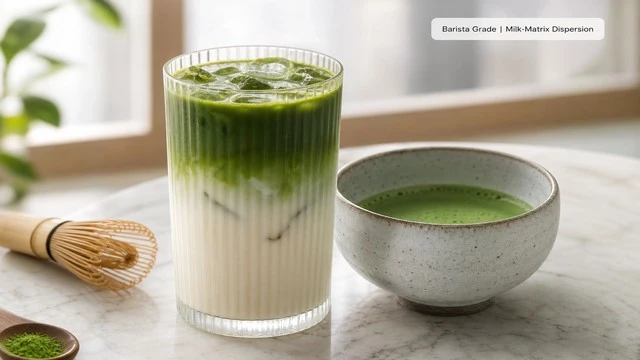
Formulating in the Milk Matrix
In iced lattes and specialty café beverages, delicate first-flush umami compounds are readily masked by milk fat globule membranes and oat lipids. Commercial barista formulations utilize precision-blended late-spring tencha, ensuring vibrant suspension color alongside crisp, unmasked green tea character at sustainable unit economics.
3.2 The Emergence of Standardized Barista Grade
To solve the commercial dilemma of ceremonial vs culinary matcha for lattes, leading beverage chains partner with an experienced Chinese matcha bulk supplier to source custom-blended "Barista Grade" or "Latte Grade" matcha:
- Agronomic Composition: Typically formulated as a 60/40 or 70/30 blend of late-spring shaded tencha (moderate amino acids) and early-summer shaded tencha (elevated chlorophyll and structured catechins).
- Sensory Balance (P/A: 5.5 – 7.5): Delivers sufficient catechins to preserve an unmistakable green tea punch against 200ml to 350ml of whole milk or oat milk, while maintaining an intense, photo-stable emerald color (Hunter a* ≤ -14.0) that customers expect on visual social media platforms.
4. Particle Physics & Milling Dynamics: Stone Milling vs. Air-Jet Micronization
Beyond leaf biochemistry, the physical milling method represents the second major axis of divergence when analyzing bulk ceremonial matcha vs culinary matcha. The particle size distribution (PSD) dictates both mouthfeel in liquid suspensions and rheological stability in dough matrices.
4.1 Micronization Techniques and Particle Morphology
Different milling systems impart fundamentally distinct physical characteristics to the finished green tea powder:
- Granite Stone & Cryogenic Ball Milling (Ceremonial Standard): Traditional granite mills and modern closed-loop cryogenic ceramic ball mills operate at ultra-low angular velocities to process wholesale first flush ceremonial matcha. Grinding destemmed tencha flakes under low friction where milling temperatures never exceed 38°C preserves volatile green aromatics and produces an ultra-fine particle distribution with a median diameter of D50: 5.0 – 8.5 µm (1200–2000 mesh). The particles possess smooth, rounded edges, resulting in a velvety oral texture with zero gritty sensation.
- Fluidized-Bed Air-Jet Milling (Culinary Standard): For large-scale production of wholesale culinary grade matcha powder, industrial facilities utilize high-speed air-jet mills. Opposing streams of high-pressure clean air accelerate tencha particles into collision zones, shattering leaf tissue by high-velocity impact. This yields particles ranging from D50: 10.0 – 18.0 µm (500–800 mesh). While coarser than ceremonial powder, air-jet milling achieves exceptional throughput (50–200 kg/hour versus 40 grams/hour per stone mill), drastically lowering processing overhead.
Particle Morphology & Dough Rheology
While stone and cryogenic ball milling achieve spherical D50 values below 8.5 µm for velvety oral sensation, industrial bakery doughs benefit significantly from air-jet micronized powders (D50: 12–18 µm). Moderate specific surface area prevents excessive moisture robbing from gluten networks, maintaining optimal pastry spread and loaf volume.
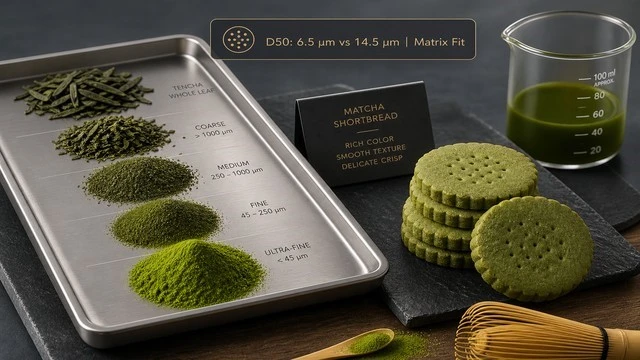
4.2 Stokes' Law and Liquid Suspension Stability
In liquid beverage applications, particulate settling velocity is governed by Stokes' Law:
Because settling velocity (v) decreases with the square of the particle radius (r²), reducing the median radius from standard culinary powder (r ≈ 7.5 µm) to ceremonial powder (r ≈ 3.5 µm) reduces gravitational sedimentation by a factor of approximately 4.6x. This is critical for RTD beverage developers seeking to minimize hydrocolloid stabilizer usage.
5. Food Matrix Interactions: Why High-Fat Bakery "Rejects" Ceremonial Grade
One of the most persistent formulation errors encountered in commercial bakery R&D is the assumption that ceremonial matcha represents a universal upgrade for all baked items. Industrial reality demonstrates the exact opposite: ceremonial matcha frequently fails in commercial ovens.
5.1 Water Competition in Gluten Networks
Due to its microscopic particle size (D50 < 8 µm), ceremonial matcha exhibits an immense specific surface area (> 1.2 m²/g). When blended into dough or cake batter, the fine tea powder acts as a physical desiccant, aggressively competing with wheat gluten proteins (gliadin and glutenin) and starch granules for free water.
This competitive hydration reduces gluten elasticity, causing commercial cookies to fail spread tests and resulting in dry, crumbly sponge cakes with reduced loaf volume. In contrast, industrial culinary matcha (D50: 12–18 µm) possesses an optimized surface area that incorporates smoothly into fat-sugar creaming stages without altering water absorption indices (WAI).
5.2 Thermal Browning and Chlorophyll Pheophytinization
During oven baking at 150°C to 180°C, the magnesium ion (Mg²⁺) located at the center of the chlorophyll porphyrin ring is displaced by hydrogen ions (H⁺) from acidic dough ingredients (such as leavening acids, sour cream, or natural fruit purees). This chemical reaction transforms radiant green chlorophyll into drab olive-brown pheophytin.
Ceremonial matcha, having lower total polyphenol content, lacks the structural astringency needed to provide background flavor once its subtle umami amino acids have been denatured by heat. High-grade wholesale culinary grade matcha powder formulated for baking retains a robust reservoir of heat-resistant catechins and concentrated foliar chlorophyll, maintaining an identifiable green tea identity even after thermal exposure.
6. Cost-in-Use Economics: The 16oz Latte & Pastry Unit Cost Breakdown
Procurement teams evaluating bulk ceremonial matcha vs culinary matcha must calculate unit costs not merely on raw FOB kilogram price, but on true Cost-in-Use per Serving. The tables below model realistic commercial economics across two high-volume product categories:
| 16oz Iced Latte Metric (3.5g Matcha) | Ceremonial Grade (First Flush) | Barista / Latte Grade | Industrial Culinary Grade |
|---|---|---|---|
| Average Bulk Sourcing Cost | $85.00 – $130.00 / kg | $35.00 – $55.00 / kg | $18.00 – $28.00 / kg |
| Powder Cost Contribution / Cup | $0.30 – $0.45 | $0.12 – $0.19 | $0.06 – $0.10 |
| Visual Hue in Plant / Dairy Milk | Luminous Jade Green | Vibrant Emerald Green | Dull Khaki / Olive |
| Palate Flavor Cut-Through | Weak (Lipid Masked) | Balanced, Crisp & Bold | Harsh & Excessively Bitter |
| Annual Expenditure (10 Tons Bulk) | $850,000 – $1,300,000 | $350,000 – $550,000 | $180,000 – $280,000 |
As demonstrated, partnering with a dependable Chinese matcha bulk supplier to deploy Barista Grade allows retail beverage operators to cut annual raw material spend by $500,000 to $750,000 per 10 metric tons compared to ceremonial powder, while simultaneously improving consumer taste ratings by cutting through thick milk fats.
7. The Comprehensive B2B Specification Matrix
To eliminate ambiguity during contract manufacturing or procurement negotiations with a Chinese matcha bulk supplier, R&D and QA teams should benchmark incoming Certificate of Analysis (COA) documentation against these empirical parameters:
| Specification Parameter | Analytical Method | Ceremonial (Top Tier / 7A) | Barista / Latte Grade | Industrial Culinary Grade |
|---|---|---|---|---|
| Botanical Identification | TLC / Microscopic ID | 100% Camellia sinensis | 100% Camellia sinensis | 100% Camellia sinensis |
| Harvest Season | Agronomic Traceability | First Flush (April / Spring) | First & Second Flush Blend | Summer / Autumn Flush |
| Pre-Harvest Shading Duration | Farm Shading Log | ≥ 21 to 28 Days (>95% shade) | 14 to 20 Days (>85% shade) | 7 to 10 Days / Open Sun |
| Free Amino Acids (Total) | GB/T 8314 Spectrophotometry | ≥ 3.5% – 5.5% | 2.2% – 3.2% | ≤ 1.0% – 1.8% |
| L-Theanine Content | HPLC-UV (ISO 14502-2) | ≥ 2.0% – 3.2% | 1.2% – 1.8% | 0.4% – 0.9% |
| Total Tea Polyphenols | ISO 14502-1 Folin-C | 13.0% – 16.5% | 16.5% – 19.5% | 20.0% – 24.5% |
| P/A Ratio (Calculated) | Ratio Equilibrium | 2.8 – 4.5 | 5.5 – 8.0 | > 10.0 |
| Hunter Lab Color (Dry Powder) | CIE Lab Colorimeter | L* ≥ 53.0, a* ≤ -16.5 | L* 48.0–52.0, a* -13.0 to -15.0 | L* 42.0–46.0, a* -8.0 to -11.0 |
| Median Particle Size (D50) | Laser Diffraction (Dry) | 5.0 – 8.5 µm (1200–2000 mesh) | 8.5 – 12.0 µm (1000–1200 mesh) | 12.0 – 18.0 µm (600–800 mesh) |
| Milling Process | Production Audit | Cryogenic Ball / Stone Mill | Cryogenic Ball / Air-Jet | High-Velocity Air-Jet Mill |
| Moisture Content | Gravimetric (105°C, 4h) | ≤ 5.0% | ≤ 5.5% | ≤ 6.0% |
| Total Heavy Metals (as Pb) | ICP-MS (USP <232>) | Pb < 2.0 ppm, As < 1.0 ppm | Pb < 2.0 ppm, As < 1.0 ppm | Pb < 2.0 ppm, As < 1.0 ppm |
| Total Plate Count (TPC) | AOAC Official Methods | < 1,000 CFU/g | < 3,000 CFU/g | < 10,000 CFU/g |
8. Frequently Asked Questions (FAQ)
Q1: Can culinary matcha be safely used in cold-whisked beverage applications?
From a food safety standpoint, culinary matcha produced in compliant, cGMP-certified facilities is entirely safe for consumption. However, from a sensory and colloidal standpoint, standard culinary grade powder possesses a median particle diameter (D50: 12–18 µm) that feels gritty on the palate during cold drinking. Furthermore, its high catechin content (P/A ratio > 10.0) produces sharp, unpalatable astringency without milk to complex the polyphenols. For straight drinking or light cold foams, formulators should exclusively specify ceremonial grade or premium barista grade.
Q2: Why does ceremonial matcha sometimes turn greyish-yellow in bottled RTD teas?
Color degradation in liquid matcha beverages is primarily driven by photo-oxidation and thermal exposure during pasteurization or UHT processing. When unbuffered RTD tea (pH < 6.0) is subjected to thermal sterilization (e.g., 121°C for 30 seconds), chlorophyll rapidly converts to pheophytin. To maintain the bright green hue of ceremonial powder in shelf-stable RTDs, formulators must buffer the pH to 6.8–7.2 with sodium bicarbonate, add ascorbic acid (0.02%–0.05%) as an oxygen scavenger, and utilize high-barrier, UV-blocking amber glass or aluminum can packaging.
Q3: What is the primary difference between Chinese and Japanese matcha for bulk B2B procurement?
Both China and Japan cultivate identical botanical varieties of Camellia sinensis (including Yabukita, Saemidori, and Okumidori) and utilize identical agronomic shading and tencha processing technology. Japan specializes in artisanal, small-batch ceremonial lots with limited global volume, resulting in significant pricing premiums. China (notably modern mountain tea estates in Zhejiang and Guizhou) has established massive industrial-scale infrastructure, providing fully certified organic (USDA/EU Organic, JAS) ceremonial and culinary grades with identical biochemical profiles at 30% to 50% lower FOB bulk pricing, backed by multi-hundred-ton annual volume consistency.
Q4: How does particle size impact bakery spread and texture?
Ultra-fine matcha powders (D50 < 8.5 µm) have high specific surface areas that absorb water away from wheat flour proteins during dough mixing. This restricts the formation of a cohesive gluten network and limits starch gelatinization, causing cookies to spread less and cakes to bake with dense, dry crumb structures. Industrial culinary matcha (D50: 12–18 µm) disperses smoothly into lipid phases without disrupting hydration equilibrium, making it the superior engineering choice for commercial pastry formulas.
Q5: What shelf-life and packaging specifications should be demanded for bulk matcha orders?
Matcha is highly susceptible to four degradation factors: light, oxygen, moisture, and ambient heat. Bulk shipments should always be packaged in multi-layer vacuum-sealed aluminum foil bags flushed with food-grade nitrogen (N2) to achieve residual headspace oxygen levels below 0.5%. When stored in climate-controlled warehouses (15°C–20°C, relative humidity < 50%), unadulterated bulk matcha maintains verified chemical and sensory stability for a minimum of 24 months from the manufacturing date.
Technical Sourcing & Formulation Partnership
The global matcha category has decisively shifted beyond one-size-fits-all product positioning. Commercial beverage developers, food formulators, and multinational brands now demand targeted, grade-specific ingredient architectures that align leaf agronomy and micronization physics with their exact matrix requirements.
For R&D teams and procurement managers, sustainable competitive advantage is achieved not by purchasing the most expensive ceremonial lot, but by implementing precision ingredient specifications that guarantee consistent visual impact, balanced flavor cut-through, and defensible unit economics.
If your organization is currently sourcing bulk ceremonial matcha vs culinary matcha, scaling commercial RTD beverage production, or reformulating clean-label bakery lines, Haoze Bio (Xi'an Haoze Biotechnology Co., Ltd.) provides full-spectrum technical support. We supply factory-direct bulk shipments, comprehensive third-party Eurofins analytical certificates (pesticides, heavy metals, microbial panels), and customized milling runs tailored to your application.
Request Technical Specifications, COA Documentation & Laboratory Formulation Samples:
References
- Unno, K., et al. (2018). Stress-reducing function of matcha green tea in animal experiments and clinical trials. Nutrients, 10(10), 1468. [Cross-referencing L-theanine accumulation kinetics under agronomic shading].
- Kavaz Yüksel, A., et al. (2017). The effect of matcha green tea powder on the physical, chemical, and sensory properties of ice cream. GIDA - Journal of Food, 42(2), 116-126. [Investigating particle size dispersion and matrix fat encapsulation].
- European Food Safety Authority (EFSA). (2018). Scientific opinion on the safety of green tea catechins. EFSA Journal, 16(4), 5239. [Regulatory benchmarks on catechin concentrations and toxicological limits].
- Wang, L., et al. (2020). Influence of shading on the quality components of green tea: Free amino acids, catechins, and chlorophyll dynamics. Journal of Agricultural and Food Chemistry, 68(14), 4150-4158. [Analysis of P/A ratios across varying solar irradiance levels].
- Horanni, R., & Engelhardt, U. H. (2013). Determination of alkylamides and phenolic compounds in green and black tea cultivars. Food Chemistry, 141(4), 3840-3848. [HPLC methodology for catechin and caffeine quantification].
- Schuh, C., & Schieberle, P. (2016). Characterization of the key aroma compounds in the beverage of shaded green tea (Matcha) by application of aroma extract dilution analysis. Journal of Agricultural and Food Chemistry, 64(26), 5369-5376. [Volatile profiling of first-flush tencha versus late-harvest leaves].